
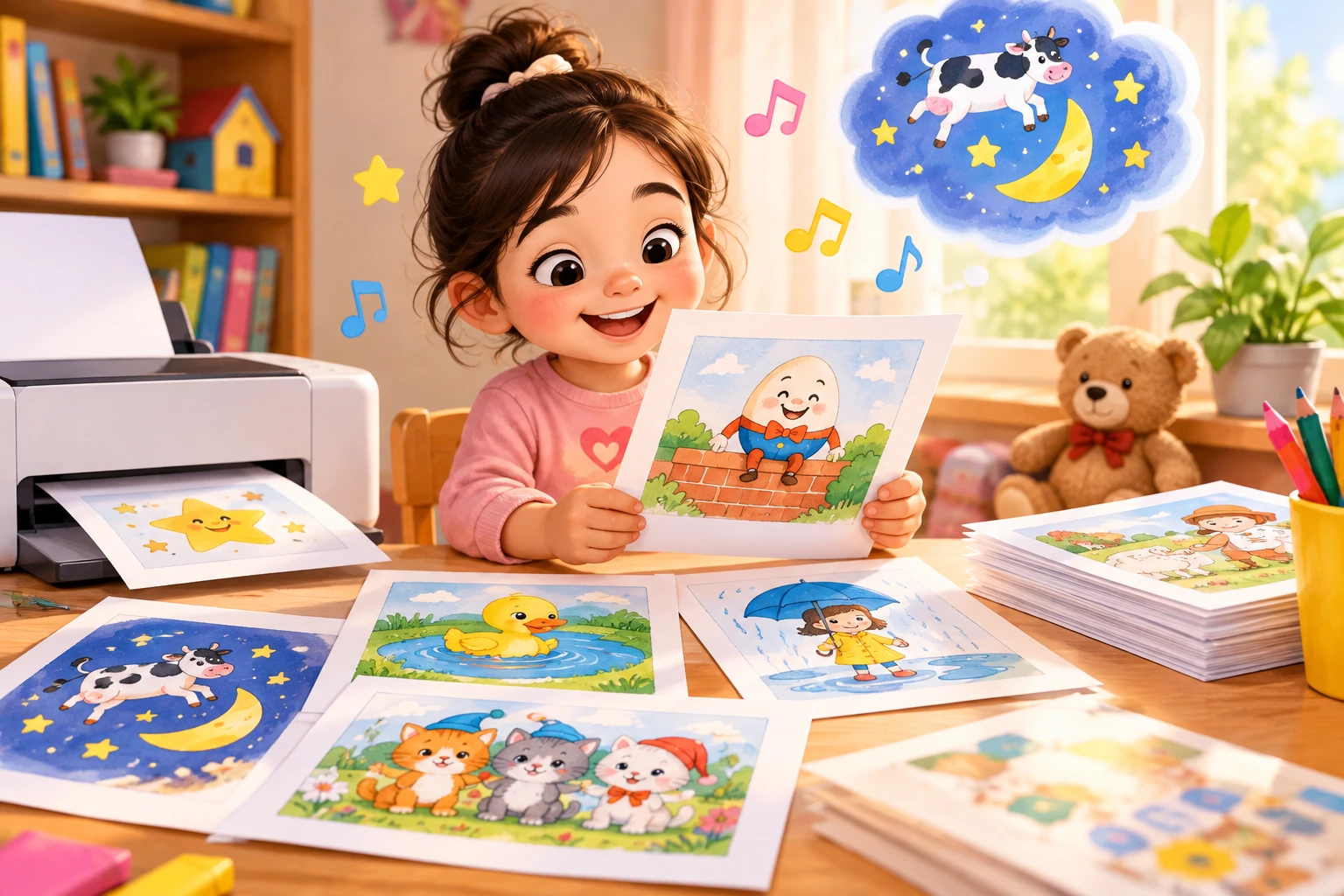
Ten traditional nursery rhymes, one per page, with the exact word to pause on printed in orange. Print them, sing them, and let your child fill in the word.
No email required. No sign-up. Just download and print.
FREE PRINTABLE PACK
10 Nursery Rhymes With the Pause Word Marked
12 pages · PDF · Ages 18 months to 5 years · No email required
Download the PDFFree to print and share for home or classroom use (CC BY-NC 4.0).
What’s Inside the Pack
Every page is built around one rhyme and one simple technique: stop before the rhyming word and wait for your child to say it.
10 Rhyme Pages
Includes full nursery rhymes with every line’s last word clearly marked in Orange for easy phonics and rhythm focus.
Age Band Guidance
Specially tailored for children from 18 months to 5 years, helping you know exactly where to start based on development.
18m – 5 YearsActions for Every Rhyme
Step-by-step hand movements, gestures, and fun physical motions designed for every single rhyme.
What It Builds
Highlights the specific developmental skills worked on—such as motor skills, vocabulary, rhythm, and confidence.
Space for Hindi Meaning
Includes dedicated ruled lines to write out translations and meanings together with your child.
Rhyme-a-Week Tracker
Built-in daily checkboxes so you can tick a box each day you sing and practice together.
Habit BuilderThe ten rhymes are Twinkle Twinkle Little Star, Jack and Jill, Humpty Dumpty, Baa Baa Black Sheep, Hickory Dickory Dock, Little Miss Muffet, The Itsy Bitsy Spider, Row Row Row Your Boat, Rain Rain Go Away, and Hey Diddle Diddle. All ten are traditional and in the public domain.
How to Use the Pause Method
This is the whole technique. It takes no preparation and no materials.
Stopping before a rhyming word asks your child to predict a sound. That prediction is the same mental move fluent readers make on every line of a page, and children who practise it in rhymes are practising it years before they open a book.
Why the Hindi Lines Are Blank
Each rhyme page has ruled lines under it for the Hindi meaning, and they’re left empty on purpose.
Writing the meaning in yourself — in your own words, with your child watching — does more than a printed translation would. Your child hears the rhyme in both languages, in your voice, and the page becomes theirs.
If you’d like the meanings to work from, every rhyme on this site has its Hindi meaning written out alongside the English.
For Teachers and Playgroups
The pack prints cleanly in black and white on standard letter or A4 paper, and it may be copied and shared freely for classroom use under a Creative Commons BY-NC licence.
[List]
- One rhyme per page means you can hand out a single sheet for circle time
- Age bands help you match a rhyme to the group in front of you
- The tracker page works as a simple weekly record for a term
- Actions are listed so a relief teacher can pick it up cold
⚠️ Action rhymes and movement games for children under five work best in a clear, supervised space. Keep small props — counters, cards, instruments — out of reach of children under three.Questions Parents Ask
1.
What age is this pack for?
What age is this pack for?
2.
Do I need to print in colour?
Do I need to print in colour?
3.
Can I share this with other parents or my school?
Can I share this with other parents or my school?
4.
My child only wants one rhyme, over and over. Is that a problem?
My child only wants one rhyme, over and over. Is that a problem?
5.
What if my child doesn’t fill in the word?
What if my child doesn’t fill in the word?
6.
Is there a Hindi-only version?
Is there a Hindi-only version?
Also Available
The same pack is hosted on two other platforms if you’d rather read it in your browser than download it:
More printables are being added — alphabet formation sheets, rhyme activity cards, and Hindi rhyme pages. If there’s something you’d find useful in your home or classroom, tell us and we’ll try to make it.