
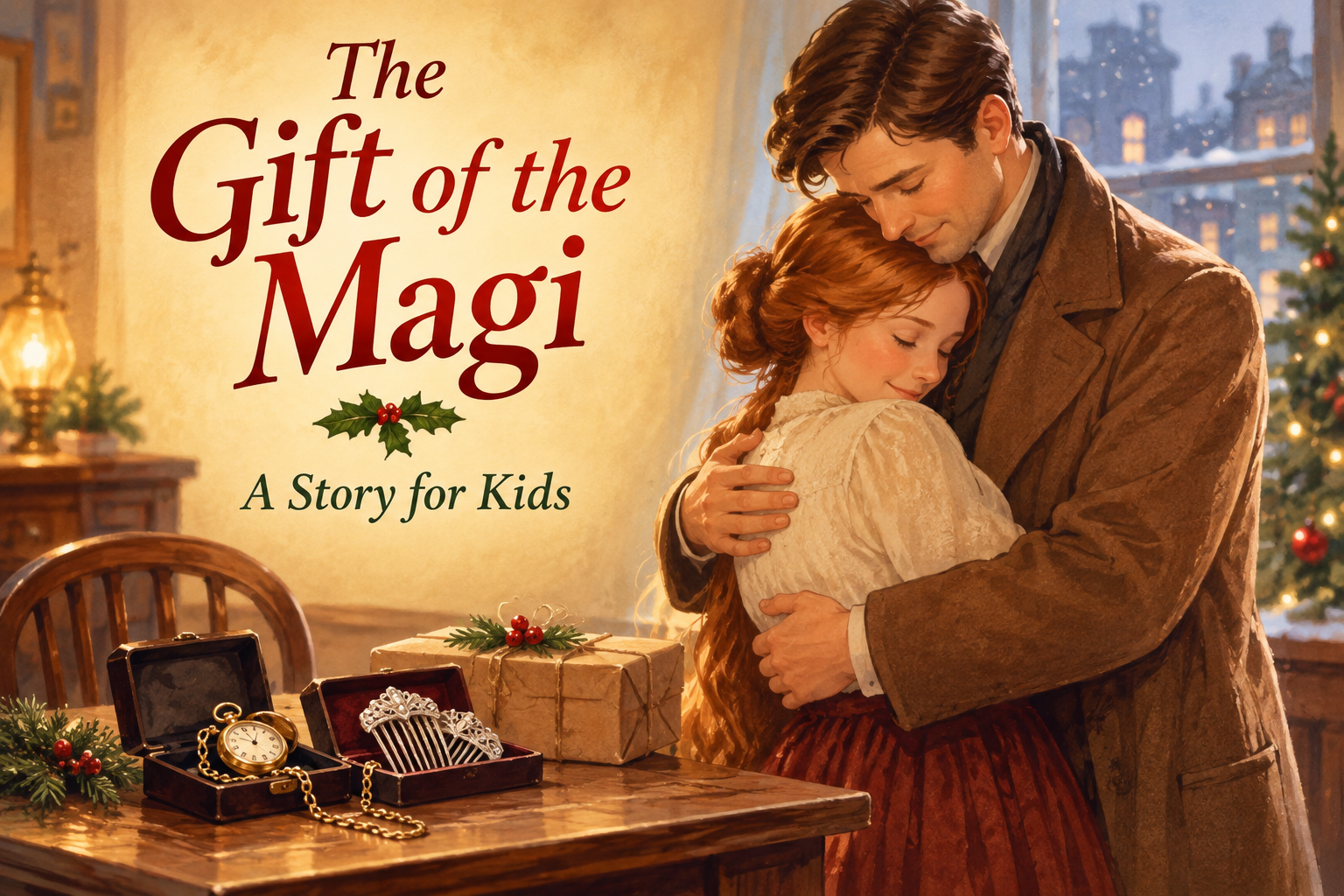
The Gift of the Magi story for kids begins with a number: one dollar and eighty-seven cents. That was all Della had, and tomorrow was Christmas. She wanted to buy her husband something wonderful, and she had spent months saving every coin she could by bargaining with the grocer, the butcher, and the vegetable man. It was still not enough for anything.
So she did something bold. And across the city, without knowing it, her husband was doing something just as bold.
By evening, both of them had a gift. Both gifts were perfect. And neither of them could be used.
This is the story of how that happened, why most people call it a story about love, and the one small thing Della and Jim could have done differently. Read the full story first. Then we will talk about that.
The Gift of the Magi Story for Kids: Simple English Retelling
One Dollar and Eighty-Seven Cents
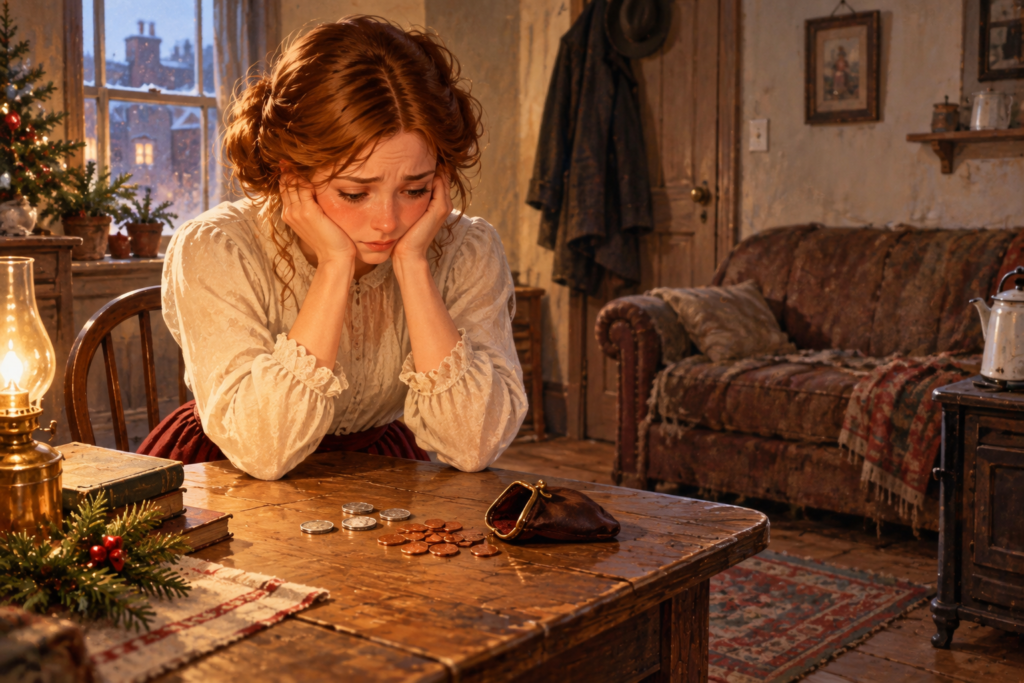
Della counted the money again. She had counted it three times already, but she could not make it grow.
One dollar and eighty-seven cents. Sixty cents of it was in pennies, and every one of those pennies had a small story behind it. She had argued with the vegetable man over the price of a cabbage. She had argued with the butcher over a piece of meat. She had argued with the grocer until her face turned red. Penny by penny, she had saved for months.
And tomorrow was Christmas.
Della dropped onto the old couch, put her face in her hands, and cried. The couch was the only real piece of furniture in the flat, and it was shabby. But then, everything in the flat was shabby.
Two Treasures in a Small Flat
Della and her husband Jim lived in a tiny rented flat that cost eight dollars a week. The letterbox downstairs was too small for a letter. The doorbell had not rung in years because it did not work. On a card by the door, in faded letters, was Jim’s full name: Mr. James Dillingham Young. He had put the card up back when he earned thirty dollars a week and felt proud. Now he earned twenty, and the card looked a little too grand for the man who came home to it every evening, thin, tired, and badly in need of a new coat and gloves.
But the Youngs owned two things that made them richer than any king.
The first was Jim’s gold watch. It had belonged to his father, and before that to his grandfather. It was heavy and beautiful, and Jim loved it. He loved it so much that he checked the time on it more often than he needed to.
The second was Della’s hair. When she let it down, it fell past her knees in a shining brown wave. If a queen had lived next door with a room full of jewels, Della could have dried her hair by the window and the queen would have felt poor.
Jim wore his watch on an old, cracked leather strap. Sometimes, when he took the watch out in front of other people, he looked at the strap and slipped it back into his pocket quickly.
Della had noticed.
Della’s Decision at the Mirror
Della stood up, wiped her eyes, and walked to the mirror. She unpinned her hair and let it fall all the way down.
She looked at it for a long moment. Then two tears landed on the worn red carpet.
“It will grow back,” she whispered.
She pinned it up again fast, before she could change her mind. She pulled on her old brown jacket and her old brown hat, and she ran down the stairs and out into the cold street.
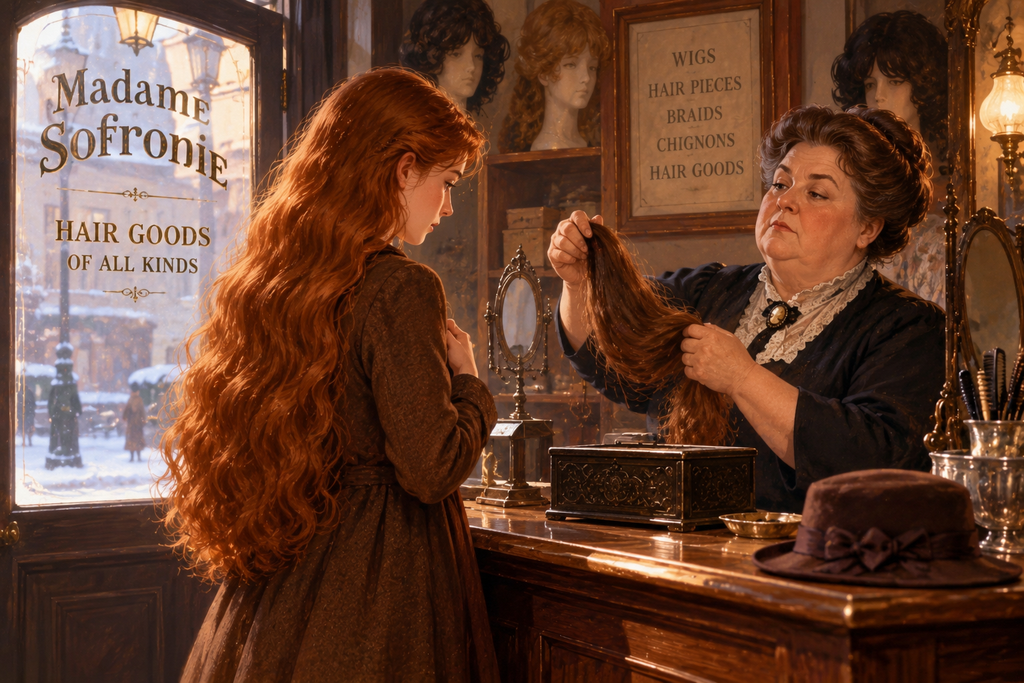
She stopped in front of a small shop. The sign said: Madame Sofronie. Hair Goods of All Kinds.
Inside, a large, pale woman looked up without much interest.
“Will you buy my hair?” Della asked.
“I buy hair,” said Madame Sofronie. “Take off your hat and let me see.”
Down came the brown wave.
“Twenty dollars,” said Madame Sofronie, lifting the hair in her practiced hands.
“Give it to me quick,” said Della.
Twenty Dollars and a Long Search
For the next two hours, Della flew from shop to shop. She was not looking for something nice. She was looking for something worthy of Jim, and that was much harder.
At last she found it. A platinum watch chain. Simple, plain, and strong. It did not shout. It did not need to. It was like Jim himself: quiet, but the real thing.
The price was twenty-one dollars. Della paid it and hurried home with eighty-seven cents left in her pocket.
“With this chain on his watch,” she thought, “Jim can check the time in front of anybody.”
At home she heated her curling iron and tried to repair the damage. What was left of her hair now curled tightly all over her head, and she looked like a schoolboy who had run away from school. She studied herself in the mirror for a long time.
“If Jim isn’t too shocked,” she said to her reflection, “he’ll say I look like a chorus girl. But what could I do? What could anyone do with a dollar and eighty-seven cents?”
By seven o’clock the coffee was ready and the pan was hot for the chops. Della sat by the door, holding the chain in her hand, and listened for Jim’s step on the stairs.
Jim Comes Home
The door opened. Jim stepped in and stopped.
He was only twenty-two, but with the weight of a family on him he already looked older. He stood there with no gloves and a coat that was too thin for the weather, and he stared at Della.
It was not anger. It was not shock. It was not disapproval. Della had prepared herself for all of those, and this was none of them. He simply stared, and she could not read his face.
She ran to him.
“Jim, please don’t look at me like that. I cut off my hair and sold it. I couldn’t let Christmas come without giving you something. It grows fast, Jim, it really does. Say Merry Christmas and be happy. You don’t know what a beautiful gift I’ve got for you.”
“You’ve cut off your hair?” Jim asked slowly, as if his mind was still catching up.
“Cut it off and sold it. Don’t you like me just as much without it? I’m still me, aren’t I?”
Jim looked around the room, almost as if the hair might be hiding somewhere.
“You say your hair is gone?”
“You don’t have to look for it. It’s sold, I tell you. It’s Christmas Eve, Jim. Be good to me. It went for you.”
Then Jim seemed to wake up. He wrapped his arms around Della and held her.
Two Gifts, Both Useless, Both Perfect
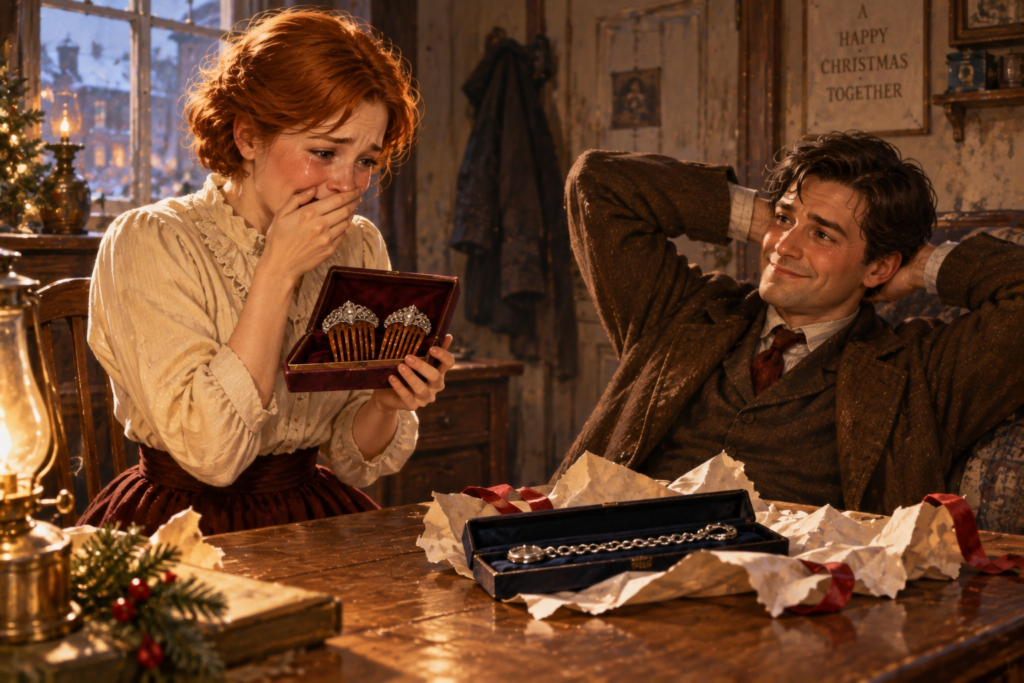
Jim pulled a small package from his coat pocket and put it on the table.
“Don’t get me wrong, Dell,” he said. “No haircut could make me love you any less. But open that, and you’ll understand why I stood there like a fool.”
Della tore the paper open.
Inside were the combs. The combs. The set of beautiful tortoiseshell combs with jewelled edges that had sat in a shop window on Broadway for months. Della had stopped in front of that window again and again. She had wanted them without any hope of ever owning them.
They were meant for hair that was gone.
She held them to her chest. For a moment she could not speak. Then she looked up with wet eyes and a smile and said, “My hair grows so fast, Jim!”
And then she remembered her own gift. She jumped up and held out the platinum chain on her open palm.
“Isn’t it wonderful, Jim? I hunted all over town for it. You’ll have to look at the time a hundred times a day now. Give me your watch. I want to see how it looks.”
Jim did not reach for his pocket. He sat down on the couch, put his hands behind his head, and smiled.
“Dell,” he said, “let’s put our Christmas presents away and keep them a while. They’re too nice to use just now. I sold the watch to get the money for your combs. And now, how about those chops?”
The Magi were the wise men who carried gifts to a baby in a stable, long ago, and started the custom of giving presents at Christmas. Jim and Della were not wise in the usual way. They were two young people in a shabby flat who gave away the two things they treasured most, and got back two gifts they could not use.
And yet, of everyone who has ever given a gift, these two might have been the wisest of all.
What Most People Miss in The Gift of the Magi
Almost every version of this story ends with the same lesson: love matters more than things. That is true. It is also the least interesting thing about the story, because everyone already agrees with it.
Look instead at what actually happened, step by step.
Della had a problem: not enough money. Jim had the same problem. Each of them solved it alone, in secret, in a single afternoon, by giving up the one thing the other person loved most. Della’s hair was Jim’s pride. Jim’s watch was Della’s pride. Each of them threw away the exact thing the other one was buying a gift for.
Now find the missed moment. It is not at the hair shop, and it is not at the watch shop. It is earlier, on the couch, when Della was crying over one dollar and eighty-seven cents. Jim was going to walk through that door in a few hours. She could have said one sentence to him: “We have almost nothing this year. What should we do?”
That sentence would have kept the hair and the watch. It would also have kept the surprise, because a surprise is about what the gift is, not about whether the other person knows you are struggling.
This is the part children can actually use. Big sacrifices feel brave. But a sacrifice made in secret cannot be checked by anyone, and that is exactly when it goes wrong. Della was not foolish for loving Jim. She was in a hurry, and she decided something enormous without asking one question.
There is a second thing worth noticing, and it is about Jim. When he walks in and sees his wife’s hair gone, he does not shout. He does not say “why did you do that?” He does not point out that his gift is now useless. He hugs her, he tells her he loves her exactly the same, and then he suggests dinner. When a plan collapses, most people look for someone to blame. Jim looks for his wife. That is the quietest and probably the best moment in the whole story.
If your child liked this, read the story of The Necklace next. It is about the same mistake, a big decision made in secret, but that time it cost ten years instead of one Christmas.
Moral of The Gift of the Magi
The traditional moral, the one O. Henry points to himself, is that love and generosity are worth more than possessions. That is true. Here is the lesson a child can actually use tomorrow:
Before you give up something big for someone you love, ask them one small question first.
- A surprise is about the gift. It does not have to be about hiding the problem.
- When a plan goes wrong, be like Jim: hug first, blame nobody, then eat dinner.
Your Turn: The One-Question Rule
The rule: Before you give up something big for someone, ask them one small question first.
Why it works: Della’s plan went wrong because nobody could check it. One question would have told her Jim was about to sell the watch.
Try this today:
- Think of one thing you were planning to do for someone as a surprise (a gift, a favour, giving up your turn, sharing your pocket money).
- Separate the two parts: the surprise (what the gift is) and the problem (why it is hard). Keep the surprise secret. Do not keep the problem secret.
- Ask the person one question about the problem. For example: “If you could only have one thing this Diwali, what would it be?” or “Is there anything you really don’t want me to change?”
Ask a grown-up: “Did you ever plan a surprise for someone that went wrong because you didn’t ask them something first? What happened?”
Della sat crying on the couch with $1.87, and Jim was coming home in a few hours. What could she have said to him that evening, and would it have spoiled the surprise?
Jim walked in and saw Della’s hair was gone. He did not get angry. Why do you think he chose to hug her instead of asking “why did you do that?”
Della sold her hair. Jim sold his watch. Were those brave choices, silly choices, or both? Can a choice be brave and silly at the same time?
Della saved for months by arguing over pennies with the grocer and the butcher. Is that a strength or a weakness? What does it tell you about her?
The story says Jim and Della were “the wisest” gift-givers of all, even though their gifts were useless. What do you think makes someone a wise gift-giver?
The Gift of the Magi was written by the American author O. Henry (real name William Sydney Porter) and first published in 1905. O. Henry is famous for short stories with a surprise ending, and this is his best-known one.
The usual moral is that love is worth more than possessions. A more useful lesson for children is this: before you give up something big for someone you love, ask them one small question first. Della and Jim each made a huge sacrifice in secret, and that secrecy is why both gifts became useless.
Yes, for ages 6 and up as a read-aloud, and for independent reading from around 8. There is nothing frightening in the story. The only thing younger children may need help with is the ending, since the sadness and the happiness arrive at the same moment. Pause after the last line and let them work it out.
Della sells her hair to buy a chain for Jim’s watch. At the same time, Jim sells his watch to buy combs for Della’s hair. Each gift is perfect for something the other person no longer has. Neither of them knows what the other has done until they exchange gifts on Christmas Eve.
The Magi were the wise men who brought gifts to baby Jesus, and O. Henry calls them the inventors of Christmas gift-giving. At the end he compares Jim and Della to them. Their gifts were useless, but the love behind the gifts made them, in his words, the wisest gift-givers of all.
About this story
- Original author: O. Henry (William Sydney Porter)
- First published: 1905, public domain
- This version: An original retelling in simple English for children, not the original text
Footer source note: The Gift of the Magi by O. Henry was first published in 1905 and is in the public domain. This is an original retelling for children.
1 thought on “The Gift of the Magi Story for Kids: Two Gifts Nobody Could Use”