
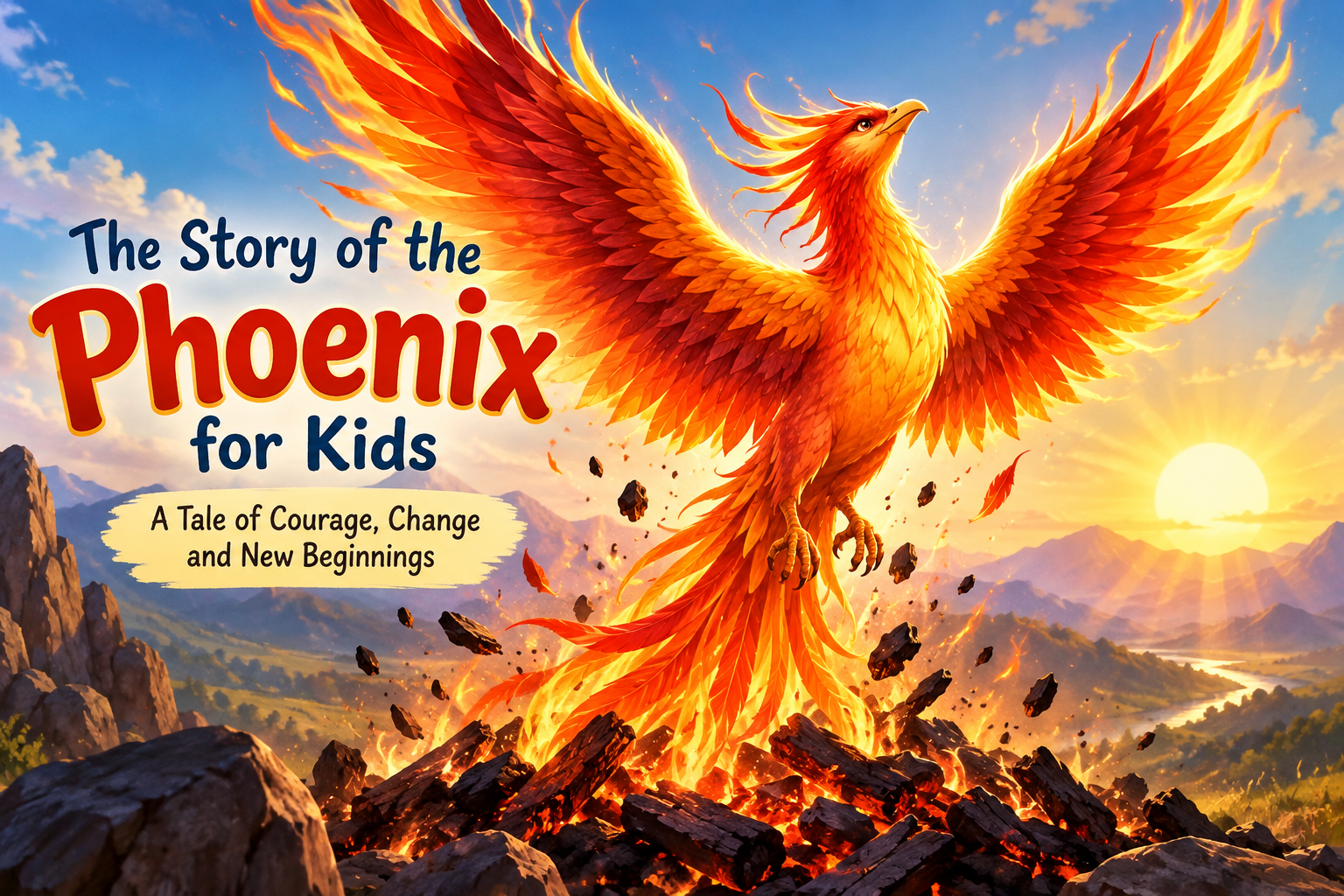
The Phoenix is famous for one thing: it rises from its own ashes. But everybody stops at the rising, and that is the part the Phoenix never actually chooses. It just happens. The real decision comes a moment earlier, and once your child spots it, this old legend stops being about a burning bird and starts being about them. Here is the full story in simple English, the meaning most retellings skip, and a Hindi summary for bilingual families.
For another timeless tale retold simply for children, read The Gift of the Magi story for kids.
The Story of the Phoenix in Simple English
The Sun’s Gift
Long, long ago, the Sun was looking down over the whole wide world when a flash of colour caught its eye. Below sat a great bird with feathers of shining red and gold. When the bird moved, it glittered like a small fire that could fly.
The Sun had never seen anything so beautiful.
“Glorious bird,” the Sun called, “you shall be my very own, and you shall live a long, long life!”
The bird lifted its head, and out came a song so lovely that the wind went quiet to listen.
“Then I shall sing,” said the Phoenix, “and I shall sing for you alone.”
The Reaching Hands
But a bird that shines like fire is hard to hide. Soon people came from every direction. They did not come to listen. They came to grab.
Everyone wanted one glowing feather for themselves. Hands reached up from every path. The Phoenix flapped higher, and still they followed, pulling and snatching.
“I cannot stay here,” the Phoenix thought sadly, “where hands are always reaching.”
So it spread its wide wings and flew far away, all the way to a quiet desert in the east, where no one could bother it.
Five Hundred Years Alone
In that lonely desert, the Phoenix sang its songs to the Sun. Morning and night, spring and winter, year after year, it praised the Sun with music.
It was the only Phoenix in all the world. There had never been two at once. So it sang alone, and the desert kept its secret.
Slowly, the years piled up. Five hundred of them. And one day the Phoenix noticed that its wings felt heavy. Its songs came slower. It remembered how it once flew fast and high, and it longed to feel young again.
“I am so tired,” it whispered. “I want to be strong once more.”
The Journey West
The Phoenix knew what it had to do. It rose into the sky and flew west, back toward the lands it had left so long ago.
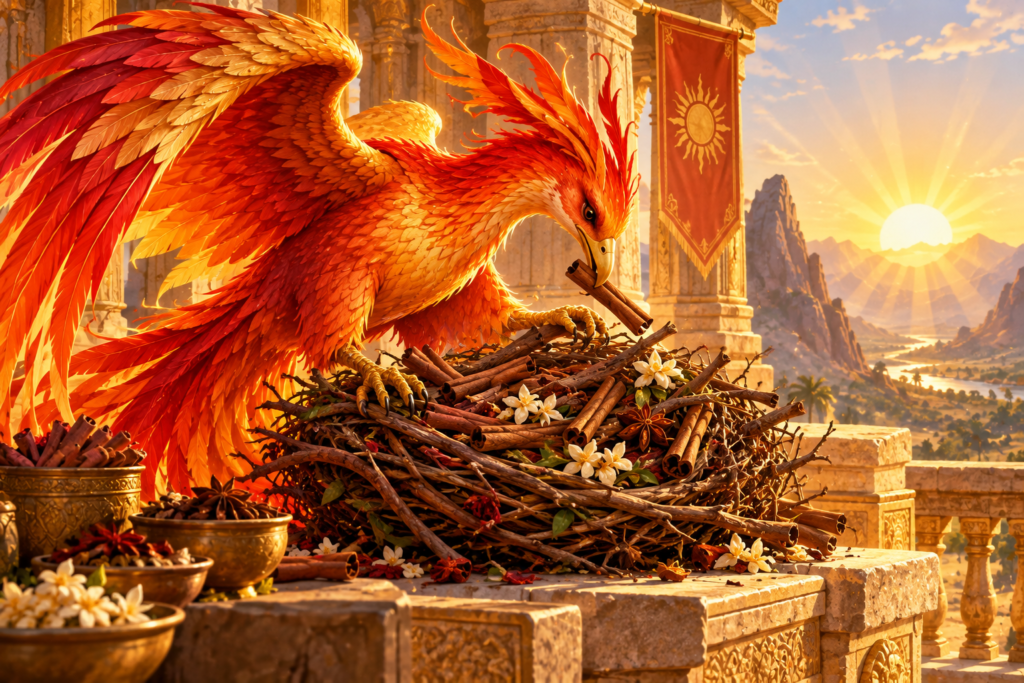
As it flew, it gathered things. It tucked sweet cinnamon twigs into its feathers. It collected fragrant green leaves that smelled of spice. In its claws it carried a small, sticky ball of golden resin.
On and on it flew, until it reached the great city of Heliopolis, which people called the City of the Sun. There stood the tall Temple of the Sun, and on the very top of it, the Phoenix built a nest from everything it had carried.
Into the Fire
The Phoenix settled into its spice-sweet nest. It looked up at the burning sky. Then it sang its bravest song of all.
“Sun, glorious Sun, make me young and strong again!”
For a moment, nothing moved.
Then the Sun answered. A flash of golden flame leapt down and lit the nest. The fire wrapped around the old bird, and in the warm light the Phoenix closed its eyes. The tired old body burned away, and the flames rose high above the temple.
Rising New
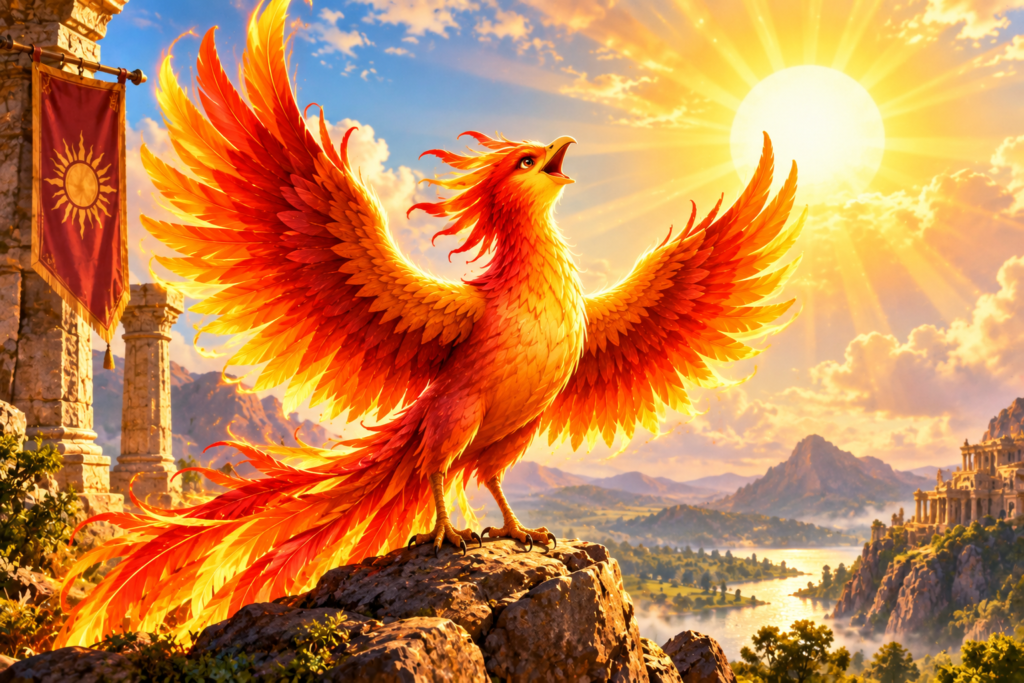
The flames sank down. The ashes lay still and grey.
And then the ashes trembled.
Something small and bright pushed up through the soft grey dust. A young Phoenix. It opened its beak and began to sing, and as it sang it grew, bigger and stronger, until it stood exactly as tall as the old bird had been.
Before it flew away, the new Phoenix did one gentle thing. It gathered what was left of the bird it had been, wrapped the ashes carefully so they would stay safe, and carried them up to the Sun’s own altar. It did not forget the old life. It honoured it, and then it let it go.
The Endless Return
Then the young Phoenix spread its wings and flew home to the quiet eastern desert. It lives there still.
But every five hundred years, when its wings grow heavy again, it flies west to the Temple of the Sun. And every single time, it rises from the ashes, young once more.
This is where we get the saying “to rise like a phoenix from the ashes.” It means to come back stronger after something hard. It’s the same spirit as when Jack got right back up after his tumble down the hill.
What Most People Miss About the Phoenix
Ask anyone what the Phoenix teaches, and they will say the same thing: never give up, keep going, rise from your failures. That answer sounds right, but look closely and it points at the wrong moment.
The rising is not a choice. The young Phoenix does not decide to be reborn. It simply appears from the ashes after the fire has already done its work. If “never give up” lived anywhere in this story, it would have to live in a decision the bird actually makes.
So walk the story backward and find the one real decision. The Phoenix is old and tired. It could hold on. It could try to keep its old feathers, its old songs, its five hundred years of memory, and drag its heavy wings around the desert for another century. Plenty of us would. Instead, the Phoenix does the opposite of holding on. It gathers the twigs for its own nest. It flies straight to the fire and asks to be changed. It chooses to let the old self go.
That is the brave part. Not the rising, but the letting go that comes first.
“Never give up” can quietly teach a child the wrong lesson. It can sound like “hold on tighter, no matter what.” But some things need the opposite. A grudge you keep replaying. A fear that shows up every time you fail. A quiet voice that says “I am just bad at this.” Holding those tighter does not make you stronger. The Phoenix shows the braver move: name the old thing, thank it for what it taught you, and let it burn away so a newer, lighter version of you can grow.
And notice how the Phoenix lets go. It does not throw its old self away in disgust. It wraps those ashes with care and carries them to a place of honour first. Letting go is not the same as pretending the past never mattered. You can respect what you were and still refuse to stay stuck as it. That is the whole quiet genius of this legend.
If you like a familiar story told with the moral turned on its head, we reframed the moral of another classic the same way.
Moral of the Story of the Phoenix
The Phoenix’s real strength is not that it rises. It is that it is willing to let the old self go so a new one can grow.
Two smaller lessons to carry with it:
- Letting go clears the runway. A grudge, a fear, or an “I can’t” takes up space inside you. Release it, and there is finally room for something braver.
- You can honour the past and still leave it behind. Like the Phoenix carrying its ashes with care, you can thank an old chapter for what it taught you, then close it for good.
Discussion Questions for Parents & Teachers
- The Phoenix could have clung to its old feathers and its five hundred years of life. Why do you think it chose to build the nest and step into the fire instead? What did it have to give up first?
- The people chased the Phoenix to grab its feathers. Was flying away the best choice, or could it have done something else? What would you have done?
- Before flying home, the young Phoenix carried its old ashes to a place of honour. What do you think that gentle act was saying?
- The saying “rise from the ashes” means coming back stronger after something hard. Can you think of a real person, or someone in another story, who did exactly that?
- Is there something you have been holding onto that might be lighter to let go of? What is one small step you could take?