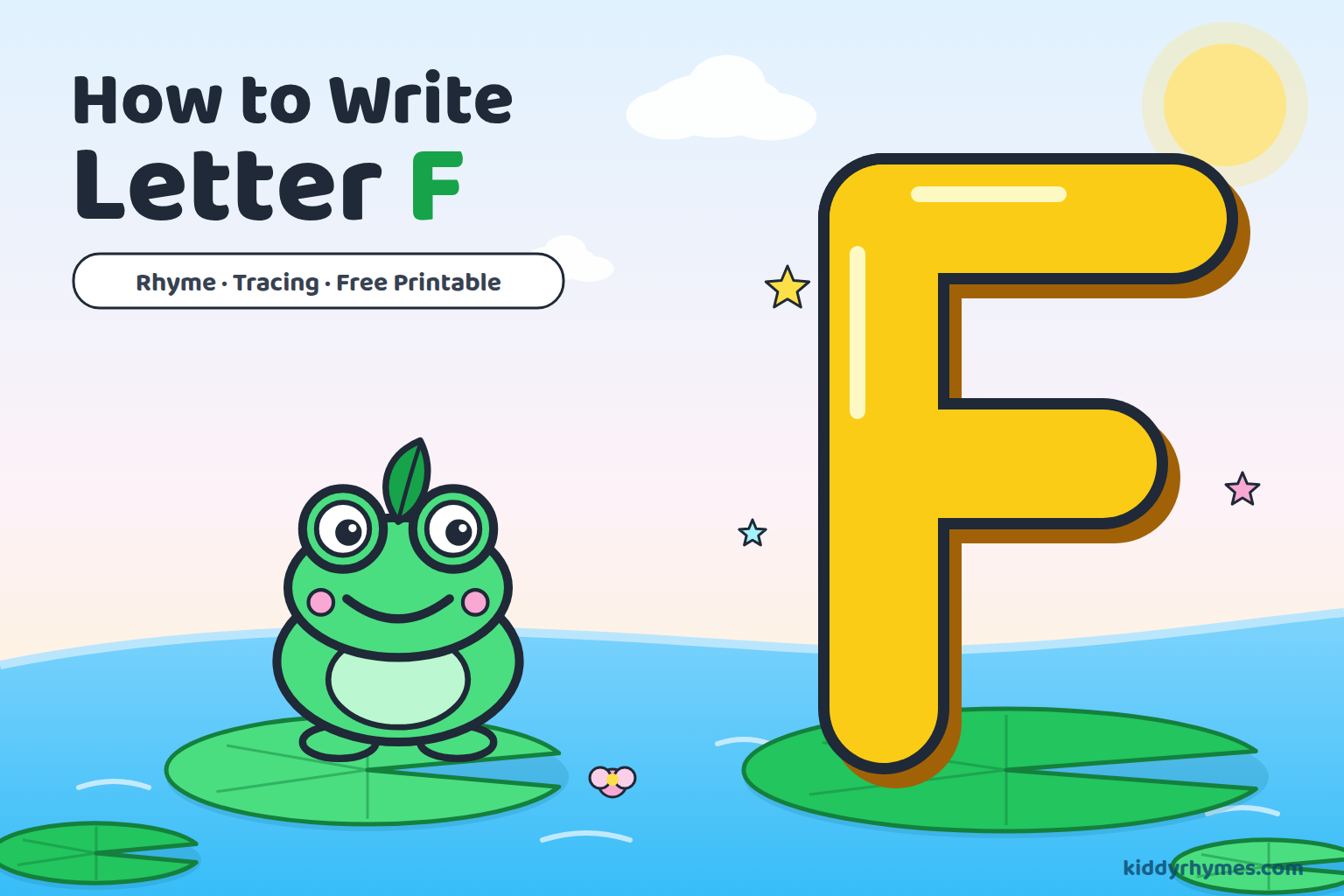
Meet Fenny the Frog! Fenny stands tall, hops back to the top, and stretches out two arms. That’s exactly how we write a capital F.
🐸 Fenny’s F Rhyme (original)
Tall line down, from top to ground,
Hop back up without a sound.
Long arm on top, short arm below — Two arms, not three, and off you go!
Say it slowly while your child writes. Rhymes give the brain a pattern to hold on to — here’s how rhymes support early language.
✅ Quick answer Capital F = 3 strokes: line down, line across the top, shorter line across the middle. Lowercase f = 2 strokes: hook back and down, then a small cross. Always start at the top. Most children begin writing letters around age 4, and every child moves at their own pace.
✨ Magic Tracing
Tap Watch Fenny first. Then trace from the orange dot 1!
You wrote F!
Fenny the Frog is so proud of you.
- Tall line down
- Hop back to the top
- Long arm across the top
- Short arm across the middle
- Start just below the top line
- Hook back, then slide down
- Lift your pencil
- Cross the middle line
How to Write Uppercase F — Step by Step
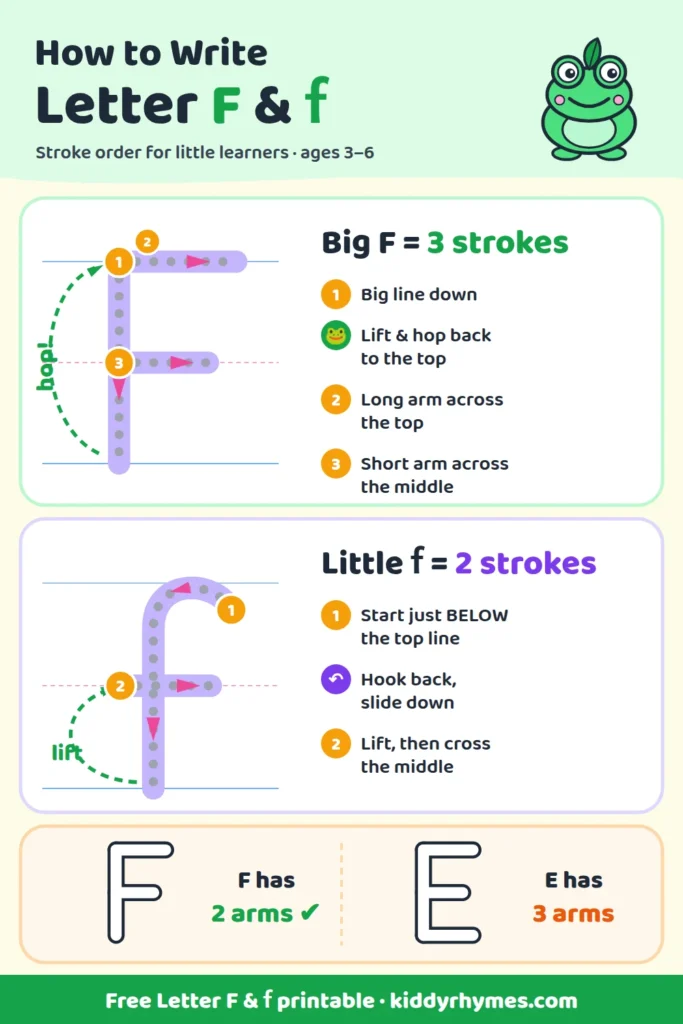
- Big line down. Put your pencil on the top line. Pull straight down to the bottom line.
- Hop to the top. Lift the pencil. Jump back to where you started — just like Fenny.
- Long arm across the top. Slide to the right along the top line.
- Short arm across the middle. Start on the tall line again, in the middle. Slide right — but stop sooner.
- Check: two arms, both pointing right, nothing on the floor. That’s F! 🎉
Tip: The Handwriting Without Tears program groups F with letters where the pencil “jumps” back to the top after the first line. The frog hop is our way of making that jump easy to remember.
How to Write Lowercase f
Little f is trickier than big F. Even the Handwriting Without Tears program teaches it near the end because of its unusual start. So be patient here.
🌱 Little f Rhyme (original)
Start near the top and hook it back, Then slide straight down along the track. Lift your pencil, cross the middle line — Little f is standing fine!
Steps (continuous method):
- Start just below the top line, a little to the right.
- Curve up and back to the left, like the handle of a walking stick.
- Pull straight down to the bottom line. Lift.
- Cross it with a short line on the middle line, left to right.
In print, lowercase f stays on the line. It does not dip below. The tail you sometimes see is part of joined or cursive handwriting, which comes much later.
The Teacher’s Version (Stroke Script)
Classrooms use short, flat words. Say the same words every time.
| Letter | Say this while writing |
|---|---|
| F | “Big line down. Jump to the top. Long line across. Short line across.” |
| f | “Start below the top. Curve back, and down. Lift. Cross the middle.” |
UK parents: Read Write Inc. uses a short formation rhyme for f that describes the tall stem and the crossbar. Our script follows the same stroke order, so it works alongside what your child learns at school.
The Mistake Most Children Make
F turns into E
Your child adds a third arm at the bottom, or makes both arms the same length. It happens because F and E are taught close together and look almost the same.
The fix — count the arms:
- Hold up two fingers and say “F has two arms.”
- The middle arm is shorter. Fenny’s short arm is tucked in.
- Nothing on the floor. The floor arm belongs to E.
If E is still fresh, revisit Elphie’s three-step E and put the two letters side by side. Seeing them together helps children notice the missing arm.
f turns into t
Both have a cross. The difference: f has a hook at the top and starts higher. t is shorter and straight at the top. Say “f has a hat, t does not.”
Arms on the wrong side
F always faces right — the same way we read. If your child draws the arms on the left, it’s usually a starting-point habit. Start every arm on the tall line and slide right.
F Songs to Sing While You Trace 🎵
All lyrics are original. Tunes are traditional and public domain.
1. “Line Goes Down” (tune: Frère Jacques)
Line goes down, line goes down, Hop to top, hop to top, Long arm on the top line, Short arm in the middle, That’s an F! That’s an F!
2. “The Frog Says Fff” (tune: The Farmer in the Dell)
The frog says fff, fff, fff, The frog says fff, fff, fff, Hi-ho, it starts with F, The frog says fff, fff, fff!
Swap in fish, fan, flower and foot for more verses.
3. “Little f” (tune: Row, Row, Row Your Boat)
Hook, hook, hook it back, Then slide down the stem, Lift, and cross the middle line, Little f again!
Want a fishy counting rhyme next? Try a classic rhyme about catching a fish — F for fish!
Fun Activities to Practice Letter F
1. Frog-Hop Floor F 🐸 Make a big F on the floor with masking tape. Your child walks down the tall line, hops back to the start, then walks each arm. Safety: clear the space and use bare feet or grippy socks on smooth floors.
2. Three-Stick F Give one long and two short craft sticks (or cut straws). Build F. Then ask, “Which arm is shorter?” Safety: supervise closely — small pieces are a choking risk for under-3s.
3. Flour Tray Tracing Spread atta or flour thinly on a tray. Trace F with one finger — F for flour! Shake gently to erase.
4. F or E? Arm Count Write five F’s and five E’s on cards. Your child counts the arms and sorts them into two piles.
Words That Start With F
📥 Free Letter F Printable
8 pages: uppercase and lowercase tracing, F-or-E sorting, f-or-t sorting, word tracing, a Hindi फ page, and a parent script card. A4 and US Letter.
Find more in our free printable rhyme sheets.
Moral of the Rhyme 🌱
Fenny lifts off the page and hops back to the top — and that’s not a mistake. That’s part of the letter. Sometimes we pause and start again from the right place. That’s how things get done well.
How many strokes is a capital F? And lowercase f?
Capital F has 3 strokes: down, across the top, across the middle. Lowercase f has 2: hook back and down, then a cross. Schemes word the steps differently, but the order is the same.
Why does my child’s F look like an E?
They’re adding a third arm or making the arms equal. Count “two arms” out loud and keep the middle arm short. This mix-up is common and usually fades with practice.
My child draws the F arms on the left. Should I worry?
Usually not. Writing letters backwards is common until around age 7. Research also shows children flip left-facing shapes more often than right-facing ones, and F faces right — so a backwards F is often just a starting habit. Start each arm on the tall line and slide right.
Why is lowercase f so much harder than capital F?
It starts with a curve instead of a straight line, the hook must point the right way, and it’s smaller. Lowercase letters are generally harder for young hands than capitals.
Should I teach capital F or lowercase f first?
Many occupational therapists suggest capitals first because straight lines are easier. UK phonics programs like Read Write Inc. start with lowercase letter sounds. Both paths work — follow what your child’s school uses.
Is it okay if my child starts the F from the bottom?
At 3, it’s fine to gently redirect: “Fenny starts at the top.” Top-down starts build habits that make joined writing easier later. If writing stays very hard, painful or slow after age 7–8 despite practice, talk to your pediatrician or an occupational therapist.
🔤 Letter Formation Series
Catch up:
- A — the Mountain & Bridge rhyme for A
- B — the Bat and Two Bellies B
- C — our Kitten Curl for letter C
- D — the Drum & Drumstick D
- E — Elphie the Elephant (linked above)
Next up: Letter G — with a curve, a shelf and a surprise! Browse all our rhyme activities in the meantime.