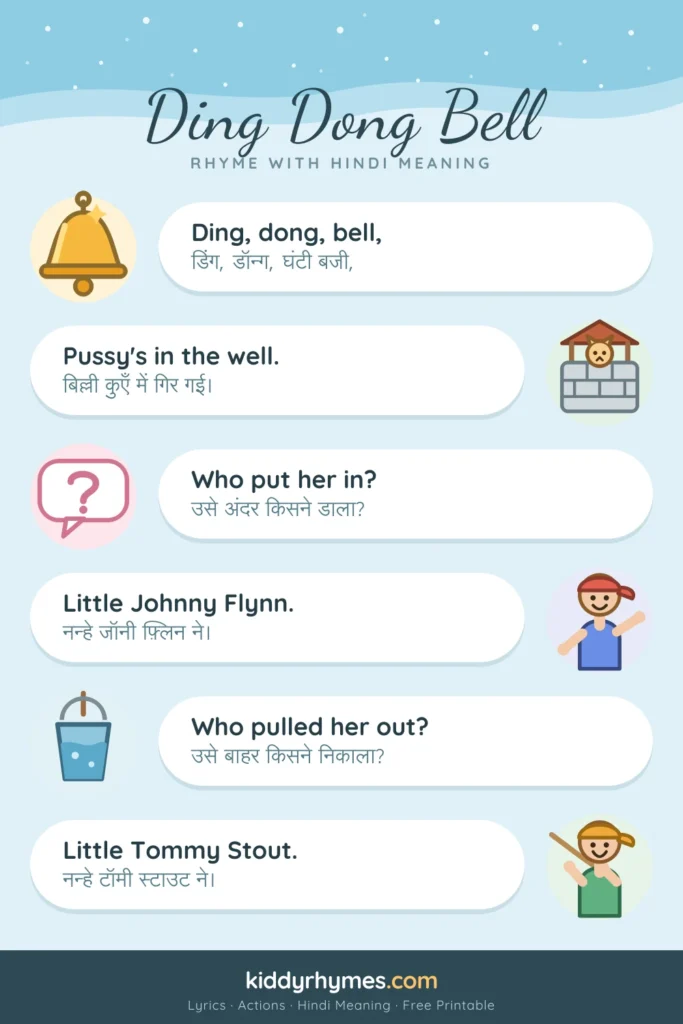
😾 What a naughty boy was that, 💧 To try to drown poor pussy cat, 🐭 Who never did him any harm, 🌾 But killed all the mice in the farmer’s barn.
Four Activities for This Rhyme
1. The steel balti well. Fill a bucket halfway, put a plastic or rubber toy cat beside it, and act the rhyme out with a dupatta for the rope. Your child does the pulling-out. Tip the bucket out when you finish — this is the point of the activity, not an afterthought.
2. Who-and-what cards. Four pieces of paper: a bell, a well, a cat, a boy. Lay them out, sing the rhyme, and have your child touch the right card as each one is named. Three-year-olds get this on the second go; two-year-olds need you to touch it with them for a week.
3. Ghanti relay. In a group, one bell gets passed around the circle. Whoever is holding it sings “ding dong bell” and passes it on. Nobody sings the rest until the bell has been round once. It turns a ten-second rhyme into five minutes of waiting practice.
4. Change the ending. For four- and five-year-olds only. Ask them what they would have Tommy Stout do next — dry the cat, feed it, take it home — and sing their new line on the end. They have just done what nursery-rhyme editors did for two hundred years, which is a reasonable thing for a five-year-old to have done before lunch. This works well alongside the shorter rhymes we recommend for two and three-year-olds, where there is less text to rework.
Using It at Home and in the Classroom
At home. Do it as a two-person rhyme, not a performance. You sing the questions, your child sings the answers. Then swap — let them ask you “Who put her in?” and you answer. Three-year-olds find being the asker far more interesting than being the answerer, and asking is the harder skill. If you own a small bell or a ghanti from the puja thali, let them ring it on the first line. Empty any bucket you use for the activities afterwards; standing water and a curious toddler do not mix.
In the classroom. Split circle time in half. One half sings the two questions, the other half sings the two answers, then swap on the second round. The last four lines everyone sings together. This gives you a natural turn-taking drill disguised as a song, and it works with a mixed-age group because the question half is easier than the answer half. For a group that already has this one, pair it with a rhyme built on the same sound-word trick so the week has a theme.
🌟 Moral of the Rhyme – 🎵 Ding, Dong, Bell
The cat did nothing wrong — it did its job, which was keeping mice out of the grain. The rhyme names the boy who hurt it and names the boy who helped, and leaves no doubt about which one it approves of. That is the whole lesson: an animal that cannot defend itself is not a toy, and the person who fixes a cruel act is worth more than the person who caused it.
Available Formats: 🎵 Audio (MP3) 📄 Printable PDF 🎬 Animated Video
Learning Style: Auditory and call-and-response
Rhyme Duration: Under a minute
Questions to Ask your Kids:
Why is there a bell in a rhyme about a cat in a well?
Because it was a funeral bell. In the 1580 version the cat has drowned and the villagers ring the church bell to announce the death — that is what a knell is. The bell stayed in the rhyme long after the death was edited out of it, which is why it now sounds like a cheerful sound effect with no obvious job.
Does the cat survive?
In the version your child is singing, yes — Tommy Stout pulls her out, and the word “try” tells you the drowning did not succeed. In every version printed before the nineteenth century, no. If your child asks, “Tommy Stout pulled her out, so she’s fine” is an honest answer to the rhyme as it stands today.
Should my child be singing the word “pussy”?
It is the older English word for a cat and that is all it means inside the rhyme. The concern is that it carries other meanings in adult English, and plenty of Indian schools have quietly switched to “Kitty’s in the well” for that reason. Either is correct and the rhythm is identical, so use whichever your child’s school uses — the mismatch between home and school is more confusing to a three-year-old than the word itself.
My child mixes up Johnny Flynn and Tommy Stout. Is that normal?
Completely. The rhyme names two boys in four lines, does not describe either of them, and then says “what a naughty boy was that” without saying which one. Adults resolve it from word order; three-year-olds cannot. Fix it with your hands, not with an explanation: point away for Flynn, pull the rope for Stout, every single time. Most children sort it out through the gesture weeks before they can tell you the answer in words.
Is this rhyme too dark for a two-year-old?
A two-year-old hears a bell, a cat and a question — the cruelty is carried in words like “drown” and “harm” that they do not yet have. The age it becomes a real conversation is four or five, when they understand what the boy did and usually object to it, loudly. That objection is the rhyme working, not failing. If you would rather not have the conversation at all, the “jolly boy / milk for pussy cat” variant in the table above exists precisely for that, and it is a legitimate choice rather than a watered-down one. Plenty of well-loved rhymes carry the same problem — Jack and Jill is a head injury set to a tune.
Tanu Bhardwaj is the creator of KiddyRhymes.com, where she shares fun nursery rhymes and learning activities for young children. Her passion is making early education joyful and inspiring little minds every day.
Trustindex verifies that the original source of the review is Google.
Kiddyrhymes in Mathura is truly one of the best playschools in the area. From the moment you step in, you can feel the warmth and positive energy. The teachers are not only well-trained but also genuinely caring and attentive to each child's unique needs.
The school offers a perfect balance of learning and fun. Their curriculum includes engaging activities, creative play, and foundational academics that help kids grow in a joyful and stress-free environment.