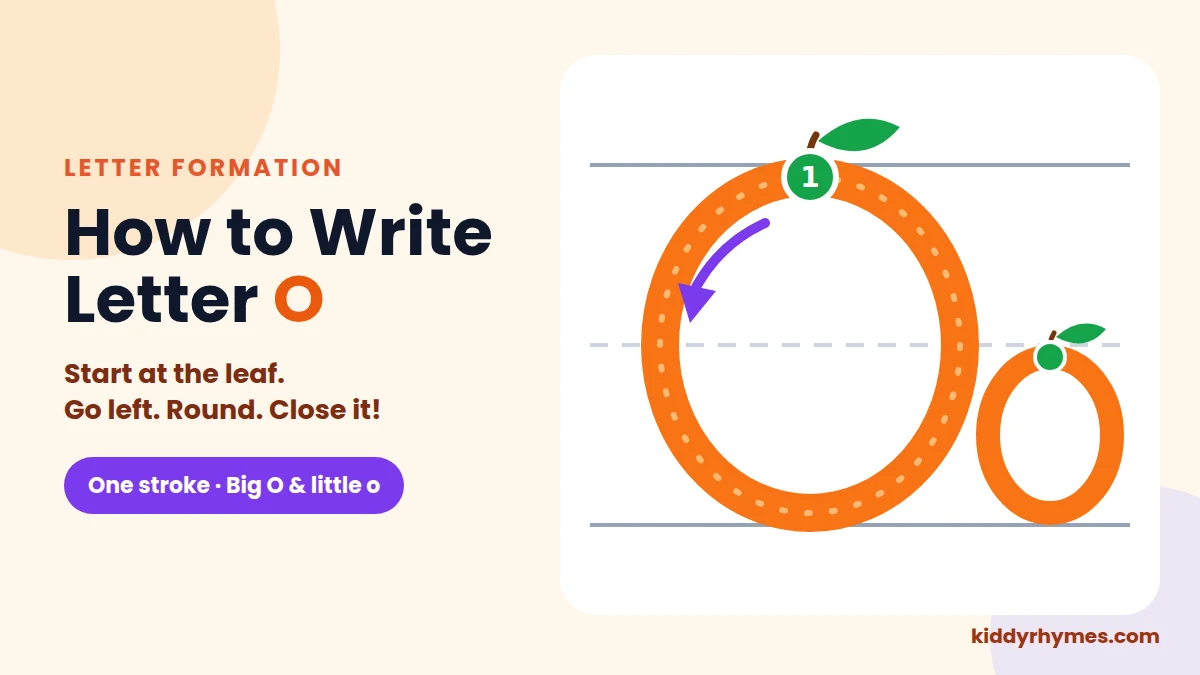
Capital O and small o are both one stroke. Start at the top, curve back to the left, go round the bottom, come up the right side, and close the circle exactly where you started. Big O fills the space from the top line to the bottom line. Small o is the same shape, sitting between the dashed middle line and the bottom line. Most children can copy a circle by about age 3, so the shape is rarely the problem — the direction is what to practice.
The Big O Rhyme (original)
Start at the top where the little leaf sits,
Curl to the left — that’s the way it fits,
Round the bottom and up you go,
Close it at the top: you’ve made an O!
Picture an orange. The little green leaf on top is where the pencil starts. Go round the fruit to the left and come back to the leaf. One stroke, no lifting. We use an orange because it is round, every child knows it, and the leaf gives them a start dot they can actually see.
How to Write Uppercase O — Step by Step
Trace the Letter O ✏️
- Start at the top. Put the pencil just under the top line, in the middle — the leaf on the orange.
- Curve back to the left. Move away from the right side, just like the start of a big C.
- Round the bottom. Touch the bottom line and keep going. Don’t stop.
- Up the right side. Climb back up toward the top.
- Close it. Join the line exactly where you started — no gap, no tail.
The exact start spot differs a little between handwriting programs. Handwriting Without Tears uses the same “Magic C” start for capitals C, O, G and Q and for small a, d, g, o and q. Zaner-Bloser calls this move a “backward circle”. Some teachers start slightly right of the top, where C begins. Every one of them goes the same way: left first, counterclockwise. If your child’s school uses a program, follow the school.
How to Write Lowercase o
The Little o Rhyme (original)
Little o is a baby O —
Start at the dashed line, left and round you go!
- Start at the dashed middle line. Not the top line — little o is short.
- Curve left and round. The exact same move as big O.
- Sit on the bottom line and close it back at the start.
O is one of the few letters where big and small are the same shape (C, S, U, V, W, X and Z are the others). So on paper, the only thing that tells them apart is size. If your child’s small o keeps touching the top line, it has quietly become a capital. Point to the dashed line and say: “Baby o stays under the roof.”
The Teacher’s Version
The classroom version — what teachers say out loud while the whole class writes:
Letter O Stroke Order & Verbal Cues
- 1 Start at the top.
- 2 Curve back.
- 3 All the way round.
- 4 Close it.
- 1 Magic c…
- 2 Keep going…
- 3 Close.
Use the long script for beginners and the short one for children who can already write C. In UK schools that use Read Write Inc., children link little o to a picture of an orange and trace right round the fruit. Our rhyme uses the same picture on purpose, so a child who hears one thing at school and another at home still gets one consistent idea.
The Mistake Most Children Make With O
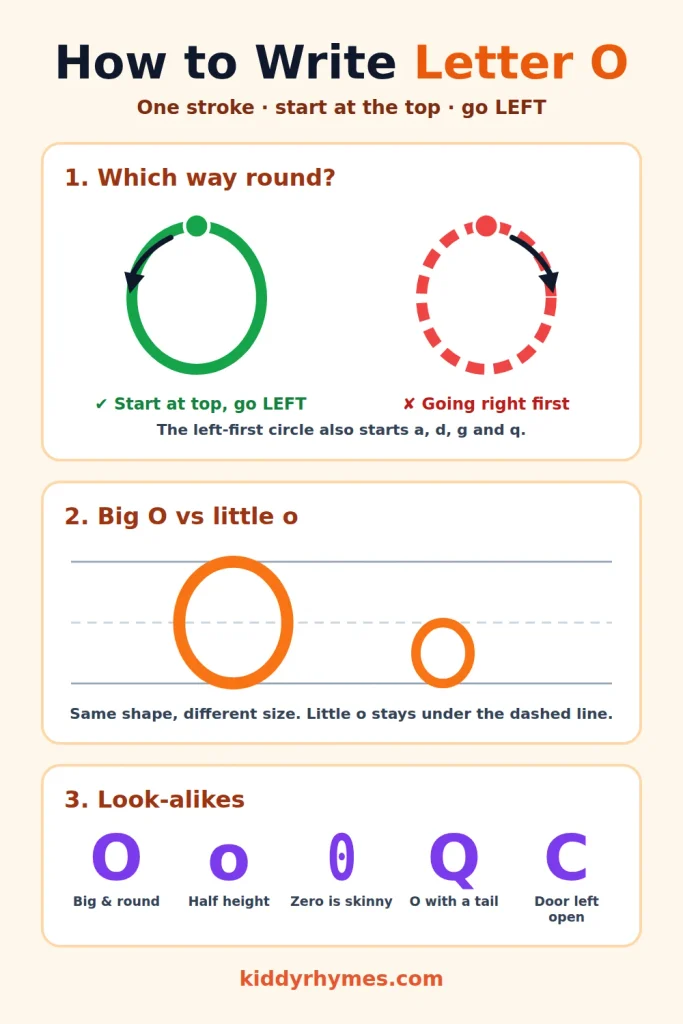
Going round the wrong way. Many children start at the bottom, or start at the top and go right (clockwise). The result still looks like an O, so nobody notices. Then the same habit shows up in a, d, g and q, which all begin with this back-curving move. Zaner-Bloser’s teacher guides point out that children who copy letters by eye often invent their own routes, including circles that go forward instead of back.
O is the best letter to fix this on, because there is nothing else in it — no stick, no tail, no second stroke to distract. Fix the circle here and a, d, g and q get easier for free.
- Leaf start dot. Put a small green dot at the top of every O on the practice sheet. The pencil must touch the leaf first.
- Clock trick. Draw a clock. Start at 12 and go to 11, 10, 9… all the way round back to 12. That is the O direction.
- Tiny arrow. Draw a small arrow pointing left beside the start dot.
- Stop on the leaf. Two smaller slips: a gap at the top (stopped too early) or a little tail past the start (it starts to look like Q or a 6). Say “stop on the leaf” as they close.
O, 0, Q or C? Telling O Apart From Its Look-Alikes
Letters & Shapes That Look Like O
| You See | What It Is | How To Tell | What To Say |
|---|---|---|---|
| O | Capital letter | Round, top line to bottom line | “Big and round, like an orange.” |
| o | Small letter | Same shape, half the height | “Baby o stays under the roof.” |
| 0 | Number zero | Thinner, taller oval | “Zero is skinny — it has zero fat.” |
| Q | Capital letter | An O with a small tail at the bottom right | “Q is an O with a tail.” |
| C | Capital letter | Stops early, open on the right | “C forgot to close the door.” |
Don’t worry about O and 0 with a three-year-old. When they write, the meaning tells you which one they mean. The “skinny zero” tip becomes useful once your child starts writing numbers, which many children begin around age five.
O Songs to Sing While You Trace
These are our own short songs, set to old public-domain tunes. Sing slowly and let one line match one part of the circle.
Round We Go (tune: Here We Go Round the Mulberry Bush)
Original song
This is the way we write an O,
write an O, write an O,
This is the way we write an O —
start at the top and round we go!
O, O, Round and Round (to the Twinkle, Twinkle tune)
Original song
O, O, round and round,
Start up high, then curve on down,
Left side, bottom, up the right,
Meet the leaf and close it tight,
O, O, round and round,
The roundest letter in the town!
Children already know the Twinkle, Twinkle tune, so all their attention goes into the new words and the hand movement. That pairing of rhythm and movement is a big part of why rhymes stick in young memories.
Fun Activities to Practice Letter O
1. Bangle trace
Lay a metal or plastic bangle, or a small steel katori turned upside down, on paper. Your child runs a finger round the edge — starting at the top, moving left. Then trace it with a crayon. Lift the bangle and there is a perfect O to trace again.
2. Atta dough O
Roll a small ball of atta dough into a long snake. Your child holds one end at the top, curves the snake to the left and round, then pinches both ends together at the top. The pinch is the leaf.
3. Wet-finger slate
Dip a finger in water and write O on a slate or blackboard. It dries and vanishes in seconds, so your child can write it again and again without a single eraser.
4. Round or skinny hunt
Walk around the house looking for O shapes: a roti, a plate, a bangle, the 0 on the TV remote. Sort them into “round like O” and “skinny like zero”.
Safety note: Use metal or plastic bangles, never glass ones, which can crack. Stay close during dough play so it doesn’t go into mouths, and keep the slate water in a small, shallow bowl.
Words That Start With O
Letter O Word Groups & Phonics Guide
| Group | Words | Use It For |
|---|---|---|
| Short o (as in octopus) |
octopus
otter
ox
olive
ostrich
|
Phonics and handwriting — start here |
| Long O (says its name) |
ocean
oval
oboe
|
Once your child knows O has two sounds |
| Starts with O (sounds different) |
owl
oven
onion
|
Handwriting only — these can confuse sound practice |
Owl shows up on many Letter O worksheets, but it doesn’t start with the o sound children learn first. And orange depends on where you live: British English says it with a short o, while American English says “or”. It is a perfect word for the shape of O, less perfect for the sound.
Free Printable
Letter O Tracing Pack — Big O & Little o
Leaf start dots on every O, a clock-face direction page, an O / 0 / Q sorting page, short-o picture words to color, and a Hindi ओ tracing page. A4, ready to print — or slip it into a plastic sleeve and use a whiteboard marker.
Sheets for other letters and rhymes are on our free printables page.
Moral of the Rhyme
An O only works if you come all the way back to where you started. Stop halfway and it is a C. Stop a little early and there is a gap. Circle time works the same way — the circle isn’t finished until everyone has a place in it. Finish what you start, and make room for everyone: that is the O lesson.
Questions Parents Ask
LETTER O HANDWRITING & PHONICS FAQ
My child can already draw a circle. Can they write O? ▼
Why does my child draw O clockwise, and does it matter? ▼
How many strokes is letter O? ▼
My 4-year-old’s O never closes, or has a little tail. Is that normal? ▼
Should I teach O before other letters? ▼
How do I stop my child mixing up O and 0? ▼
More letters in the series
- Climb the mountain for capital A
- Letter B: a bat and two bellies
- C, the curve that starts every O
- Writing D with a drumstick
- E and Elphie’s three steps
- F with Fenny the Frog
- Big G, little g and the hook-left tail