🎵 Letter B Formation Rhyme for Preschoolers | Bat & Two Bellies Method
🏏 Draw a bat, tall and straight, 🐻 Give it two bellies, it’s never late! 🐝 One for the bear, one for the bee, 🎉 That’s how you make a Capital B!
Teacher's Guide: Step-by-Step Letter B Formation
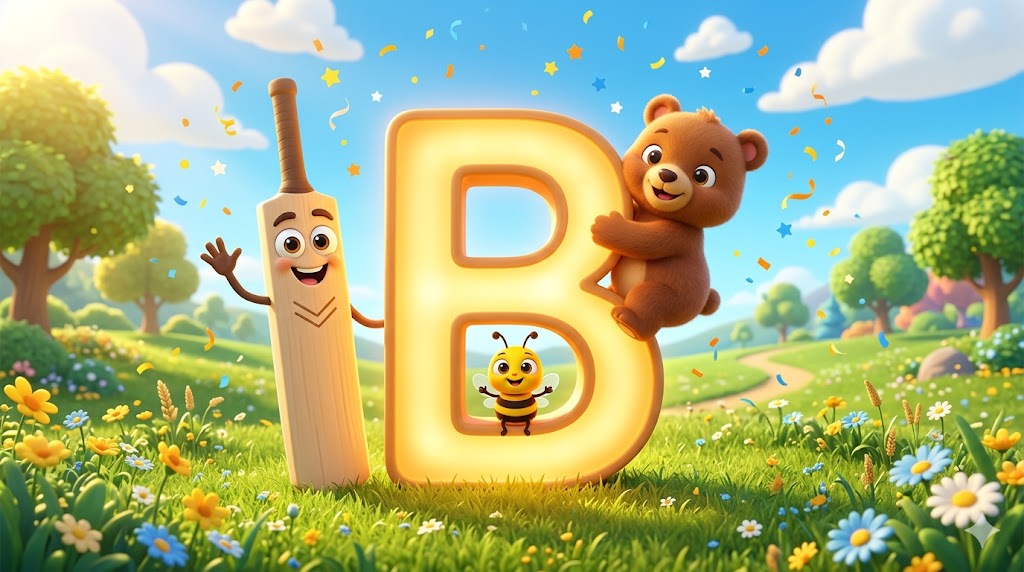
Time for a cricket adventure! Tell your little ones that today, a friendly bat is going to make two new friends — a big Bear and a tiny Bee. And together, they are going to build the most beautiful Letter B!
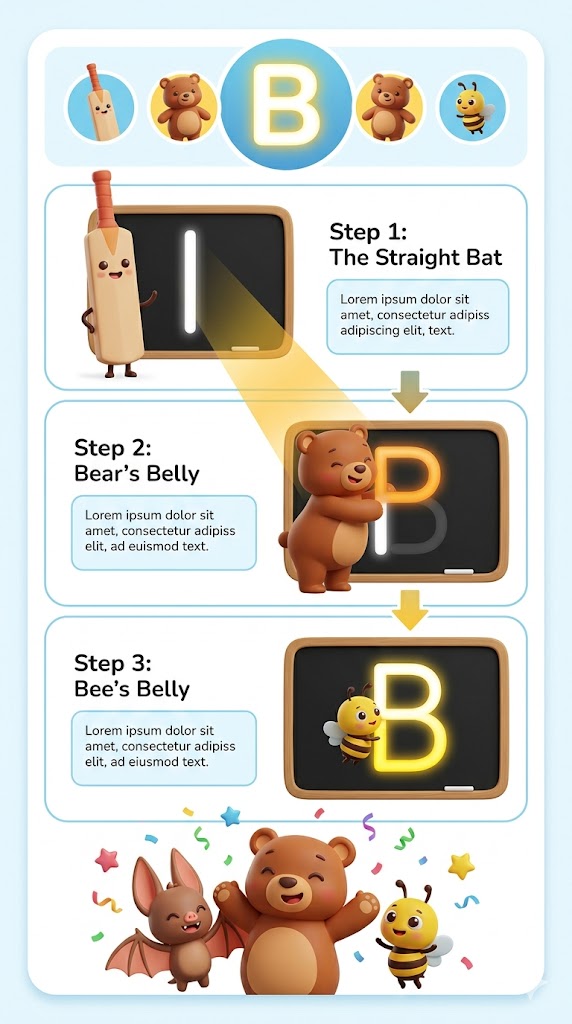
1. The Straight Bat ( | ) Start your pencil at the top and draw one straight line all the way down to the bottom. “Draw a bat, tall and straight!” 🏏
2. The Bear’s Belly ( B – Upper Curve ) Go back to the top of your bat. Now curve outward to the middle line — nice and round, just like a bear’s big, cozy belly. “Give it two bellies… One for the bear!” 🐻
3. The Bee’s Belly ( B – Lower Curve ) From the middle, curve outward again down to the bottom line — this belly is a little fuller, just like a happy bee! “One for the bee!” 🐝
Result: ( B )“That’s how you make a Capital B!” 🎉
An Easy Way to Explain it to Kids:
“Imagine a cricket bat standing tall and proud on the ground. Suddenly, a big fluffy Bear and a tiny buzzing Bee come running toward it — and the bat gives each of them a warm, round belly to hug! Bear hugs the top, Bee hugs the bottom — and just like that, you have your Capital B!”
📌 Just like we climbed a mountain to write Letter A, now we are giving out bellies for Letter B! Haven’t tried Letter A yet? 👉 Start with the Letter A Formation Rhyme — Mountain & Bridge Method and keep your alphabet adventure going!
Dear little ones, imagine that the tall, straight bat is your beautiful long life — standing bold and brave from top to bottom. And those two big, round bellies? They are the hurdles that will come along the way — sometimes big like a Bear, sometimes small like a Bee!
But here is the secret — when you embrace those hurdles with love, face them with a smile, and gently work through them one by one, something magical happens. Your life becomes just as simple, just as smooth, and just as beautiful as the Letter B you just drew with your little hands.
So never be afraid of the bumps on your path, dear children. Every hurdle you hug becomes a part of your story — and every B you write reminds you that you are stronger than any challenge that comes your way! 🐻🐝✨
Age Group: 2 to 5 years
Theme: Animals, Actions, Imagination & Creativity
Skills Focused: ✅ Fine Motor Skill Development ✅ Animal Vocabulary (Bat, Bear, Bee) ✅ Alliteration Awareness — Triple B Power! ✅ Rhyming and Rhythm ✅ Shape and Curve Recognition
Available Formats: 🎵 Audio (MP3) 📄 Printable PDF 🎬 Animated Video
Learning Style: Sing-along with actions
Rhyme Duration: Approx. 51 seconds
FAQ: Letter B Formation for Preschoolers
Q1. What is the easiest way to teach Letter B to preschoolers?
Ans. The easiest way is to break it into three simple strokes — one straight line and two curves. The “Bat & Two Bellies” method turns each stroke into a character from a story, so children remember the shape naturally instead of just copying it.
Q2. Why is Capital B harder to write than Capital A?
Ans. Capital A uses straight diagonal lines, which are easier for young hands to control. Capital B requires two smooth outward curves of different sizes — and keeping them balanced takes more fine motor practice. According to the CDC’s developmental milestones, children typically develop controlled pencil grip between ages 3 and 5, which is exactly when curve-writing becomes manageable.
Q3. What does the “Bat & Two Bellies” method mean?
Ans. It is KiddyRhymes’ original way of teaching Letter B. The bat stands for the straight vertical stroke. The bear’s belly and the bee’s belly represent the two curves. Together, they make a complete Capital B — through a story kids actually enjoy.
Q4. How do animals help children learn alphabet letters?
Ans. Animals give abstract letter shapes a personality. Research from the National Association for the Education of Young Children (NAEYC) shows that children connect new information faster when it links to something familiar and emotional. A Bear and a Bee are far more memorable than “curve one” and “curve two.”
Q5. Should children practice uppercase or lowercase B first?
Ans. Start with uppercase B. Its strokes are larger and easier to control for small hands. Lowercase “b” can confuse beginners because it looks similar to “d” and “p.” Most early childhood educators introduce uppercase letters first for this exact reason.
Q6. How can I make Letter B practice more fun at home?
Ans. Try these simple ideas:
Sing the Bat & Two Bellies rhyme together
Trace Letter B in sand, flour, or a tray of rice
Build the letter using sticks and playdough
Use our printable Letter B worksheet
Watch the animated video and pause at each stroke
Short sessions of 5–10 minutes work best. According to Zero to Three, young children learn most effectively through play-based, short bursts of activity rather than long structured practice.
Tanu Bhardwaj
Tanu Bhardwaj is the creator of KiddyRhymes.com, where she shares fun nursery rhymes and learning activities for young children. Her passion is making early education joyful and inspiring little minds every day.
Trustindex verifies that the original source of the review is Google.
Kiddyrhymes in Mathura is truly one of the best playschools in the area. From the moment you step in, you can feel the warmth and positive energy. The teachers are not only well-trained but also genuinely caring and attentive to each child's unique needs.
The school offers a perfect balance of learning and fun. Their curriculum includes engaging activities, creative play, and foundational academics that help kids grow in a joyful and stress-free environment.