🎵 Letter D Formation Rhyme for Preschoolers | The Drum & Drumstick Method

🥁 Drumstick straight, drop it down,
🔵 Curve it right, big and round!
💥 Hit the drum — BOOM! What a sound,
🎉 That’s Letter D you’ve just found!

Teacher's Guide: Step-by-Step Letter D Formation

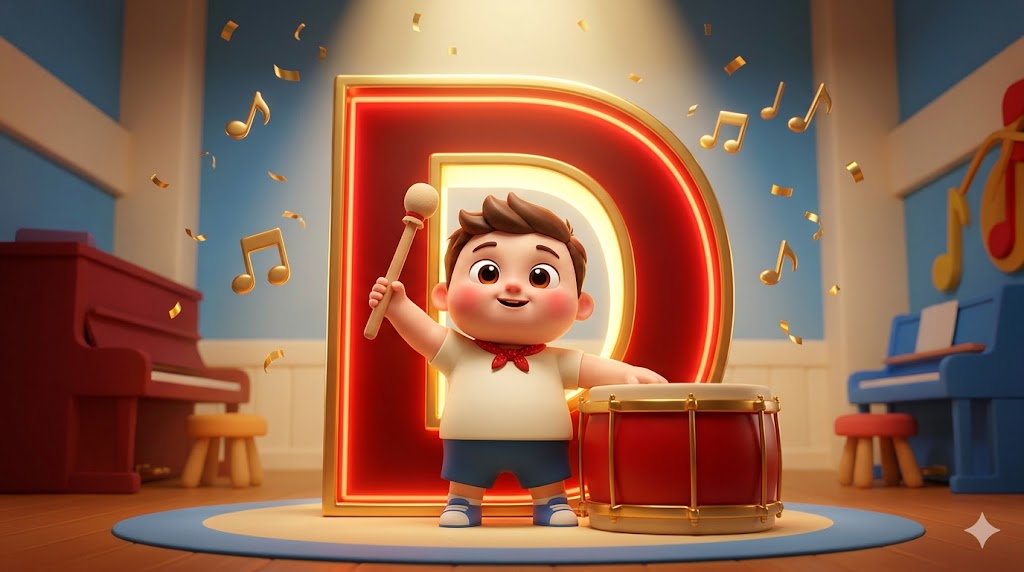
Every great drummer starts with two things — a drumstick and a drum. Today, your little ones are going to use both to write the most powerful letter in the alphabet!

One straight drop. One big curve. One legendary BOOM. That is all it takes to build a perfect Letter D.

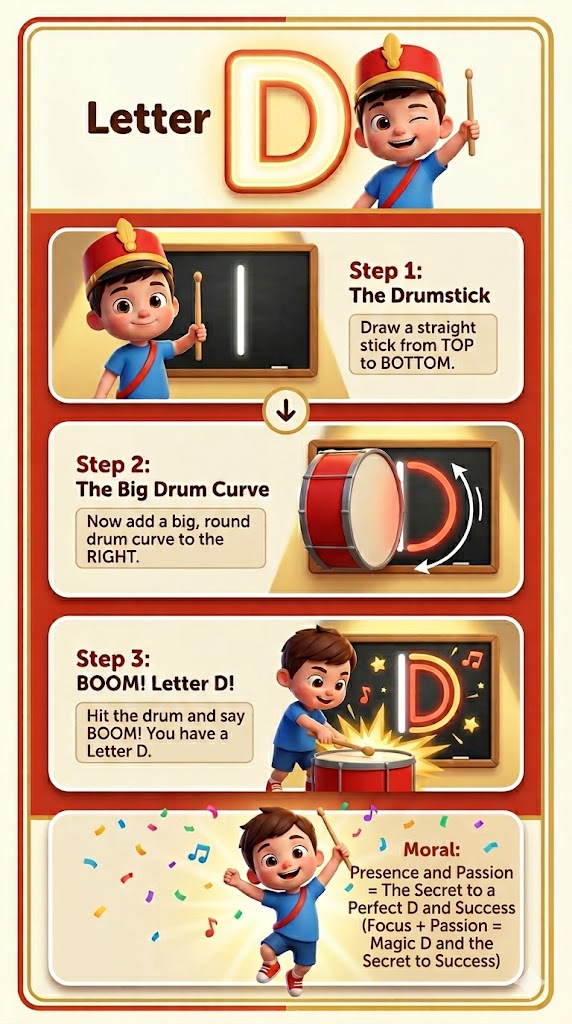
1. The Drumstick ( | ) Hold your pencil at the top and drop it straight down to the bottom — tall, confident, and steady, just like a drumstick ready to play. “Drumstick straight, drop it down…” 🥁

2. The Big Drum ( D — Right Curve ) Go back to the top of your straight line. Now curve your pencil outward to the right — big, bold, and round — and bring it all the way back down to the bottom. That is your drum! “Curve it right, big and round!” 🔵

3. Hit the Drum — BOOM! The drumstick meets the drum. The two strokes come together and form a perfect Letter D. Now shout it out loud! “Hit the drum — BOOM! What a sound!” 💥

Result: ( D ) “That’s Letter D you’ve just found!” 🎉

An Easy Way to Explain it to Kids:

“Imagine you are the world’s greatest little drummer. You pick up your drumstick and hold it perfectly straight. Then — right beside it — you place the biggest, roundest drum you have ever seen. You raise your stick, you bring it down, and — BOOM! The drumstick and the drum crash together and make the most beautiful Letter D anyone has ever heard!”

📌 Every letter in our alphabet has its own adventure — and you have already been on three incredible ones! Go back and revisit them anytime:

👉 Start from the very beginning with the A Formation Rhyme by Mountain & Bridge Method

👉 Learn how a bat and two animals build a letter with the Letter B Tracing Rhyme with the help of Bat & Two Bellies Method

👉 Follow Kitty’s graceful curl in the Alphabet C Tracing Rhyme

Keep going — your alphabet adventure is just getting started! 🌟

Letter D Infographics

🌟 Moral of the Rhyme – 🎵 Letter D Formation

Just like a drumstick needs a drum to make a joyful beat, a great life needs both focus and fun to be complete.

The drumstick stands straight — tall, disciplined, and ready. The drum curves wide — warm, open, and full of energy. Neither one makes music alone. But the moment they come together — BOOM — something extraordinary happens.

Dear little ones, that is exactly how you should live your life. Bring your focus and your joy together. Hit your goals with everything you have. And watch how beautifully you shape your Letter D — and your destiny! 🥁✨

  • Age Group: 2 to 5 years
  • Theme: Music, Actions, Rhythm & Confidence
  • Skills Focused:
    ✅ Fine Motor Skill Development
    ✅ Vocabulary Building (Drum, Drumstick)
    ✅ Auditory Learning — BOOM Sound Effect
    ✅ Rhyming and Rhythm
    ✅ Pencil Pressure and Curve Control

  • Available Formats:
    🎵 Audio (MP3)
    📄 Printable PDF
    🎬 Animated Video
  • Learning Style: Sing-along with actions
  • Rhyme Duration: Approx. 51 seconds
/* Premium Brand-Themed FAQ Accordion */ .preschool-faq-container { font-family: 'Roboto', 'Segoe UI', Arial, sans-serif; max-width: 850px; margin: 35px auto; background-color: #ffffff; border-radius: 14px; border: 1px solid #e5e7eb; overflow: hidden; /* Professional Material Elevation Shadow */ box-shadow: 0 4px 6px -1px rgba(0, 0, 0, 0.1), 0 10px 15px -3px rgba(0, 0, 0, 0.05); } .preschool-faq-nav { background-color: #1a1a3a; /* Your Brand Navy */ padding: 22px 25px; border-bottom: 4px solid #e66400; /* Your Brand Orange Accent */ } .preschool-faq-nav h2 { margin: 0; font-size: 20px; color: #ffffff; display: flex; align-items: center; gap: 12px; font-weight: 700; letter-spacing: 0.5px; } /* Individual FAQ Row */ .faq-preschool-row { border-bottom: 1px solid #f1f3f4; counter-increment: preschool-faq-count; transition: background-color 0.2s ease; } .faq-preschool-row:last-child { border-bottom: none; } .faq-preschool-row summary { display: flex; align-items: center; padding: 22px 25px; cursor: pointer; list-style: none; outline: none; position: relative; } /* Professional Orange Numbering */ .faq-preschool-row summary::before { content: counter(preschool-faq-count, decimal-leading-zero); font-weight: 800; color: #e66400; /* Brand Orange */ font-size: 13px; margin-right: 18px; background: #fff3e6; padding: 4px 8px; border-radius: 6px; } .faq-preschool-q { font-size: 17px; font-weight: 600; color: #1a1a3a; flex: 1; padding-right: 40px; line-height: 1.4; } /* Animated Brand Arrow Icon */ .faq-preschool-row summary::after { content: '▼'; position: absolute; right: 25px; font-size: 12px; color: #e66400; transition: transform 0.3s ease; } .faq-preschool-row details[open] summary::after { transform: rotate(180deg); } /* Open State Visual Feedback */ .faq-preschool-row details[open] { background-color: #fffaf5; /* Soft Brand Orange Tint */ box-shadow: inset 6px 0 0 #e66400; /* Left Indicator Bar */ } .faq-preschool-ans { padding: 0 25px 25px 80px; color: #4b5563; font-size: 16px; line-height: 1.8; animation: faqFadeUp 0.4s ease-out; } /* Specialized Feature Badges */ .research-tag { display: inline-block; background-color: #e8f0fe; color: #1a1a3a; font-size: 11px; font-weight: 700; padding: 2px 10px; border-radius: 4px; margin-bottom: 8px; text-transform: uppercase; letter-spacing: 0.5px; } @keyframes faqFadeUp { from { opacity: 0; transform: translateY(10px); } to { opacity: 1; transform: translateY(0); } } /* Mobile Tweaks */ @media (max-width: 600px) { .faq-preschool-row summary { padding: 20px 15px; } .faq-preschool-ans { padding-left: 15px; } .faq-preschool-row summary::before { margin-right: 10px; } }

Letter D Formation FAQ

What is the easiest way to teach Letter D to preschoolers?
Break it into exactly two strokes — one straight line going down and one big curve going right. The "Drum & Drumstick" method gives each stroke a real identity that children can see, touch, and act out. When kids physically mime holding a drumstick and hitting a drum, their hands remember the shape far better than pencil drills alone.
How is Capital D different from Capital B — and why do kids confuse them?
Both letters start with a straight vertical line on the left. The difference is in the curves — Capital B has two smaller curves stacked on top of each other, while Capital D has one single large curve on the right. Children confuse them because both feel similar to draw. The Drum & Drumstick method solves this — one big drum is very different from Bear's belly and Bee's belly, and that story contrast makes the difference stick.
Why does the BOOM sound effect help children learn Letter D faster?
NAEYC Guidelines
Sound effects create what educators call an auditory anchor — a memorable moment the brain attaches to new information. According to the National Association for the Education of Young Children (NAEYC), children retain new skills most effectively when multiple senses are engaged together. Saying "BOOM!" out loud while completing the letter stroke connects movement, sound, and memory all at once.
At what age should children start practicing Letter D?
CDC Milestones
Most children develop enough fine motor control for two-stroke letters like D between ages 3 and 5. According to the CDC's developmental milestones, children around age 4 can copy simple shapes and lines with increasing control. If your child can already draw a straight line and a simple circle, they are ready for Letter D practice.
Does teaching letters through music and rhythm actually work?
Early Literacy Research
Yes — and the research strongly supports it. Rhythm helps young children predict patterns, and pattern recognition is a core early literacy skill. Zero to Three highlights that music-based learning builds both language development and memory in children under five. The beat of the Drum & Drumstick rhyme naturally guides the hand through each stroke in the right order.
How can I make Letter D practice more exciting at home?
Try these ideas that actually work:
  • Bang a real drum or pot with a spoon while singing the rhyme — then draw the letter
  • Trace Letter D in sand and shout BOOM every time you complete the curve
  • Use playdough to roll a long drumstick and a round drum shape, then press them together
  • Use our printable Letter D worksheet with the rhyme printed alongside
  • Watch the animated video and let your child conduct the BOOM moment themselves

Keep every session to 5–10 minutes. According to Zero to Three, short and playful practice always outperforms longer structured drills for children under five.

Picture of Tanu Bhardwaj

Tanu Bhardwaj

Tanu Bhardwaj is the creator of KiddyRhymes.com, where she shares fun nursery rhymes and learning activities for young children. Her passion is making early education joyful and inspiring little minds every day.

Leave a Comment

Leave a Comment