🎵 Letter C Formation Rhyme for Preschoolers | The Kitten Curl Method
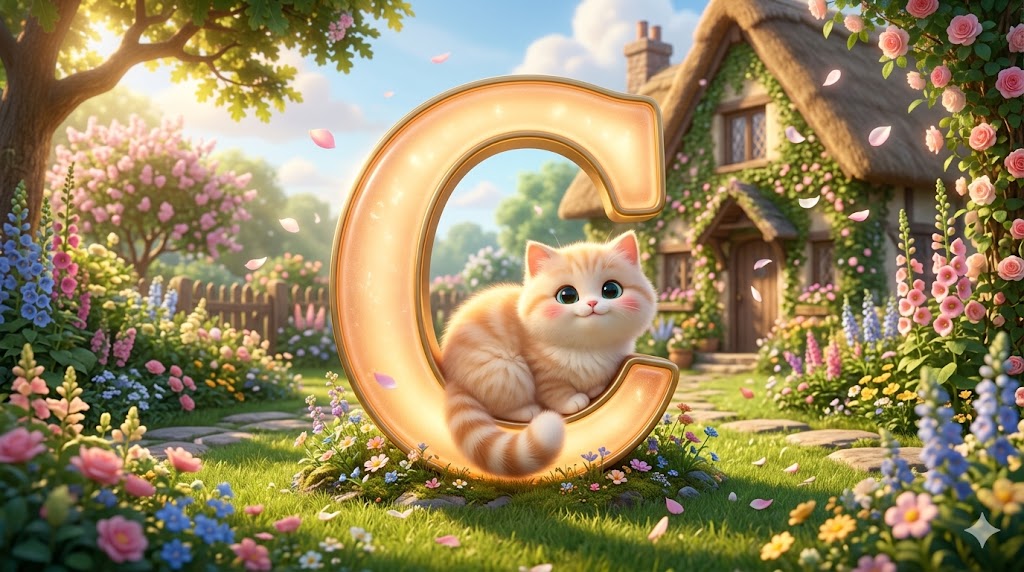
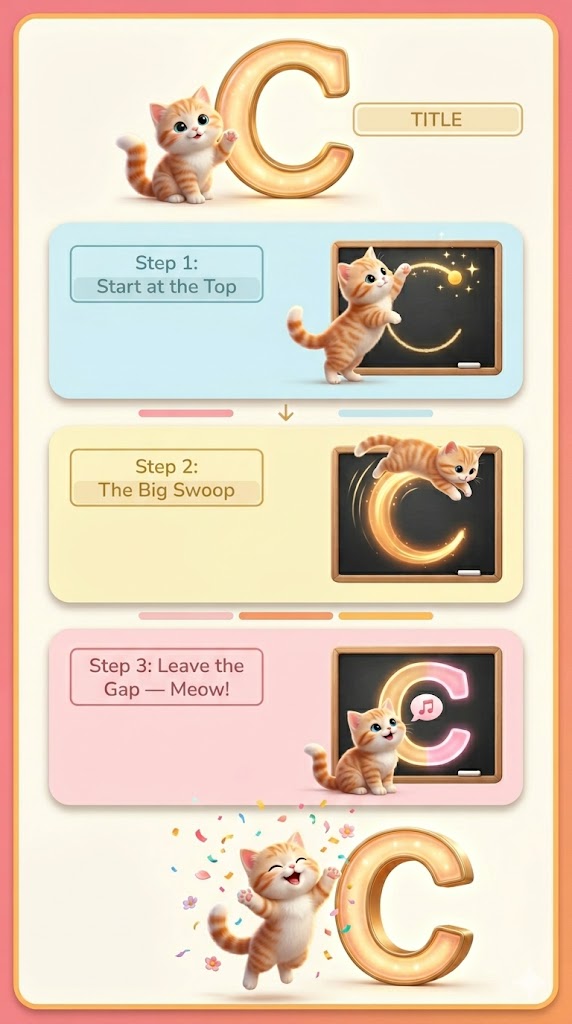
Kitty curls from top to ground, 🐱✨
She swoops her tail all the way round! 🐈⬛🌀
She leaves a gap to say “Meow!”, 👅🎀
That’s your Letter C right now! 🥳🎉
Teacher's Guide: Step-by-Step Letter C Formation
My dear children, today let me introduce you to a cute little kitty! If you look closely, the shape of her tail looks just like the Letter C (🐈) in the alphabet. So, come along, and let’s learn how easily we can write the Letter C just like a kitty’s curling tail!
No straight lines. No sharp corners. Just one confident swoop — and done!
1. Start at the Top ( • ) Place your pencil at the top right — just like Kitty raising her head before she curls up. “Kitty curls from top to ground…” 🐈
2. Swoop All the Way Round ( ) Now sweep your pencil to the left, curve it down, and bring it around to the bottom right — just like Kitty wrapping her tail around her body. “She swoops her tail all the way round!” 🐾
3. Leave the Gap Open ( C ) Stop before you close the circle. That open space on the right is Kitty’s little mouth — ready to say Meow! “She leaves a gap to say ‘Meow!'” 😺
Result: ( C ) “That’s your Letter C right now!” 🎉
An Easy Way to Explain it to Kids:
“Imagine Kitty sitting in a sunny window. She stretches her body from the top, sweeps her fluffy tail all the way around — and then stops, leaving a little gap just to say hello! That curl, that tail, that tiny open space — that is your Letter C!”
📌 We climbed a mountain for Letter A, gave out bellies for Letter B — and now Kitty is curling up for Letter C! Make sure you have done all three:
Keep the alphabet adventure going — one letter at a time! 🌟
🌟 Moral of the Rhyme – 🎵 Letter C Formation
Dear little ones, imagine that Kitty’s graceful curl is your life — it never goes in a straight line, and that is perfectly okay! Just like Kitty sweeps from the top all the way round, you too will take beautiful turns and curves on your journey.
But here is the most magical part — Kitty always leaves a gap. She never closes herself completely. That little open space is her way of saying — “I am still learning, I am still growing, and I always welcome something new!”
So remember, dear children — life’s most beautiful letters are never closed. Stay open, stay curious, and keep your heart as warm and soft as a curled-up kitten. Because just like Kitty’s curl becomes Letter C, your small, gentle steps will always lead to something wonderful! 🐱✨
- Age Group: 2 to 5 years
- Theme: Animals, Movement, Imagination & Creativity
Skills Focused:
✅ Fine Motor Skill Development
✅ Animal Vocabulary (Cat, Kitten)
✅ Curve and Arc Recognition
✅ Rhyming and Rhythm
✅ Pencil Control and Grip
- Available Formats:
🎵 Audio (MP3)
📄 Printable PDF
🎬 Animated Video - Learning Style: Sing-along with actions
- Rhyme Duration: Approx. 51 seconds
FAQ: Letter C Formation for Preschoolers
Q1. What is the easiest way to teach Letter C to preschoolers?
The easiest way is to connect the shape to something children already love — like a curling cat. The “Kitten Curl” method teaches kids that Letter C is simply one smooth swoop from top to bottom, with a small gap left open on the right. No complicated strokes, no sharp turns.
Q2. Why do young children find curves harder than straight lines?
Straight lines follow a single direction, which is easier for developing hands to control. Curves require the wrist to rotate smoothly while maintaining consistent pressure — a skill that takes practice. According to the CDC’s developmental milestones, children typically build this level of fine motor control between ages 3 and 5, which is exactly when Letter C practice becomes most effective.
Q3. Why does Letter C have an open gap — and how do I explain it to kids?
The open gap is what makes Letter C different from the letter O. For kids, the simplest explanation is Kitty’s mouth — she stops her curl just in time to say “Meow!” This visual gives the gap a purpose, and children remember it far better than a technical explanation ever could.
Q4. Is Letter C a good starting point for teaching curves to preschoolers?
Yes — and most early childhood educators agree. Letter C is the foundation for several other letters, including G, O, Q, and D. Research from the National Association for the Education of Young Children (NAEYC) highlights that teaching foundational strokes early builds confidence and makes the rest of the alphabet easier to learn.
Q5. Should I teach uppercase C or lowercase c first?
Start with uppercase C. The shape is larger, the stroke is the same, and it gives little hands more room to practice control. Lowercase c is almost identical but smaller — once children master the uppercase version, lowercase comes naturally.
Q6. How can I make Letter C practice more fun at home?
Try these simple ideas:
- Sing the Kitten Curl rhyme and act out the swoop together
- Trace Letter C in sand, playdough, or a flour tray
- Use a finger to draw C on each other’s backs — kids love this one!
- Use our printable Letter C worksheet
- Watch the animated video and pause at the gap to say “Meow!” together
Keep sessions short — 5 to 10 minutes works best. According to Zero to Three, young children learn most effectively through playful, short bursts of focused activity rather than long structured drills.
Tanu Bhardwaj
EXCELLENT Based on 1 reviews Posted on Google Akash Sharma gamingTrustindex verifies that the original source of the review is Google. Kiddyrhymes in Mathura is truly one of the best playschools in the area. From the moment you step in, you can feel the warmth and positive energy. The teachers are not only well-trained but also genuinely caring and attentive to each child's unique needs. The school offers a perfect balance of learning and fun. Their curriculum includes engaging activities, creative play, and foundational academics that help kids grow in a joyful and stress-free environment.