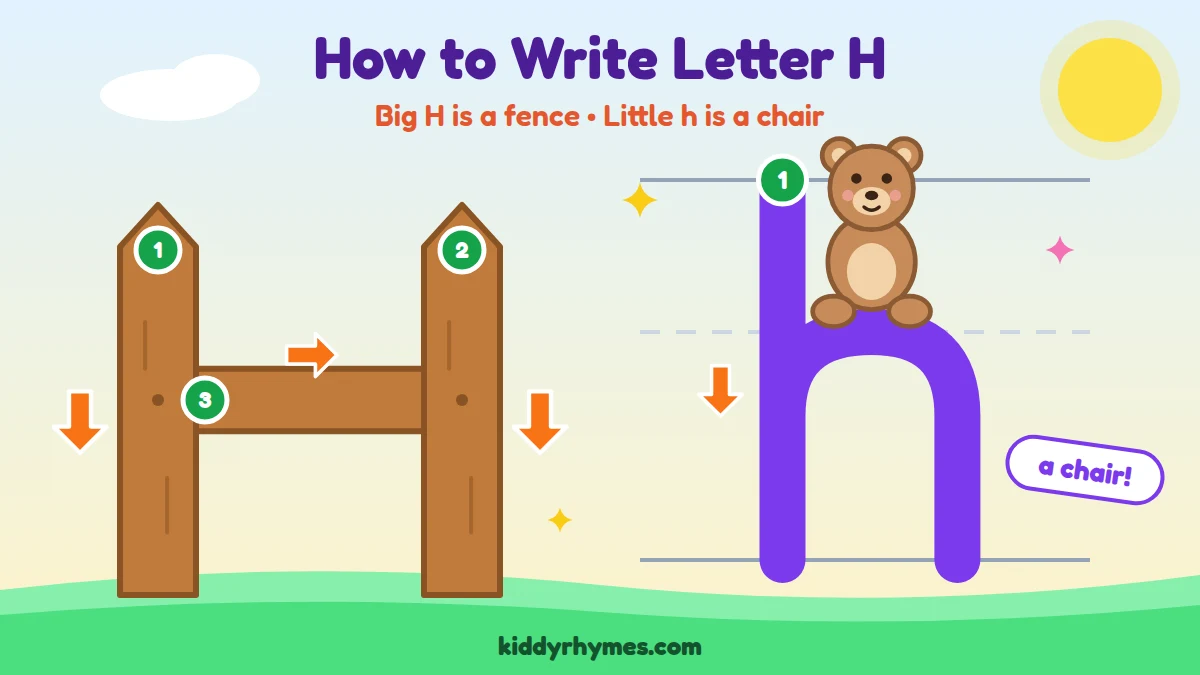
Capital H takes three strokes: a tall line down on the left, a tall line down on the right, then a short line across the middle. Always start at the top. Lowercase h is one stroke: a tall line down, bounce back up to the middle, then hump over and down. Most children practice H in preschool and kindergarten (roughly ages 3–6), each at their own pace.
Big H is one of the friendliest letters in the alphabet. It is only straight lines, so there are no curves to wobble. Little h is where children slip. Make the tall line too short and it turns into an n. Close up the hump and it turns into a b. This page shows you both letters, the fix for each mix-up, and a free tracing pack to practice with.
The Big H Rhyme (original)
One tall post goes down, down, down,
Lift and hop — one more post down!
Now one rail across the middle,
That’s big H — a fence so little!
🏗️ How to Write Uppercase H — Step by Step
Think of big H as a tiny fence: two posts and one rail. This is not just a cute picture. The letter H most likely began, thousands of years ago, as a drawing of a fence or posts.
- Left post down. Put your pencil on the top line. Pull a straight line down to the bottom line.
- Lift and hop. Lift the pencil and hop to the right. Leave a little space — about as wide as a finger.
- Right post down. Start on the top line again. Pull straight down to the bottom line. Both posts should be the same height.
- Rail across. Go to the middle of the left post. Draw a short line across to the right post. Stop when you touch it — the rail doesn’t poke out.
If your child can already write Elphie’s three straight steps, H will feel easy. E, F and H are all built from the same “line down, line across” moves.
🪑 How to Write Lowercase h
Little h looks like a chair. It has a tall back and a seat with one leg. Children who remember “a chair needs a tall back” rarely mix it up with n.
The Little h Rhyme (original)
Tall back down, all the way to the floor,
Bounce up halfway, hump over, and down once more.
A chair for teddy, tall and neat —
Little h has a back and a seat!
- Tall back down. Start on the top line, just like big H. Pull a straight line all the way down to the bottom line.
- Bounce back up. Don’t lift! Slide back up the same line until you are about halfway to the middle line.
- Hump over. Curve up and over to the right, like a little hill. The top of the hump touches the middle line.
- Leg down. Pull straight down to the bottom line. Stop. Now teddy has a chair.
That “bounce back up” move is the heart of little h. Your child will use the exact same bounce again for n, m, r, b and p, so it is worth slowing down here.
🧑🏫 The Teacher’s Version
The classroom version — what teachers say out loud, one beat per stroke:
| Letter | Say this while writing |
|---|---|
| H | “Line down. Line down. Line across.” |
| h | “Tall line down. Bounce up. Over and down.” |
Different handwriting programs describe the same shapes in their own words. None of them is “the only right way” — follow your child’s school if it uses one of these.
| Program | Big H | Little h |
|---|---|---|
| Handwriting Without Tears (US) | Taught very early, in the first group of capitals with L, F, E, T and I. A “corner starter” — the pencil begins at the top-left corner. | One of the “diver” letters (with r, n, m, p, b): dive down, swim back up, and over. |
| Read Write Inc. (UK) | Lowercase comes first, with the letter sounds. | Uses a horse picture: down the head to the hooves, then over the back. |
| Common US print | Three strokes with lifts, top to bottom. | Start at the top line, down to the bottom, trace back up, then make the hump. |
⚠️ Chair, Stool or Box? The h Mistakes to Fix
- Mistake 1: The back is too short (h turns into n). If the first line only starts at the middle line, your child has drawn a stool, not a chair. Stools have no back — that’s n. Fix it: point to the top line and say, “Chairs start up here.”
- Mistake 2: The hump closes (h turns into b). If the curve comes back to touch the tall line at the bottom, the chair has become a box — that’s b. Fix it: “A chair has an open front so teddy can sit down.” The leg goes straight down and stops.
- Mistake 3: Lifting the pencil for the hump. Many children draw the tall line, lift, and start the hump somewhere new. This leaves gaps and wobbly humps. Fix it: say “bounce, don’t lift” and let them feel the pencil slide back up the line.
A quick test at home: write h, n and b in a row and ask, “Which one is the chair? The stool? The box?” When your child can sort them, the mix-up usually fades.
🗣️ Why Doesn’t H Say Its Own Name?
Say “bee” and you hear the b sound. Say “dee” and you hear the d sound. But say “aitch” — there is no h sound in it at all! That makes H one of the harder letters for children to link with its sound. Letters whose names don’t hint at their sound are the hardest ones to learn, according to language researchers writing in The Conversation.
So teach the name and the sound separately. The name is “aitch” (some people say “haitch” — both are heard around the world). The sound is just a breath: /h/. Hold your child’s hand in front of their mouth and say “hat.” They will feel a little puff of warm air. That puff is H.
🎶 H Songs to Sing While You Trace
These three short songs are our own, set to old public-domain tunes you already know.
Song 1: The Fence Song (Tune: London Bridge Is Falling Down)
One tall post goes down, down, down,
Down, down, down, down, down, down.
One tall post goes down, down, down —
Hop and make another!
Now a rail goes straight across,
Straight across, straight across.
Now a rail goes straight across —
Hooray, we made a big H!
Song 2: The Chair Song (Tune: Here We Go Round the Mulberry Bush)
This is the way we write little h,
Write little h, write little h.
Tall back down, then bounce back up,
Then over the hump and down!
Song 3: The Breath Song (Tune: Frère Jacques)
Hand in front, hand in front,
Say /h/, /h/, /h/!
Feel the warm air, feel the warm air —
Hat, hen, hop! Hat, hen, hop!
Want a classic to pair with these? The Two Little Hands clapping rhyme is a perfect H warm-up — hands, after all, start with H. And if you wonder whether all this singing really helps, here is why singing rhymes helps young brains.
🎨 Fun Activities to Practice Letter H
- Stick fence H. Give your child three ice-cream sticks or cotton buds. Two stand up as posts, one lies across as the rail. Then mix them up and build it again.
- Floor tape hop. Make a big H on the floor with masking tape. Your child walks down the left post from the top, hops over, walks down the right post, then walks along the rail. Big body moves help the small pencil moves stick.
- Chair, stool, box dough game. Roll playdough snakes and make h, n and b. Ask your child to name each one: chair, stool or box? Then fix a stool into a chair by adding a tall back.
- Warm-breath hunt. Hold a hand in front of your mouth and walk around the house saying names of things. Hat, hanger, handle? Warm puff = H word!
Safety note: Sticks, cotton buds and dough are small enough to go in mouths. Sit with children under 3 the whole time. For the floor hop, clear the space and use bare feet or non-slip socks.
🎩 Words That Start With H
Stick to words where H makes its own breathy sound. These are easy to picture and fun to draw:
| Word | Draw it as |
|---|---|
| hat | a round sun hat |
| horse | a horse in a field |
| hand | trace your own hand |
| hippo | a hippo in the mud |
| house | a square and a roof |
| honey | a honey pot |
| hen | a hen on her nest |
| heart | a big red heart |
| hop | a frog mid-jump |
| helicopter | a helicopter in the sky |
Save for later: In “hour” and “honest,” the H is silent. And in “ch,” “sh” and “th,” H teams up with another letter to make a new sound. These are big-kid lessons — for now, one letter, one breath.
Letter H Tracing Pack
Five pages: the big H fence page, the little h chair page, the chair-stool-box sorting game, H picture words to trace and color, and a Hindi ह page. A4 and US Letter friendly.
💜 Moral of the Rhyme
One fence post on its own can tip over. But join two posts with a rail, and they both stand strong. That is big H — two friends holding hands in the middle. When we help each other, we stand taller too. So the next time your child writes H, ask them: “Who will you help today?”
❓ Questions Parents Ask
Why does my child’s h look like an n?
The first line is too short. For h, the line must start at the top line, not the middle line. Use the chair picture: an n is a stool with no back, and h is a chair with a tall back. Point to the top line before every h until it becomes a habit.
Is it okay to draw big H without lifting the pencil?
It is better to lift. Children who draw H in one go usually go down, across, then up the right side — which trains a bottom-up stroke. Handwriting Without Tears and most print programs teach H as three separate lines, each starting from the top.
Is it “aitch” or “haitch”?
Both are used. “Aitch” is the standard name in the US and England, and “haitch” is common in places like Ireland and Australia. Either is fine for a small child. What matters more is the sound: a soft /h/ breath, which is not in the letter’s name at all.
Should I teach uppercase or lowercase H first?
It depends on the school. Handwriting Without Tears teaches capitals first, and big H is one of the very first letters. Read Write Inc. and many phonics programs start with lowercase, together with the sound. Match what your child’s school does so they don’t learn it twice.
My child starts the H lines from the bottom. Does it matter?
It matters more as they start writing faster. Almost every letter starts at the top, so starting H at the bottom builds a habit that slows them down later. Gently put a dot on the top line and say, “We start at the top.” No need to fuss if a few slip through.
My child writes h backwards, with the hump on the left. What should I do?
This is very common while children are learning. Say “tall back first, then the hump goes to the right” and practice with the chair picture. Reversals usually fade with time; if they keep happening into Grade 2–3, this guide on letter reversals explains when to mention it to the teacher.
More letters in the series