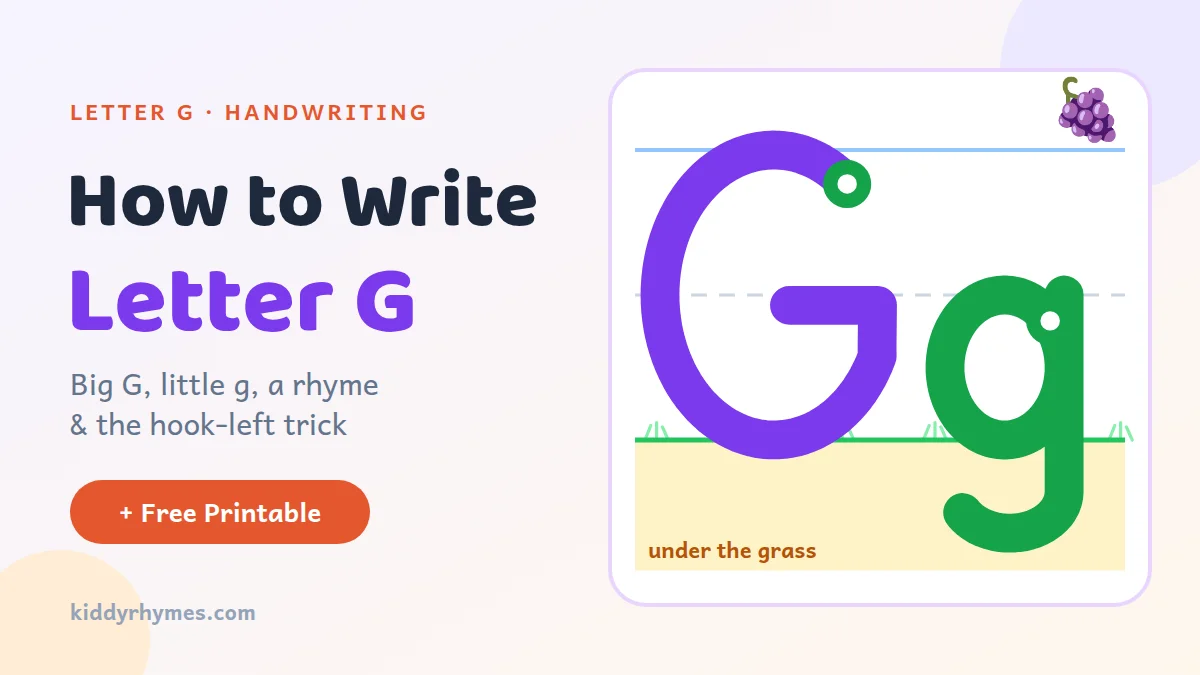
Capital G is one smooth stroke: start near the top on the right, curve back and around like a big C, come up to the middle, and step in to make a little shelf. Lowercase g is also one stroke: go round like a little c, close it, go up, then drop straight down below the line and hook to the left. Little g is the first letter in the alphabet whose tail hangs under the line, so that is the part to practice most.
The Big G Rhyme (original)
Start up high and curve back round,
Like a big C, down to the ground.
Come up the side, then step in tight —
A little shelf, and G is right!
How to Write Uppercase G — Step by Step
Trace the Letter G ✏️
Loading the tracer… If this message does not change, JavaScript is being blocked or changed on this page.
Big G sits between the top line and the bottom line. It begins exactly like a C, so if your child can already write C, they are most of the way there.
- Start near the top, on the right. Put the pencil just under the top line, a little to the right of the middle.
- Curve back. Go up and over to the left, down the side, and round the bottom — a big C.
- Come up. Without lifting the pencil, go up the right side until you reach the middle line.
- Step in. Draw a short line in toward the middle of the letter. That little shelf is what turns C into G.
Schools do not all draw the shelf the same way. Handwriting Without Tears teaches G as one stroke that begins with a “Magic C”. Other schemes lift the pencil and add the shelf as a second line, and some fonts add a short line going down. All of these are correct. Follow the version your child’s school uses so they don’t have to learn two.
How to Write Lowercase g
The Little g Rhyme (original)
Round the little grape we go,
Up to the top, then down below,
Down through the grass, don’t stop, don’t stall,
Hook to the left — and that is all!
Think of the space between the middle line and the bottom line as the “grape”. The space under the bottom line is the “grass”. Little g is the only letter so far that goes under the grass.
- Start at the middle line. Put the pencil just below the dashed middle line, on the right side.
- Round the grape. Curve back to the left, down, and all the way round until the circle closes.
- Go up. Keep the pencil down and go up to the middle line.
- Down through the grass. Pull a straight line down, past the bottom line.
- Hook left. Curl the tail to the left, like a fishing hook. It should point back under the grape, not away from it.
The classroom version — the short words teachers say out loud while the whole class writes:
| Letter | Say this while writing |
|---|---|
| G | “Big curve. Up. In.” |
| g | “Magic c. Up. Down under. Hook.” |
These cues follow the Handwriting Without Tears “Magic C” group, which starts capitals C, O, G and Q, and lowercase a, d, g, o and q, with the same back-curving stroke. In UK schools using Read Write Inc., children learn little g with a short picture rhyme about a girl’s face, her hair and a curl — the same three moves: round, down, curl.
The Mistakes Most Children Make With g
1. The tail hooks the wrong way. A tail that curls to the right makes g look like a backwards letter. Say “hook left, back under the grape” every time.
2. The circle goes the wrong way round. Many children start at the bottom or draw the circle clockwise. That habit makes a, d, g, o and q slower and messier later. Always start at the top and curve back.
3. g and q get mixed up. Both are a circle with a line down. The only difference is the tail: g hooks left, q has a straight line (often with a small flick to the right). Handwriting Without Tears teaches q much later on purpose, so the two don’t get muddled.
Writing letters backwards is common while children are learning, and many still reverse letters up to about age 7 (Understood.org explains when it’s normal). If reversals continue into Grade 2–3, or your child finds pencil work very hard in general, talk to their teacher, a pediatrician or an occupational therapist.
Why Does the g in Storybooks Look Different?
Look closely at a picture book and you may see a g that looks like a pair of glasses — a small circle on top, a closed loop underneath. This is called a “two-storey” g. It is common in printed fonts, but children are not taught to write it. The g we write by hand is the simpler “one-storey” g with an open hook.
Even adults get confused by this. A 2018 Johns Hopkins study found most people could not write the two-storey g, or even pick it out correctly (ScienceAlert summarized the study). So if your child points at a book and says “that’s not a g!”, tell them: “Both are g. Books use the fancy one. We write the easy one.”
Hard G or Soft G? Pick Your Practice Words Carefully
G usually makes the hard sound in goat, garden and gum. But when g comes before e, i or y, it often sounds like j — as in giraffe, gem and gym. There are exceptions too (get, give, girl keep the hard sound).
That matters because giraffe is one of the most common pictures on letter G worksheets. For a child learning the g sound, start with hard-g words like the ones below. Save giraffe for later, when you can explain that G has two sounds.
Words That Start With G
| Word | G Sound | Easy Picture or Action |
|---|---|---|
| goat | hard g | Say “baa” and butt heads gently |
| grapes | hard g | A bunch of round circles — like little g |
| garden | hard g | Point to plants on your balcony or in the park |
| gift | hard g | A box with a bow |
| gate | hard g | Open and close your arms |
| goose | hard g | Honk and waddle |
| green | hard g | Find three green things in the room |
| glove | hard g | Wiggle your fingers |
| giraffe | soft g (sounds like j) | Use later, to show that G has two sounds |
G Songs to Sing While You Trace
These are our own short songs, set to old public-domain tunes you already know. Sing slowly, one line per stroke.
Big G Song (tune: London Bridge Is Falling Down)
Big G starts just like a C,
like a C, like a C,
Big G starts just like a C —
then step in: G!
Little g Song (tune: Row, Row, Row Your Boat)
Round, round, round the grape,
up and then straight down,
under the grass and hook it left —
little g is found!
Songs and rhymes help because children remember the order of the moves, not just the shape. You can read more about how rhymes support early learning.
Fun Activities to Practice Letter G
1. Grass-line tray
Spread a thin layer of salt, sand or flour on a tray. Draw one line across it with your finger — that’s the grass. Your child writes little g on top, making sure the tail goes under the grass line every time.
2. Green G hunt
Write a big G on paper with a green crayon. Then walk around the house and find green things. For every green thing found, your child traces the G once more.
3. Hook-left fishing
Draw a row of little circles (the grapes). Your child adds the tail to each one: up, down, hook left. Say “hook left, catch a fish!” on every hook. This one activity targets the most common g mistake.
4. Big body G
Stick a line of tape on the floor as the “grass”. Your child walks a big g shape: round in a circle above the tape, then straight across the tape, and a hook on the other side.
Safety Note: Stay close for tray play with children under 3 — salt, sand and flour should not go in mouths or eyes. If you use real grapes as counters, whole grapes are a choking risk for young children; cut them lengthwise into quarters or use playdough balls instead. Clear the floor before the body-G game.
Letter G Tracing Pack — Big G & Little g
Big-arrow stroke guides, a “grass line” page for little g, hard-g picture words to color, and a Hindi ग tracing page. Print it and use it with a crayon, or slip it into a plastic sleeve for a whiteboard marker.
Moral of the Rhyme
Little g is brave. It is the first letter that goes below the line, somewhere new. The first few tries may wobble, and that is fine. Every time your child hooks the tail to the left, they are learning that it’s okay to try something new, one small stroke at a time.
Questions Parents Ask
Why does my child write g backwards?
Usually the tail is hooking right instead of left, or the circle is drawn the wrong way round. Both come from not having a fixed starting point yet. Always start at the middle line, curve back, and say “hook left” out loud. Reversals are common while children learn; if they still happen a lot in Grade 2–3, mention it to the teacher.
Should the tail of g be a hook or a loop?
For print, a simple hook. A closed loop under the line is usually a cursive (joined) g, which comes later. If your child’s school teaches a loop, follow the school.
How many strokes is correct for capital G?
One or two — both are correct. Handwriting Without Tears teaches one continuous stroke (curve, up, in). Some schemes lift the pencil to add the shelf as a second stroke. What matters most is starting at the top and curving back.
Is it okay if my child starts the g from the bottom?
It looks fine at first, but it becomes a problem when your child starts writing words quickly. Letters like a, d, g, o and q all start at the top and curve back. Gently move the start point each time: “Start at the top, like a c.”
Should I teach uppercase or lowercase G first?
It depends on your child’s school. Handwriting Without Tears teaches capitals first because they are simpler to form. Many phonics programs, including Read Write Inc. in the UK, teach lowercase letters first, together with their sounds. Ask the school and match it.
Why does the g in my child’s books look like glasses?
That’s the “two-storey” g used in many printed fonts. Children only need to write the simple one-storey g. Tell them both are g — books just use a fancier one.
More letters in the series