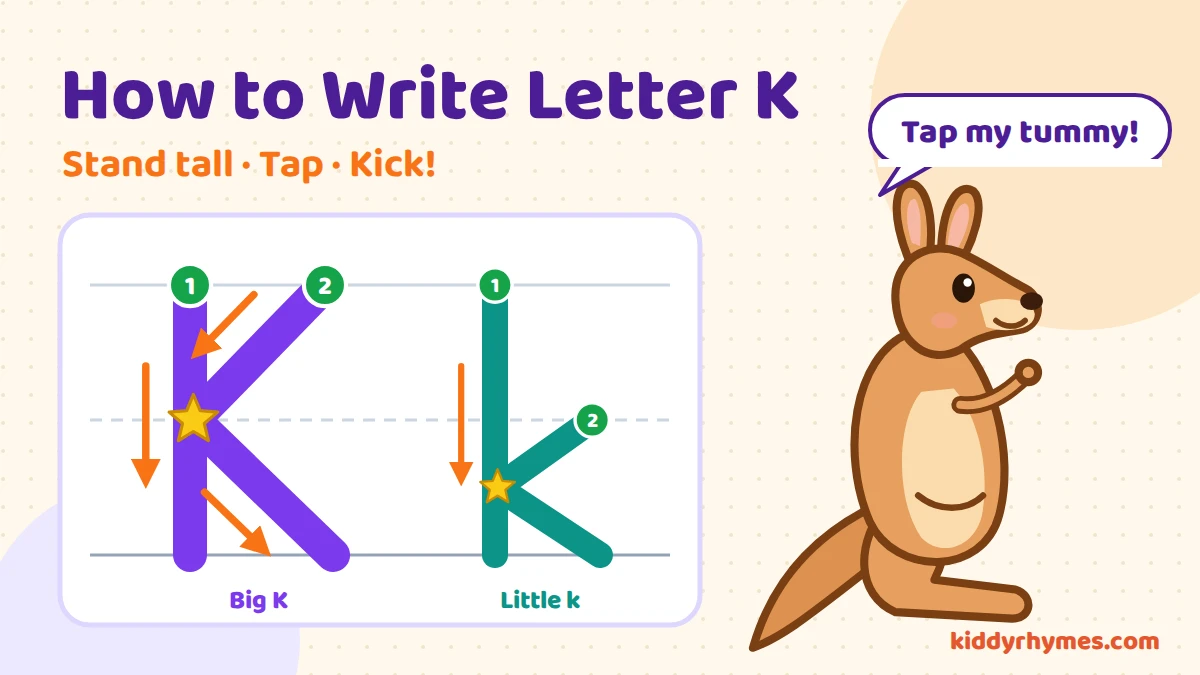
Big K is a tall line down, then a lift. Start at the top right corner, slide in to touch the middle of the tall line, and slide out to the bottom line. That is two strokes in Handwriting Without Tears. Little k works the same way, but its arm starts lower, on the middle line. K needs slanted lines, which most children can copy at around 4½ to 5, so K often takes longer than E, F or H. That is normal.
The Big K Rhyme (original)
Kip the Kangaroo stands up tall,
Hops to the corner by the wall,
Slides in to tap his tummy — tap!
Then kicks out wide. Now clap, clap, clap!
How to Write Uppercase K — Step by Step
Trace with Kip the Kangaroo
Loading the tracer…
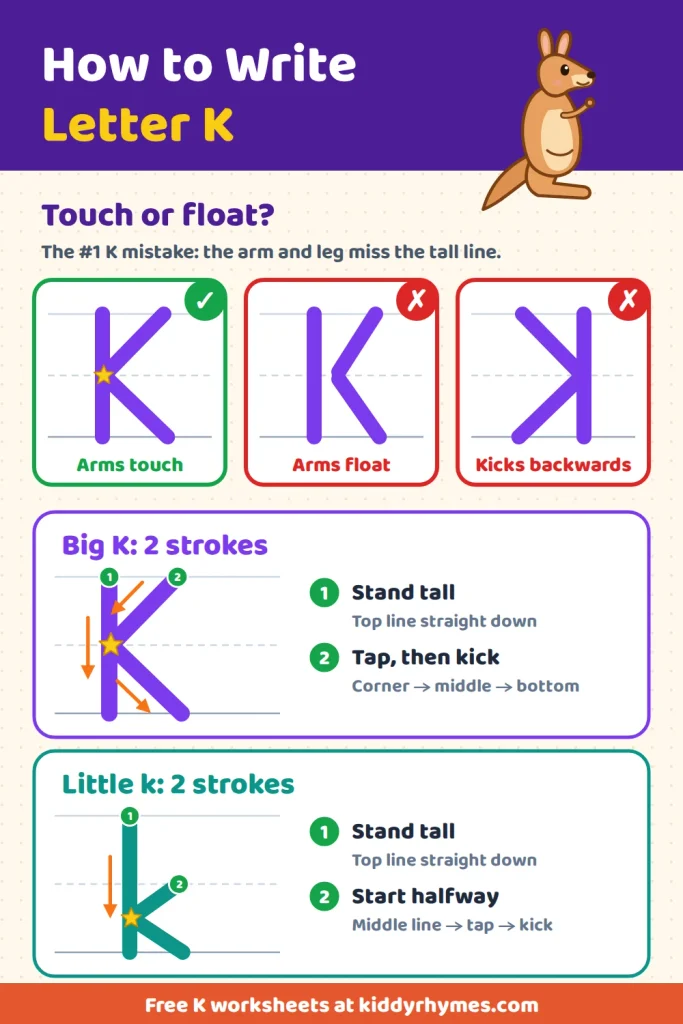
Meet Kip the Kangaroo. His body is the tall line. His arm and leg are the two slanted lines. The one rule that makes a K look like a K: the arm and the leg must touch Kip’s tummy, right in the middle of the tall line.
- Stand tall. Start on the top line and pull a straight line down to the bottom line.
- Hop to the corner. Lift the pencil. Put it on the top line, a little to the right of the tall line.
- Tap the tummy. Slide down and in until you touch the middle of the tall line.
- Kick out. Without lifting, slide down and out to the bottom line.
This is the Handwriting Without Tears order, and it is also the order most US print worksheets show. Some schools lift the pencil again at the tummy, so the arm and the leg become two separate lines. Both ways are correct. What matters is that every line starts at the top and both slants meet the tall line.
How to Write Lowercase k
The Little k Rhyme (original)
Little k stands tall, then starts halfway,
Tap the line and kick away!
Little k is Kip’s baby. It is still a tall letter, but the tap and the kick are smaller.
- Tall line down. Start on the top line and pull down to the bottom line, just like big K.
- Start halfway. Lift the pencil. Put it on the dashed middle line, leaving a small space from the tall line.
- Tap and kick. Slide in to touch the tall line, then slide out to the bottom line.
Some UK schools teach a little k with a small loop instead of a sharp point. Read Write Inc., for example, pictures a kangaroo too and describes tracing down its body before adding a tail and a leg. If your child comes home with a loop, that is their school’s style, not a mistake. Follow the school.
The Teacher’s Version
The classroom version — the flat words teachers say out loud while children write in the air:
At home, use the story. In class, use the stroke words. Children do best when they hear both, because the story helps them remember and the stroke words help them follow a teacher.
Why K Is Harder Than It Looks
K is made only of straight lines, so it looks easy. But two of those lines are slanted, and slanted lines come later than straight ones. Occupational therapists use a set order of shapes, based on the Beery test of visual-motor skills: straight lines and circles first, then a cross, a square, slanted lines, an X and a triangle. One pediatric therapy clinic puts slanted lines at around 4½ and X and triangles at around 5.
K asks for even more than a slant. Both slants have to land on one exact spot on the tall line. So if your 3-year-old draws a tall line and then two wobbly lines floating nearby, their hand is not being lazy. It is simply not ready for slants yet. Ages are ranges, not deadlines.
If K feels too hard right now: play slide games instead. Draw slides for a toy car, zigzag roads, and rain falling sideways in the wind. Big arm movements on a wall or a chalkboard help more than tiny lines on paper. For a 2 or 3 year old, singing is still the best letter practice, and gentle rhymes for 2 and 3 year olds build the listening skills that K will need later.
The Arms That Miss: Common K Mistakes
The number one K mistake: the arm and the leg don’t touch the tall line. They float next to it, like a K that has come apart. Fix it with one word: “Tap!” Say it out loud each time the pencil reaches the tall line. A small dot on the middle of the tall line gives your child a target.
The tracer above catches most of these. It will not accept a start at the bottom, a start at the tummy, arms on the left side, or a little k whose arm starts too high.
Cat or Kite? When C and K Make the Same Sound
Here is a question K brings up that no other letter so far has: why is cat spelled with C when it starts just like kite? Both C and K can say /k/. That is why your child might write “kat” for cat. It shows they heard the sound correctly.
Later, usually around first grade, many schools teach the cat-kite spelling pattern: at the start of a word, K usually comes before e and i (kite, kid, key), and C usually comes before a, o and u (cat, cot, cup). English has exceptions, so treat it as a helper, not a law.
For now: praise the listening, and gently show the real spelling. If your child already knows how the letter C gets its curl, you can put a C and a K side by side and say, “These two share a sound.”
One more K trap: silent K in knee, knife and knot. The K is written but not heard. Keep these words out of first K lessons so the letter and its sound stay matched.
K Songs to Sing While You Trace
Song 1: Stand Up Tall (tune: Row, Row, Row Your Boat)
Stand, stand, stand up tall,
Hop up to the top,
Slide in, tap, and kick out wide,
K is done, now stop!
Song 2: Kite and Key (tune: London Bridge Is Falling Down)
Kite and key and kitten too,
Kitten too, kitten too,
Kite and key and kitten too,
K says /k/ for you!
Both songs are original KiddyRhymes lyrics on traditional tunes. Sing the first one slowly while your child writes, one line for each move.
Fun Activities to Practice Letter K
- Three-stick K. Use two long craft sticks or straws and one short one. Lay the long one down as Kip’s body, then make the arm and leg touch its middle.
- Kangaroo kicks. Stand tall like the first line. Reach one arm up and out, then kick one foot forward while saying “tap, kick!”
- Tape K on the floor. Make a big K with painter’s tape. Your child walks the tall line from top to bottom, hops to the corner, then walks the arm and the leg.
- Kite K. Cut a paper diamond, write a big K in the middle, and add a string tail. Talk about how the kite and the K both have slanted lines.
- Salt tray tapping. Pour salt or sand into a tray. Draw the tall line, then practice only the tap and kick until the slants always touch.
Safety note: For children under 5, an adult handles the scissors, stays close during salt or sand play, and keeps straws and craft sticks out of mouths. Clear a safe space before kangaroo kicks.
Words That Start With K
We left out knee, knife and knot on purpose. Their K is silent, which confuses early learners.
Free Printable
Letter K Worksheet Pack
Five pages: big K with Kip, little k on the middle line, a “touch or float?” spot-the-mistake game, K picture words and a Hindi क page. Free for home and classroom use.
Letter K Printable Pack (US Letter)
Free Printable Worksheets • US Letter Format • Big K, Little k & Phonics
Moral of the Rhyme
Kip always stands tall first. Only then does he reach out and kick. Children are the same. When they feel steady, they are brave enough to try new things. So before a hard letter like K, give your child something they can already do well, then a big smile, and then the new challenge.
Questions Parents Ask
FREQUENTLY ASKED QUESTIONS
Why can’t my 3-year-old draw the slanted lines in K? ▼
Why don’t the arm and leg of my child’s K touch the tall line? ▼
Should K’s arm and leg be one stroke or two? ▼
My child writes K backwards. Should I worry? ▼
Why is cat spelled with C if it starts with the same sound as kite? ▼
My child’s school teaches little k with a loop. Which way is right? ▼
More letters in the series
- Capital A’s two slanted slides
- Letter B’s line-and-bumps steps
- Tapping out a drumstick D
- E’s elephant and its three lines
- Fenny’s frog jump for F
Written by Tanu Bhardwaj — an early-childhood teacher who runs a playschool in Mathura, India. She writes the KiddyRhymes letter series in the same words she uses with her own class.