
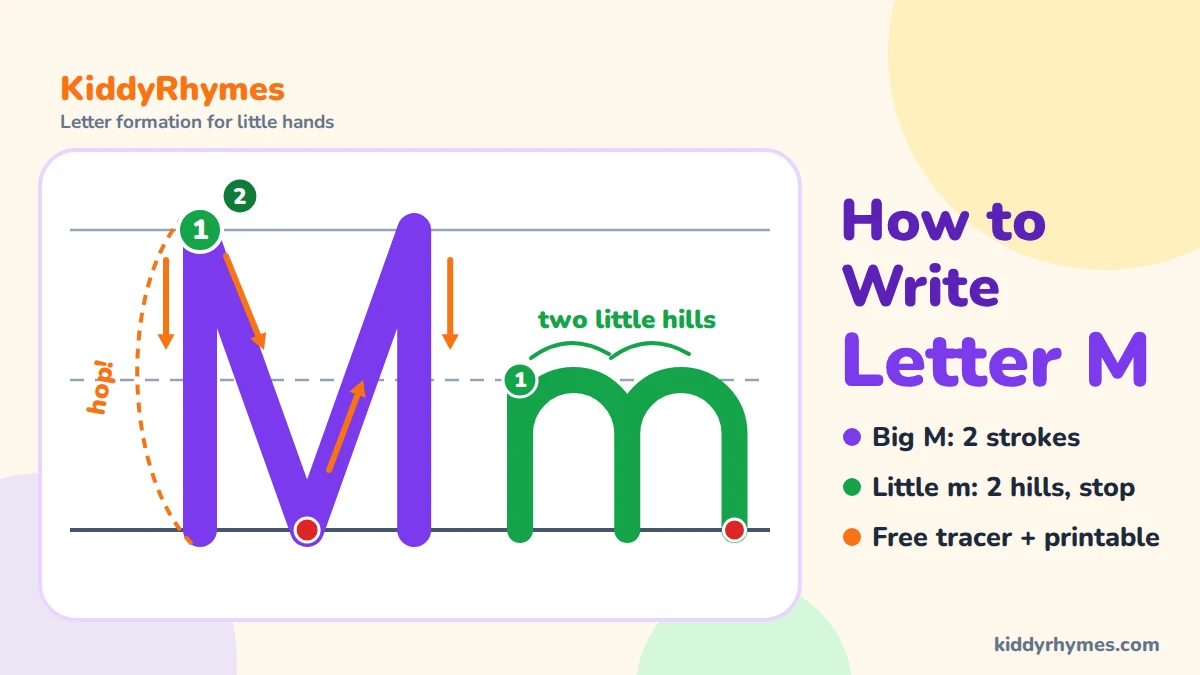
Big M takes 2 strokes in Handwriting Without Tears: a tall line down, then hop back to the top, slide down to the bottom line in the middle, climb up, and pull a second tall line down. Little m is 1 stroke that starts on the middle line: down, back up the same line, then over two small hills. Two hills is the rule. One hill is an n.
The Big M Rhyme (original)
Tall line down, then hop to the top,
Slide to the middle, touch bottom and stop!
Climb back up to the top once more,
Then one tall line straight down to the floor.
How to Write Uppercase M, Step by Step
Trace the Letter M with your finger
Big M: line down, hop to the top, slide down, climb up, line down.
Use paper with three lines: a top line, a dashed middle line and a bottom line. Big M is a tall letter, so it fills all the space from the top line to the bottom line.
- Tall line down. Start on the top line, on the left. Pull a straight line down to the bottom line.
- Hop back to the top. Lift the pencil and go back to where you started. Handwriting Without Tears calls this a “frog jump”, and M belongs to its frog-jump group with F, E, D, P, B, R and N.
- Slide down to the middle. Draw a slanted line down to the bottom line, right in the middle of the letter.
- Climb up. Without lifting, slant back up to the top line on the right.
- Tall line down. Still without lifting, pull a straight line down to the bottom line. Both sides of M are the same height.
Some worksheets draw big M as four separate lines, lifting the pencil each time. That still makes a correct M. What matters most is that every line starts at the top.
How to Write Lowercase m
The Little m Rhyme (original)
Start in the middle, go down and back up,
Over two hills — then stop. That’s enough!
- Start on the middle line. Little m is a short letter. It never touches the top line.
- Line down. Pull a short line down to the bottom line.
- Back up the same line. Go up over the line you just made, almost to the middle line.
- First hill. Curve over to the right like a little hill, and come down to the bottom line.
- Second hill. Go back up that line, make one more hill the same size, and stop on the bottom line.
Going back up the same line (step 3) is the tricky part. Many children want to lift the pencil there instead. That is fine too. Some guides teach little m with a lift before each hill. Just check that each hill starts on the line below it, not out in empty space.
The Teacher’s Version
What to say out loud while your child writes. Short words are easier to remember than long ones.
M & m Formation Verbal Chants
Big M Chant
Uppercase Formation- 1 Line down.
- 2 Back to the top.
- 3 Slant down, slant up.
- 4 Line down.
Little m Chant
Lowercase Formation- 1 Down.
- 2 Back up. Hill.
- 3 Back up. Hill.
- 4 Stop.
If your child’s school uses Read Write Inc. (UK): m is usually the very first sound children learn to write. RWI pictures little m as a girl standing next to two mountains: down the girl, then over each mountain. If your child comes home with that picture, use the school’s words at home. It helps to hear one story, not two.
The 3 Mistakes Children Make With M
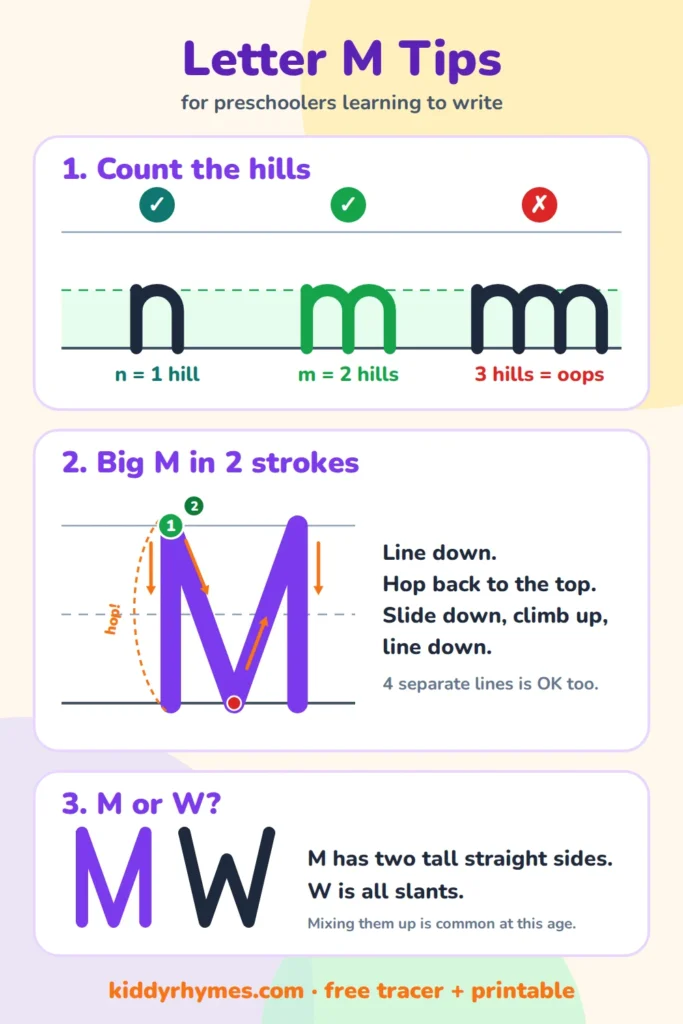
1. Three hills instead of two. Children love making bumps, so the m just keeps going. It can also happen when an older brother or sister writes in cursive, where some styles give lowercase m three humps.
Fix: count out loud as you trace: “One hill, two hills, stop!” Put a small dot on the paper where m ends so there’s a place to stop.2. One hill only, so it turns into n. The child stops after the first hill.
Fix: say “n has one hill, m has more.” Write n and m side by side and let your child count the hills.3. Writing big M upside down, or from the bottom. Turn M over and you get W. Many young children flip letters this way. Others draw big M as one zigzag starting from the bottom left. The shape looks right, but it builds a bottom-up habit. Fix: green dot on the top line, every time. “M has two tall straight sides. W has no straight sides at all, only slants.”
Letter Formation Quick Reference
| Letter | Where it Starts | Hills or Points | Quick Check Phrase |
|---|---|---|---|
| m | Middle line | 2 hills | “One, two, stop.” |
| n | Middle line | 1 hill | “n is m with one hill.” |
| h | Top line | 1 hill | “A tall line first, then one hill.” |
| M | Top line | V points down | “Two tall sides, V in the middle.” |
| W | Top line | 2 points down | “Slant down, up, down, up.” |
Mmm: The Lips-Together Sound
Say “mmm” and your lips press shut. Sounds made with both lips, like m, p and b, are among the first speech sounds babies make, which is why so many first words start with m. It is also why the word for mother starts with an m sound in so many languages that are not related at all: mama, maa, ammi, amma.
So your child has been saying M since they were a baby. Now they get to write it. Teach it as the sound “mmm” (lips shut, a little hum), not as the letter name “em”.
M Songs to Sing While You Trace
Song 1: Big M Song (tune: “Mary Had a Little Lamb”)
Original lyrics · traditional tune
Big line down and hop back up,
Hop back up, hop back up,
Slide down, climb up, then go down,
Now we have a big M!
Song 2: Two Little Hills (tune: “Frère Jacques”)
Original lyrics · traditional tune
Little letter, little letter,
Two small hills, two small hills,
Down, back up and over,
Up and over, stop now!
Mmm, mmm, mmm! Mmm, mmm, mmm!
The “stop now” line is on purpose. It is the three-hills fix, set to music. Songs work for letters for the same reason singing sticks in young minds: rhythm makes the steps easy to remember.
Fun Activities to Practice Letter M
- Hum and trace. Your child hums “mmm” while tracing little m and stops humming when the pencil stops. If the humming keeps going past two hills, so did the pencil. This links the sound and the shape.
- Blanket hills. Your child sits with knees up under a blanket: two hills. Drive a toy car down, back up and over each knee, then park it at the end. That is the whole little m motion, made big.
- Dough m. Roll one dough snake. Stand one end up, then bend it over into two hills. Feel how it is one long line, not three pieces.
- Mirror mouth. Sit in front of a mirror and say “mmm”, then “mama”, then “moon”. Watch the lips close each time. Then write an m on a sticky note and stick it on the mirror.
Safety: stay close during dough play with under-3s, and keep toy cars with small parts away from children who still put things in their mouths.
Words That Start With M
- moon and milk: say them slowly and feel the lips close first.
- mango, mat, mop and mug: short words to write once little m is easy.
- mitten and map: good picture words for a letter hunt.
- monkey and mouse: act them out, or sing the jumping-monkeys counting song and trace an M for every monkey.
Letter M Practice Pages
Five pages: big M with numbered start dots, little m with a green middle line, an m-or-n hill-counting page, M picture words to color and trace, and a Hindi म page.
Moral of the Rhyme
Little m climbs a hill, comes back down, then climbs one more. That is how every new skill feels for a small child: you try, you come down, you go again. Then you stop, proud of two good hills. There is no need to rush to a third.
Questions Parents Ask
LETTER M HANDWRITING & PHONICS FAQ
Is big M two strokes or four? ▼
Should the middle of M touch the bottom line? ▼
Should my child lift the pencil between the hills of little m? ▼
My child keeps writing w instead of m. Should I worry? ▼
Why does my child write m with so many humps? ▼
Why is M such an easy sound for little ones? ▼
More letters in the series
- The slanted sides of Letter A
- B, another tall-line-first letter
- Curve practice with Letter C
- D, a frog-jump letter like M
- E with its three straight arms
- F, where frog jumps begin