Capital W is four straight slanted lines — down, up, down, up — made in one continuous movement without lifting the pencil. Start at the top left, slant down to the baseline, slant back up to the top, slant down again, and slant up once more. Small w is the exact same shape at half the height, so your child learns two letters at once. Most children can trace W at 3 to 4 years and write it alone closer to 5, because slanted lines are the last writing stroke to develop.
The Letter W Rhyme · original
Down to the sea and up to the sky,
Down to the sea and up you fly.
Two little waves, side by side —
That’s a W, big and wide!
Say one line for each line your child draws. Four lines in the rhyme, four lines in the letter. That matching is the whole trick: the rhyme is not decoration, it is the stroke order said out loud.
How to Write Uppercase W — Step by Step
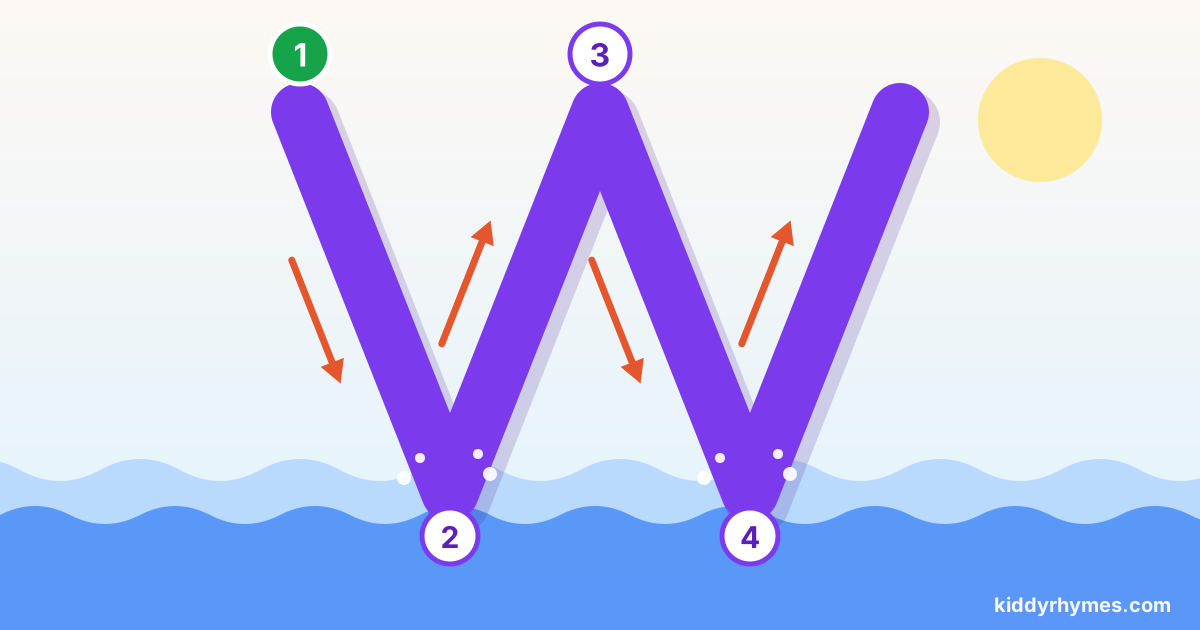
Trace the letter W
Start on each number and slide along the purple road to the orange arrow. Down, up, down, up — no lifting in between.
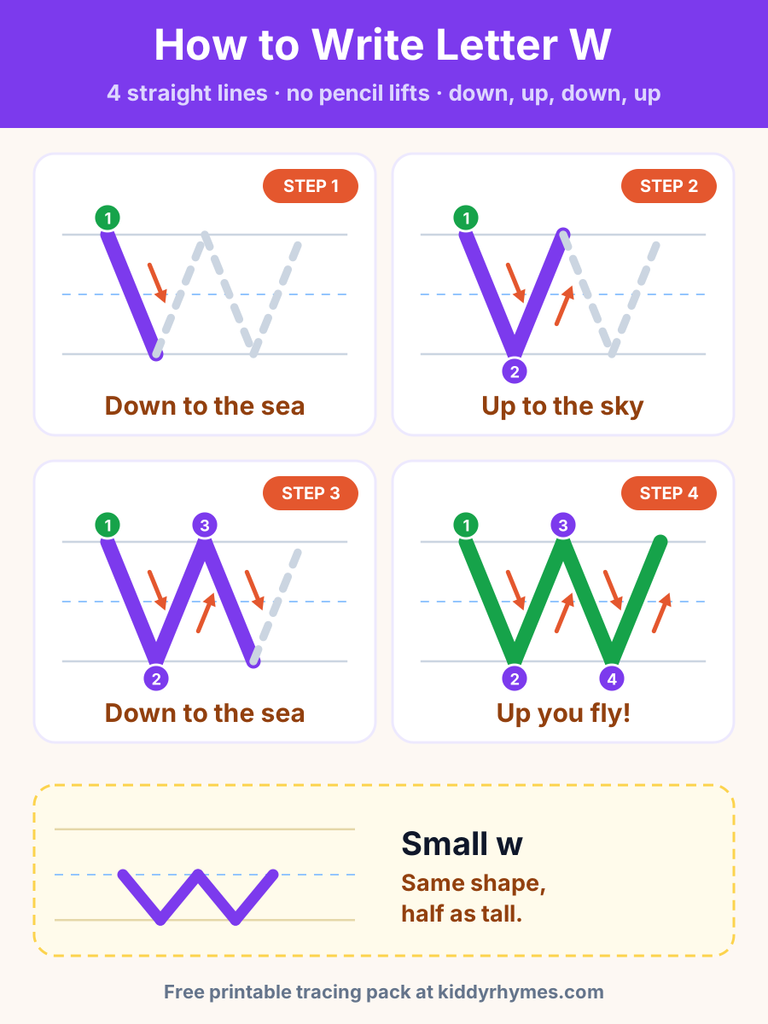
Put your pencil on the top line, at the left. Keep it on the paper the whole way through — W has no pencil lifts at all.
- Slant down to the sea. From the top line, draw a straight line that leans to the right as it falls, and stop exactly on the bottom line. This is the first wave going down.
- Slant up to the sky. Without lifting, carry the line straight back up to the top line, leaning right again. You have made your first V shape.
- Slant down to the sea. Repeat the first line. Same lean, same length, back down to the bottom line.
- Slant up to the sky. One last line up to the top. Four straight lines, all the same size, and the W is finished.
The two things worth checking are length and sharpness. All four lines should be roughly equal, and the two bottom points should be sharp corners, not little curves.
Good News: Lowercase w Is the Same Letter
Most letters make your child learn a whole second shape for the small version. Think of how little a, b and e look nothing like A, B and E. W is one of the few generous ones.
The small w rhyme · original
Small w waves the very same way,
Just half as tall — same lines, same play!
- Start at the dashed middle line instead of the top line.
- Down, up, down, up — exactly as before, between the middle line and the bottom line.
This is why the Handwriting Without Tears programme teaches lowercase c, o, s, v and w before all the other small letters: they are their capitals, shrunk. If your child can write capital W today, they can write small w today too. Teach them in the same sitting.
The Teacher’s Version
In a classroom nobody says “down to the sea.” Teachers use a flat, rhythmic cue that a whole group can chant while they write. Use the rhyme at home for memory, and the script below when your child already knows the shape and just needs the beat.
The classroom version — what teachers say out loud:
Slant down, slant up, slant down, slant up.
UK schools following Read Write Inc use a four-beat down-and-up chant for this letter, paired with a wriggly creature as the picture cue. The published Read Write Inc handwriting guidance describes W as four straight lines, all the same length, which is exactly the point we check above.
W is unusual in one happy way: the main handwriting schemes do not argue about it. Where they disagree constantly on letters like f and k, every scheme below starts W at the top left and runs it down, up, down, up.
| Handwriting scheme | How it groups W | Start point | Pencil lifts |
|---|---|---|---|
| Continuous-stroke manuscript (US classroom standard) | Slanted-line letter | Top line, left | None |
| Handwriting Without Tears | Starting Corner Capital, taught in the diagonal group | Top left corner | None |
| Read Write Inc (UK) | Four straight lines of equal length | Top line, left | None |
| Twinkl Handwriting Scheme (UK) | Zigzag letter family, with v, x and z | Top line, left | None |
Why W Is Harder Than It Looks
Parents often tell me their child draws a neat circle and a clean cross, then produces a W that looks like a crumpled ribbon. That is not carelessness. It is the order in which hands learn.
Occupational therapists track the shapes children can copy at each age, and slanted lines arrive near the very end of that list:
| Shape your child copies | Typical age |
|---|---|
| Vertical line | around 3 |
| Horizontal line | around 3 |
| Circle | around 3 |
| Cross (+) | around 4 |
| Square | around 4 |
| Slanted line (/ or \) | around 4½ |
| X | around 5 |
| Triangle | around 5 |
Now count the W: four slanted lines, joined at sharp corners. A three-year-old is being asked to do four times over the one thing their hand has not learned yet. Of course it wobbles.
These ages are ranges, not deadlines, and children arrive at them in their own time. Trace W with a finger, paint it, walk it on the floor — but do not expect a pencil-perfect W at 3. If you have a wider worry about your child’s hand strength or pencil control, a paediatrician or an occupational therapist is the right person to ask.
The Mistake Most Children Make: W Turns Into M
The big one: your child writes a perfectly good W upside down and it becomes an M. This is the classic W mix-up, and it is completely normal in the early years. Letter flips and reversals are widely expected to settle by around age seven.
Three things go wrong with W, and each has a one-line fix you can say while your child writes:
| What you see | What went wrong | What to say |
|---|---|---|
| Letter looks like uu | The bottom corners got rounded | “Sharp points at the bottom — stop, then turn.” |
| Three valleys instead of two | Lost count mid-letter | “Down, up, down, up — then stop.” Count on four fingers. |
| Lines of different sizes | No top or bottom guide line | “All four lines are brothers. Same size.” |
| It came out as an M | Letter flipped top to bottom | “W’s points poke the floor. M’s points poke the sky.” |
The mouth trick for W and M. This one is lovely because the child can feel it. Ask them to say mmm — their lips close, just like the closed humps at the top of an m. Now ask them to say wuh — their lips open, just like the open tops of a w. Closed mouth, closed letter. Open mouth, open letter. Children remember this far longer than any rule about direction.
Two W Songs to Sing While You Trace
Both sets of words below are ours, written for this post and set to public-domain tunes you already know.
1. The Wave Song
To the tune of “Row, Row, Row Your Boat”
Down, down, down the wave,
Up into the blue.
Down and up and down and up —
A W for you!
2. The Waves in the Sea
To the tune of “The Wheels on the Bus”
The waves in the sea go down and up,
down and up, down and up.
The waves in the sea go down and up —
and that’s how we write W!
Sing slowly. One “down” or “up” per line drawn, so the music and the pencil stay in step. If you want more of this, we have more hands-on rhyme activities across the site.
Five Ways to Practise Letter W at Home
Big movements first, pencil last. A child needs to feel a slanted line in the shoulder and elbow before the fingers can manage it on paper.
- The water wave tray. Pour a thin film of water onto a steel plate or tray. Your child draws W with one finger. It shines, then disappears — which makes doing it again feel like a game rather than a correction.
- Walk the W. Tape a giant W on the floor with masking tape and have your child walk the lines, heel to toe, saying “down, up, down, up.” This is the single most useful activity on this list for a child under four.
- Atta or rava tray. Spread a layer of flour or semolina in a flat tray and let them write W with a finger, then shake the tray flat and start again. The slight resistance helps the hand feel where the corners are.
- Four sticks, same size. Give your child four ice-cream sticks of equal length and ask them to build a W. Because the sticks cannot stretch, the letter teaches its own rule: all four lines are the same.
- Wet sponge and slate. Write a W on a small slate with chalk. Your child traces over it with a damp sponge finger, then with a dry cloth, then with chalk themselves. Three passes, same shape.
Safety note: ice-cream sticks, pins and any small loose pieces need adult supervision, and are not suitable for children under three who still mouth objects. Keep floor-walking games on a dry, non-slip surface.
Words That Start With W
Say the word, then stretch the first sound: wwww-ater. Stretching is what makes the letter sound stick.
| Word | Meaning in Hindi |
|---|---|
| water | पानी |
| wave | लहर |
| whale | व्हेल |
| watch | घड़ी |
| window | खिड़की |
| wheel | पहिया |
| wall | दीवार |
| wind | हवा |
| worm | कीड़ा |
| watermelon | तरबूज |
W in Hindi — and the व Trap
व
The Devanagari letter व carries both the English v and w sounds. It genuinely sits between them: the lips are less rounded than an English w, and the teeth touch the lip less than an English v.
Hindi words with व: वर्षा (rain) · वन (forest) · वायु (air) · व्हेल (whale)
The bilingual tracing tip. English has two separate sounds where Hindi has one, which is exactly why “very” and “wery” blur together for so many Indian speakers later in life. You can head this off at four years old, and it takes ten seconds.
While your child traces the English W, have them round their lips as if blowing out a birthday candle and say wuh. While they trace व, let the lips relax. Same hand, two different mouths. Doing this during tracing — when the sound and the shape are being stored together — is far more effective than correcting pronunciation in Class 3.
Letter W Tracing Pack
Eight pages: guided four-stroke W and w with numbered arrows, a capital-and-small matching sheet, a W-or-M sorting page, the wave rhyme poster, and blank practice lines with a dashed middle guide.
Letter W Tracing Pack
Printable handwriting practice worksheets for kids
Moral of the Letter W Rhyme
A wave never reaches the shore in one push. It goes down, comes up, goes down and comes up again — and only then does it arrive.
W is the same. Four small lines, none of them impressive on its own, and together they make one wide, confident letter. When a child’s W comes out crooked, they have not failed at a letter. They have finished three good lines and run out of hand. Point at the three that worked.
Questions Parents Ask
Letter W Handwriting FAQ
Why does my child write W as an M?
Because W and M are the same shape turned upside down, and young children read shapes by what they are rather than which way up they are. This settles on its own for most children by around age seven. Two cues help in the meantime: “W’s points poke the floor, M’s points poke the sky,” and the mouth trick — lips close for mmm, lips open for wuh.
My three-year-old cannot write W at all. Should I be worried?
Almost certainly not. W is made of four slanted lines, and slanted lines are typically the last basic stroke a child masters, at around four and a half years. A child who copies a neat circle at three and still cannot manage a W is behaving exactly as expected. Keep it to finger tracing, floor walking and painting at this age, and save the pencil for later. If you have a broader concern about hand strength or pencil control, ask your paediatrician or an occupational therapist.
Is W one stroke or four strokes?
Both answers are right, which is why the question confuses people. W is four counted lines made in one continuous movement — the pencil never leaves the paper. Count four when you teach it, so your child knows when to stop, but do not let them lift the pencil between the lines. Every major handwriting scheme teaches it this way.
Should I teach capital W or small w first?
Teach them together, which is unusual advice and specific to this letter. Capital W and small w are the identical shape at two different heights, so the second one costs your child almost nothing once they have the first. Handwriting Without Tears deliberately teaches lowercase c, o, s, v and w before the other small letters for exactly this reason.
Is it okay if my child starts the W from the bottom?
At three, yes — let it go. The shape matters more than the route at that age, and over-correcting makes children avoid writing. From about five it is worth fixing, because starting at the top keeps handwriting faster and makes joined writing possible later. The gentlest fix is to put a small green dot at the top-left starting point and say “begin on the dot.”
Why is W called “double u” when it looks like two v’s?
Because it used to be two u’s. Early scribes writing Germanic languages had no single letter for the w sound, so they wrote two u’s side by side, and in that period u and v were drawn the same way. The pair eventually fused into one letter, the shape settled into the pointed version we use now, and the old name stuck. It is also the only letter in English whose name has more than one syllable — a nice piece of trivia to hand a curious five-year-old.
Keep Going
Letter formation sticks fastest when the shape, the sound and a rhyme all arrive together — the same reason rhyme makes new words stick for toddlers long before they can read.
More letters in the series
- The mountain-and-bridge rhyme for A
- How D gets its drum and drumstick
- The staircase steps that build an E
- Fenny the Frog’s three-line F