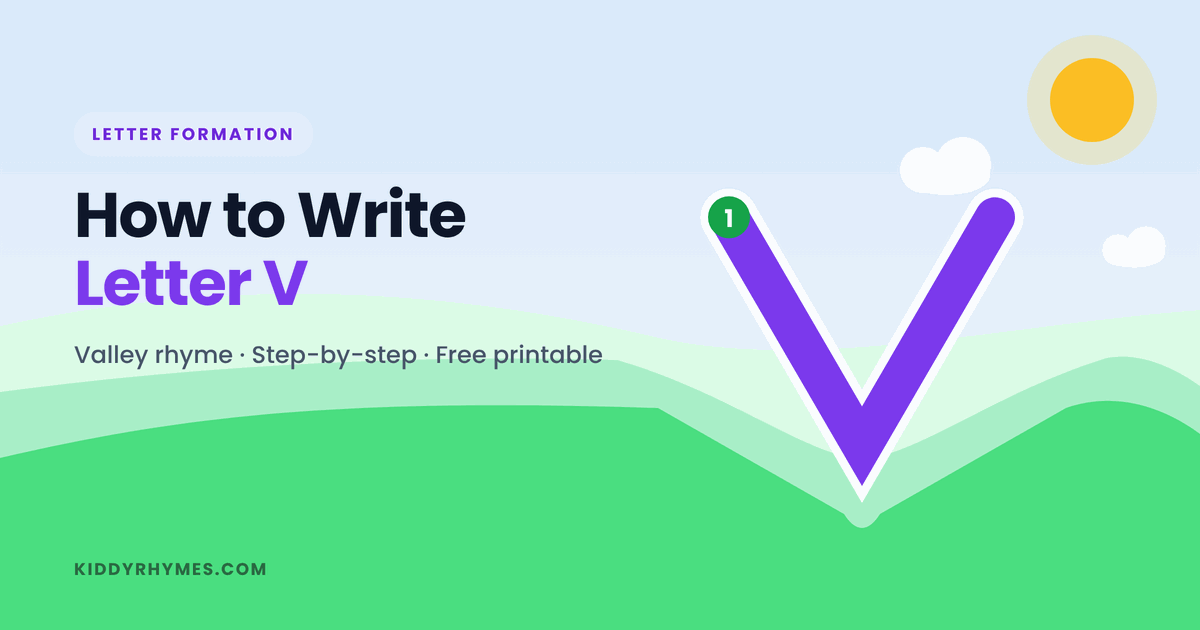
Capital V takes two strokes, both slanting, with no pencil lift needed. Start at the top-left, slant down to a sharp point on the bottom line, then slant back up to the top-right. Lowercase v is exactly the same shape, just half the height, starting at the middle dotted line. Most children can copy the slanted lines V needs at around four and a half years — it is one of the later letters, and that is completely normal.
V looks like the easiest letter in the alphabet. Two lines. No curves, no circles, no crossing over. So parents are often surprised when a child who writes a neat L and a tidy O turns a V into a wobbly U, or draws it upside down like a little mountain.
There is a good reason for that, and once you know it the whole letter becomes easier to teach. Let’s start with the rhyme.
The Letter V Valley Rhyme
Slide down the hill to the valley below,
Sharp little point — not a curve, oh no!
Climb back up, nice and straight and tall,
Two slanted lines, and that’s V, that’s all!
An original KiddyRhymes rhyme, written to match the strokes exactly. Say it slowly while your child’s pencil is actually moving — the words and the hand should travel together.
How to Write Uppercase V — Step by Step
Trace the Letter V
Stroke 1 of 2 — slant down to the valley point.
Interactive tracing needs JavaScript. The picture above still shows both strokes and where to start.
Letter Tracing Game
Fun online handwriting practice for kids
This is the order used in Handwriting Without Tears, where V sits in the “starting corner” group of capitals — letters that all begin at the top-left and travel left to right, the same direction we read.
- Start at the top-left. Put the pencil on the top line, a little left of centre. Not in the middle — that is where upside-down Vs come from.
- Slant down to the point. Travel down and to the right in one straight line until you touch the bottom line. Stop dead. This is the moment that matters.
- Slant back up. From that same point, travel up and to the right until you reach the top line again. Two slanted lines, one sharp corner, done.
You do not need to lift the pencil between step 2 and step 3. V is one of the few capitals that can be written in a single continuous movement — the pencil simply changes direction. Some schemes count it as two strokes, some teach it as one motion. Both are correct, and neither will hurt your child's handwriting.
The classroom version — what teachers actually say out loud:
Slant down. Point. Slant up.
In UK classrooms using Read Write Inc, the phrase for v is built around a vulture: one wing travelling down, the other travelling up. Different picture, identical movement. If your child's school uses the vulture wording, the rhyme above will sit happily alongside it.
How to Write Lowercase v
Good news: lowercase v is the same letter, smaller. No new movement to learn, only a new starting height. It belongs to the small group of letters — c, o, s, v, w, x, z — that keep their capital's shape and just shrink.
The Little v Rhyme
Little v is big V's twin,
Start at the dotted line and slide right in.
Down to a point, then up you go —
Same two lines, just small and low.
- Start on the middle dotted line, slightly left of centre. Not the top line — that is the only difference from capital V.
- Slant down to the bottom line and stop at the point.
- Slant back up to the dotted line. The v should sit in the lower half of the writing space, the same height as a, c and e.
Why V Is Harder Than It Looks
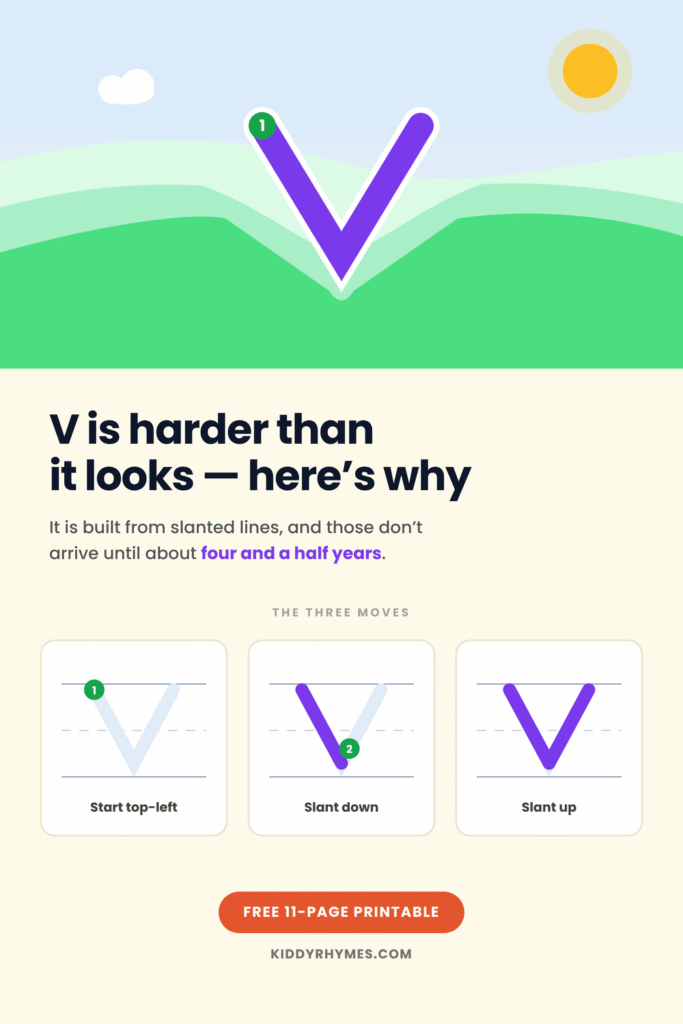
Before a child can write a letter, their hand has to be able to make the shape the letter is built from. Occupational therapists track these pre-writing shapes in a fairly predictable order, and slanted lines arrive near the end of it.
| Shape | Typical age a child can copy it | Letters it unlocks |
|---|---|---|
| Vertical line | 2–3 years | I, L, T, E, F |
| Horizontal line | 2½–3 years | T, E, F, H |
| Circle | 3 years | O, C, G, Q |
| Cross (+) | 3½–4 years | T, E, F |
| Square | 4 years | — |
| Slanted (diagonal) line | about 4½ years | V, A, K, M, N, W, X, Y, Z |
| X shape and triangle | 5 years | X, A, W |
So a three-year-old who writes a confident L and a lovely round O and then makes a mess of V is not behind. Their hand has simply not reached the slanted-line stage yet. These are ranges that describe most children, not deadlines any child has to meet. If a slanted line is still genuinely out of reach well past five, a paediatrician or an occupational therapist is the right person to ask — not a worksheet.
The practical takeaway: practise slanted lines on their own before you practise V. Ten seconds of drawing tick marks and forward slashes does more for this letter than ten minutes of tracing it.
The Mistake Most Children Make With V
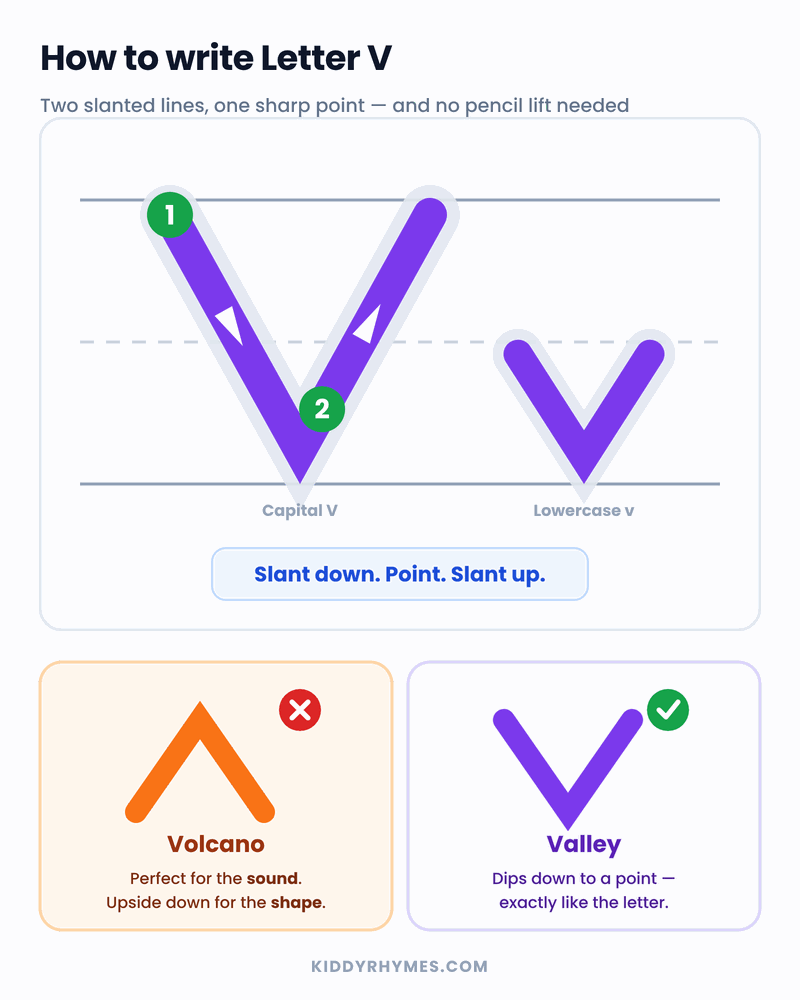
Mistake 1 — the bottom turns into a U. A curve is an easier movement for a small hand than a sharp change of direction, so the pencil takes the smooth route. The fix is a full stop, not more tracing: say “down — STOP — up” and have your child lift their eyes to the point before starting the second line. Putting a real dot on the bottom line to aim at works even better.
Mistake 2 — the V comes out upside down. This one is usually our fault, not the child's. The most popular letter-V picture in the world is a volcano — and a volcano is shaped like ∧, not V. Same for a mountain, a tent and a slice of pizza. We hand children an upside-down image and then wonder why the letter flips. Keep volcano and violin for the sound of V, and use a valley for the shape. A valley dips down to a point in the middle, exactly like the letter.
If you have already read the mountain trick we used for Letter A, this will click instantly: A is a mountain with a bridge across it. Take the bridge off and turn it over, and you have V. Show your child that flip once and the orientation usually sticks.
And if V still comes out backwards or flipped now and then, that is ordinary. Reversals are common in young writers and most children grow out of them as reading and writing get stronger — the usual guidance for parents on reversed letters is to gently show the right way rather than drill it.
V or W? Telling the Confusion Pair Apart
V has two neighbours it gets muddled with, and they cause different problems. U is a shape problem. W is a counting problem — W is simply V written twice.
| Letter | Bottom | Slanted lines | Say this while writing | The sound |
|---|---|---|---|---|
| U | Rounded | 0 | “down, round, up” | open mouth, no teeth |
| V | One sharp point | 2 | “down, up” | top teeth touch bottom lip |
| W | Two sharp points | 4 | “down, up, down, up” | lips round, no teeth |
Teach V before W, always. Once a child owns V, W costs nothing — it is the same movement repeated. Doing it in the other order means learning four slanted lines before you have mastered two.
Three V Songs to Sing While You Trace
All three are original KiddyRhymes lyrics set to well-known public-domain tunes, so you already know the melodies.
1. Slant and Climb (tune: Twinkle Twinkle Little Star)
Slant on down and slant back up,
V is shaped just like a cup.
Two straight lines that meet below,
Sharp and pointy — watch them go!
Slant on down and slant back up,
That is V — now hold it up!
2. Where's the Valley? (tune: Are You Sleeping / Frère Jacques)
Where's the valley? Where's the valley?
Here it is! Here it is!
Slanting down and up again, slanting down and up again,
That's a V! That's a V!
3. V Goes Down (tune: London Bridge)
V goes down and V goes up, V goes up, V goes up,
V goes down and V goes up — pointy at the bottom!
Fun Ways to Practise Letter V at Home
- Walk the valley. Draw a giant V on the floor with chalk or masking tape and let your child walk it, heel to toe, saying “down — point — up”. Big body movement first, pencil later. This is the single most useful thing on this list for a three-year-old.
- Two-stick V. Join two ice-cream sticks, two spoons or two dry spaghetti strands at the bottom to make the point. Then slide the tops apart and together — wide V, narrow V, still a V.
- The paper flip. Fold a sheet of paper in half, open it slightly and stand it up: that is a volcano. Now lay it flat with the fold at the bottom: that is a V. Flipping it yourself is what fixes the upside-down habit.
- Rice or rangoli V. Draw a big V with glue or chalk on card and let your child pour rice, suji or rangoli powder along the two lines. The pouring hand travels the same path the pencil will.
- Slanted-line warm-up. Before any V practice, fill one line of a page with forward slashes and one line with backward slashes. Thirty seconds. This is the stroke V is made of, and it is the stroke most children are still building.
Safety first: rice, suji, ice-cream sticks and dry spaghetti are small or breakable items. Stay within arm's reach of children under three, and keep loose grains off the floor where a crawling sibling can reach them.
Words That Start With V
V is one of the rarer letters at the start of English words, so the list is shorter than most — that is normal, not a gap in your teaching. Ten that preschoolers actually meet:
- van — the easiest one to draw
- vase — and a vase is roughly V-shaped too
- vet — the animal doctor
- vest
- vine
- violin
- volcano — great for the sound, upside down for the shape
- vegetables
- village
- valley — our shape word
A quick sound check while you go: V is voiced, so the throat buzzes. Put your child's fingers on their own throat and say “vvvv” then “ffff”. V hums, F does not. That one trick separates the two letters faster than any worksheet.
Letter V in Hindi
The nearest Hindi letter to English V is:
व
व (va) begins words like वन (van — forest), वर्षा (varsha — rain) and वीणा (veena — a stringed instrument). Lovely coincidence for bilingual homes: वन sounds almost exactly like the English word van.
Bilingual tracing tip: do not expect the shapes to help each other. English V is two straight slanted lines; Hindi व is built on a curve. Teach the two shapes separately. The sound, though, is where bilingual children need real help — Hindi has one sound, व, where English has two, V and W. Linguists describe it as sitting between the English v and w, which is exactly why “van” and “wan” blur together for so many Indian children and adults. The fix is physical, not phonetic: for V, the top teeth must touch the bottom lip. For W, the lips round and the teeth stay out of it. Let your child watch your mouth, then their own in a mirror.
Letter V Tracing Pack
Eleven pages: uppercase and lowercase formation with numbered arrows, a slanted-line warm-up sheet, V-vs-U and V-vs-W sorting pages, a cut-and-build V, Devanagari व practice, and a certificate. No sign-up.
Letter V Tracing Pack
Printable handwriting practice worksheets for kids
Moral of the Rhyme Letter V
Every valley has another side. V goes all the way down to its lowest point before it climbs back up — and it needs that low point to be a V at all. When a child's line wobbles, or the letter comes out backwards for the tenth time, that is the down-slope. Nobody skips it. The climb is what comes next.
Questions Parents Ask
Letter V Handwriting FAQ
Why does my child’s V look like a U?
Because a curve is an easier movement than a sharp change of direction. The hand takes the smooth path unless it is told to stop. Put a visible dot on the bottom line for your child to aim at, and say “down — STOP — up” with a real pause in the middle. The pause is the whole fix; more tracing without it just practises the curve.
Why does my child write V upside down?
Almost always because of the picture we gave them. Volcano, mountain, tent and pizza slice are the four most common letter-V images and all four point upwards, which is the opposite of the letter. Use a valley for the shape — a dip that goes down to a point — and keep volcano for the sound. Show the flip physically with a folded sheet of paper and most children correct it within a few tries.
How many strokes is a V, and should the pencil lift?
Two strokes, and no, the pencil does not have to lift. Handwriting Without Tears counts V as two lines, both starting from the top-left corner group. Read Write Inc treats it as one continuous wing-down, wing-up movement. Both produce the same letter and neither is wrong. What matters is the starting point (top-left) and the direction of travel (left to right).
Should I teach V or W first?
V first, every time. W is V written twice — four slanted lines instead of two, two bottom points instead of one. A child who can make one clean V gets W almost for free. Teaching W first means learning the harder version of a movement you have not mastered yet.
My child says “wan” instead of “van”. Is that a handwriting problem?
No — it is a sound problem, and a very common one in India. Hindi and most Indian languages use a single sound, व, where English uses two separate ones, V and W. It sits between the English v and w, so the ear does not automatically split them. Keep it separate from letter formation: practise the shape with the pencil, and practise the sound with a mirror, top teeth touching the bottom lip for V. Both improve faster when you do not mix them.
At what age should my child be able to write V?
Most children can copy the slanted lines V needs at around four and a half, with X and triangle shapes following near five. Many manage a recognisable V earlier with a model in front of them. These are ranges describing most children, not targets any individual child has to hit. If slanted lines are still genuinely out of reach well past five, or writing is painful or exhausting, a paediatrician or occupational therapist can assess properly.
Are backwards letters a sign of dyslexia?
Usually not. Reversals are typical in young writers and most children who reverse letters before about seven do not turn out to have dyslexia. Young children see letters as shapes without meaning attached, so direction takes a while to matter to them. Show the correct direction calmly, keep it light, and raise it with your child’s teacher if reversals are still frequent by the end of Year 2 or second grade.
More letters in the series
- Why B needs two bellies, not one
- The kitten curl that makes a C
- D, the drum and its drumstick
- Elphie's three-step staircase for E
- Fenny the Frog and the two little arms of F
Looking for something beyond letters? Browse all our rhyme-based learning activities.