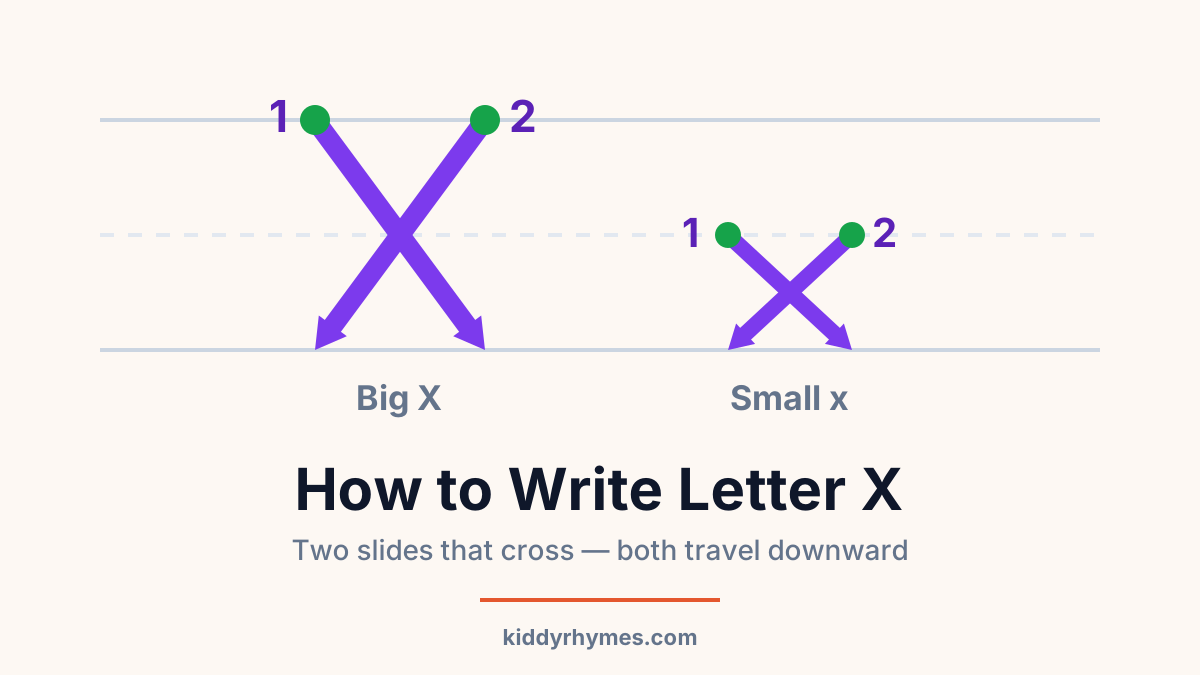
Capital X takes two strokes. Start at the top line just left of the middle and slide down to the right, all the way to the bottom line. Lift your pencil. Go back to the top line, just right of the middle, and slide down to the left. The two slides cross in the middle. Small x is exactly the same shape — it just starts at the middle line instead of the top, so it is half the height. Most children can copy a proper X somewhere between 4½ and 5 years, and that is the normal, expected age.
The Letter X Rhyme
Slide down right, from top to floor,
Lift your pencil — back for more.
Slide down left and cross the line —
Criss-cross X is looking fine!
How to Write Uppercase X — Step by Step
Watch the letter X being written
Big X starts on the top line. Slide down to the right, lift your pencil, then slide down to the left. Small x is the same shape, half the height. Both slides start on the middle line.
- Put your pencil on the green dot.
- Slide down and to the right, all the way to the bottom line.
- Lift your pencil and go back up to the second green dot.
- Slide down and to the left. The two slides kiss in the middle.
Tap Small x to see the lowercase version. Both slides always travel downward.
Now you try — trace it with your finger
Stroke 1 of 2.
X is a two-piece letter. Both pieces are straight, both travel downward, and they meet in the middle. There are no curves to get wrong — which is why X looks easy on paper and feels hard in the hand.
- Start at the top line, a little left of centre. Slide straight down and to the right, in one smooth movement, until your pencil touches the bottom line. Say it out loud with your child: slide down right.
- Lift your pencil off the paper. This is the only lift in the whole letter. Capital X cannot be written without it — and that is normal, not a mistake.
- Go back up to the top line, a little right of centre. Now slide straight down and to the left, until you touch the bottom line again. Say: slide down left.
- Check the kiss in the middle. The two slides should cross halfway down. If they cross near the top, the X looks like a Y. If they cross near the bottom, it looks like a bird's feet.
The direction matters more than most parents expect. Both strokes travel top to bottom. A child who draws X from the bottom upward will usually still produce a letter that looks correct — but the habit slows them down badly once they start joining letters in school.
How to Write Lowercase x
Here is the good news, and it is the only letter in the alphabet where we get to say it this plainly: small x is the same shape as big X. Nothing new to learn. It simply lives in the middle lane of the writing line instead of the tall lane.
The Small x Rhyme
Start at the middle, slide down right,
Back to the middle, slide down left.
Same criss-cross, just half the height!
- Start on the middle line, slightly left. Slide down to the right until you reach the bottom line.
- Lift. Start on the middle line again, slightly right. Slide down to the left until you reach the bottom line.
- Check the height. Small x must stay inside the middle lane — nothing pokes above the middle line, nothing drops below the bottom line. It is a short, wide letter, not a tall one.
| Feature | Capital X | Small x |
|---|---|---|
| Strokes | 2 | 2 |
| Pencil lifts | 1 | 1 |
| Starts at | Top line | Middle line |
| Ends at | Bottom line | Bottom line |
| Shape | Identical — only the size changes | |
Why X Is Harder Than It Looks
Parents often arrive at X genuinely confused. Their child writes O, T, L and H neatly, then produces something unrecognisable for a letter made of two straight lines. Nothing has gone wrong. X is one of the last shapes a young hand learns to make, and that is measurable.
Occupational therapists track pre-writing shapes in a fixed developmental order, drawn from assessments like the Beery-Buktenica Developmental Test of Visual-Motor Integration and the Peabody Developmental Motor Scales.
The order looks like this:
| Shape | Typical age a child can copy it |
|---|---|
| Vertical line | | around 3 |
| Horizontal line — | around 3 |
| Circle O | around 3 |
| Cross + | 3½ – 4 |
| Square | around 4 |
| Single diagonal line / | around 4½ |
| Diagonal cross X | 4½ – 5 |
| Triangle | around 5 |
Only the triangle comes after X. Some therapy guidance places a confidently copied X closer to 5½ or 6. These are ranges across many children, not deadlines for yours.
The reason is the diagonal. A vertical line only needs the hand to travel up and down. A diagonal needs the shoulder, elbow and wrist to cooperate while the hand crosses the middle of the body — and crossing the midline is a skill that develops on its own schedule, separate from pencil control. That is why big-arm practice helps X far more than extra worksheets do.
If you would like the wider picture of how rhythm and repetition support this stage, we wrote about why rhymes stick so well in little heads.
The Teacher's Version
In a classroom nobody talks about slides and criss-crosses. Teachers use flat, repeatable stroke language so thirty children hear exactly the same instruction every time.
The classroom version — what teachers say out loud:
Slide down. Lift. Slide down. Cross.
Different handwriting schemes dress it differently, and it is worth knowing which one your child's school uses before you correct anything at home:
- Read Write Inc (UK phonics). RWI attaches x to an exercise figure — the child forms one arm-and-leg diagonal, then mirrors it on the other side. If your child comes home talking about arms and legs for this letter, this is why.
- Nelson-style letter families (UK). x sits in the zig-zag family alongside v, w and z — all the letters built from slanted lines rather than curves or ladders.
- Handwriting Without Tears / Learning Without Tears (US). Capitals are taught before lowercase, and the diagonal-line capitals are deliberately saved for last because they are the hardest group. Its formation language is "big line slide down".
- Zaner-Bloser style print, used in most US worksheets and the order we have shown above: top-left to bottom-right, lift, top-right to bottom-left.
None of these is the one correct order. They agree on what matters: two straight diagonals, both travelling downward, crossing in the middle. For a reference you can show a teacher, the UK's Oak National Academy sets out the same point for capitals X, Y and Z — they all begin at the top line, and X needs a pencil lift to add the second line (Oak National Academy, KS1 capital letters).
The Mistake Most Children Make
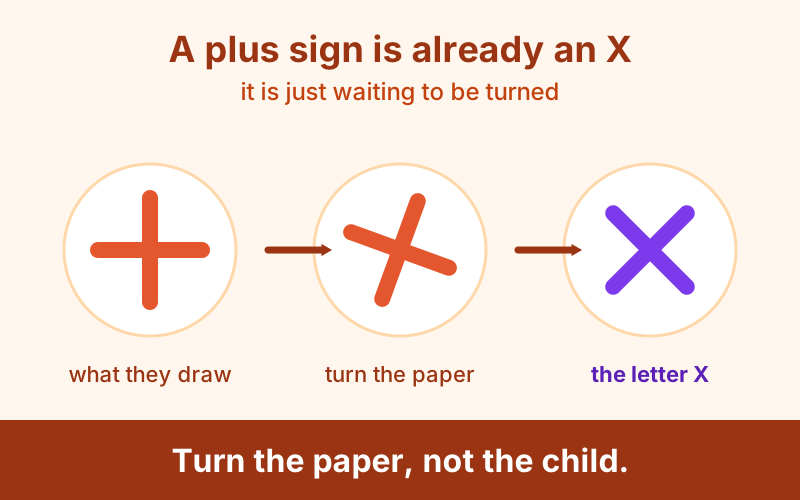
Your child draws a plus sign instead of an X. This is by far the most common letter-X error, and it is not carelessness. Look at the table above: a child masters the upright cross + around age 4, a full year before the diagonal cross X. When you ask for a shape the hand cannot make yet, the hand offers the closest shape it can make. A plus sign is a sensible answer to a hard question.
What to do: don't correct the letter — rotate it. Draw a big + on paper together, then turn the paper itself 45 degrees so the plus becomes an X in front of their eyes. Children find this genuinely delightful, and it moves the problem from "you did it wrong" to "look what happens".
Three other things worth watching for:
- Four lines instead of two. Some children draw X as four short strokes radiating out from the centre point. It looks right and reads right, but it is slow and it will not survive joined-up writing. Use a start dot at the top of each slide.
- Drawing upward from the bottom. Very common, very hard to unlearn later. Don't scold it — just put two small dots on the top line and say "pencil starts on a dot".
- Crossing in the wrong place. If the lines meet near the top you get a Y. If they meet near the bottom, the letter falls over. "Kiss in the middle" is the cue that works.
X also gets mixed up with K and Y, because all three contain diagonals that meet. The simple distinction for a preschooler: X has nothing standing up straight. K has a tall post. Y has a tail that goes down.
Two X Songs to Sing While You Trace
Both of these are original KiddyRhymes songs, set to tunes that are free for everyone to use.
Criss-Cross X (tune: Twinkle, Twinkle, Little Star)
Slide down right and slide down left,
Criss-cross, criss-cross, that's the best.
Make them kiss right in the middle,
X is such a clever riddle.
Big X, small x, just the same —
Two short slides, that's all it takes.
X Marks the Spot (tune: Skip to My Lou)
X marks the spot, come and see,
X marks the spot, one, two, three.
Arms out wide and legs out too —
You are an X, and so am I!
The second one is meant to be done standing up, with the whole body. That is not a gimmick: arms out, legs apart is a diagonal-cross shape, and making it with the body is exactly the midline practice the pencil work depends on.
Fun Activities to Practice Letter X
X needs big movement before it needs small movement. Every one of these uses things you already have at home.
- Be the X. Stand with arms stretched out and feet apart. Hold it, wobble, laugh, hold it again. Then jump feet together and arms down, and jump back out to X. Ten of these before you pick up a pencil will do more than ten worksheets.
- Tape X on the floor. Two long strips of masking tape crossed on the floor. Walk the first slide heel to toe, lift your foot at the middle, walk the second slide. Drive a toy car down each line. Children feel the stroke order through their whole body.
- X marks the spot. Hide a small toy somewhere in the room and mark the spot with a paper X. Then swap roles and let them hide and mark. This is where X earns its meaning — it is the only letter that is also a symbol children already understand.
- Two sticks, one X. Cross two lolly sticks, two straws or two pencils and tape them at the middle. Let them build it themselves. Ask: which stick did you put down first?
- Chalk X outside. Draw an X as big as the child on a wall or a path, and let them trace over it with their whole arm, top to bottom, again and again.
Safety note: lolly sticks, straws and small toys are choking hazards for children under three — stay with your child for the building and hiding games, and put the small pieces away afterwards. For the standing X and the jumps, clear a little floor space first.Words With X — And Why Almost None of Them Start With X
Here is the honest thing most letter-X pages avoid saying. The letter X makes a /ks/ sound, and in English that sound lives at the end of words, not the beginning. Of the two words every classroom reaches for, xylophone actually begins with a /z/ sound, and x-ray begins with the letter's name rather than its sound.
So teach X backwards. Start with words where the sound is loud and clear at the end, and your child will hear it immediately:
| Word | Where the X sits | What to say |
|---|---|---|
| fox | end | Clearest /ks/ of all. Start here. |
| box | end | Hold up a real box and say it slowly: b-o-ks. |
| six | end | Count to six on fingers, land hard on the x. |
| ox | end | Two letters, one of them is X. Easy win. |
| mix | end | Mix something in a bowl while you say it. |
| fix | end | Pairs naturally with mix. |
| taxi | middle | A familiar Indian word, and the x is loud. |
| exit | middle | Point it out on a sign next time you are out. |
| next | end | Used in everyday talk all day long. |
| x-ray | start | A name word, not a sound word. Fine to teach — just tell them it's a special one. |
| xylophone | start | Starts with a /z/ sound. Lovely to play, unhelpful for phonics. Say so. |
Telling a four-year-old "this one is a special case" is not too complicated for them. It is far less confusing than letting them believe X says "zuh".
X in Hindi
एक्स · बक्सा · टैक्सी
Devanagari has no single letter for X. The /ks/ sound is written as the joined letter क्ष (ksha), and the English letter itself is simply spelled out as एक्स (eks).
Bilingual tracing tip: the sound bridge is easier than the letter. Say बक्सा (bak-sa, box) and टैक्सी (taik-see, taxi) with your child, stretching the middle: बक…सा. That is the same /ks/ they need for box and taxi in English. Trace one X while saying the Hindi word, one while saying the English word. Two languages, one stroke.
Letter X Tracing Pack
Six pages: big X and small x tracing with start dots and direction arrows, the plus-to-X rotation drill, a diagonal-line warm-up sheet, an X-marks-the-spot map, and a blank practice page. Print it as many times as you like.
Letter X Tracing Pack
Printable handwriting practice worksheets for kids
Moral of the Rhyme
On its own, each line in an X is just a slide — it does not mean anything. It is only when the second line crosses the first that the two of them become a letter. That is a nice thing to say out loud to a child who is finding this one hard. One try was not wrong. It was simply the first line, waiting for the second.
Questions Parents Ask
Letter X Parent FAQs & Troubleshooting
Why can't my 3-year-old write X when she can write O and T?
Because X is almost the last pre-writing shape to arrive. Children typically copy a circle around 3, an upright cross around 4, and the diagonal cross X somewhere between 4½ and 5 — with some guidance putting a confident X closer to 5½. A three-year-old who can write O and T is exactly on track; her hand simply has not reached the diagonal yet. Big-arm practice helps far more than more pencil work: chalk on a wall, tape on the floor, arms out wide.
My child draws X as a plus sign (+). Is that normal?
Completely normal, and it is the single most common letter-X error. The upright cross develops about a year before the diagonal cross, so the hand offers the shape it already owns. Rather than correcting it, draw a big plus together and then turn the paper 45 degrees so it becomes an X. Children love the trick, and it shows them the target shape without the lesson feeling like a failure.
Does it matter which slide you draw first?
Less than you would think, and far less than the direction. Most print schemes start top-left and slide down to the right, lift, then start top-right and slide down to the left. What genuinely matters at this age is that both strokes travel downward. A child who drags strokes upward from the bottom usually produces a letter that looks fine but writes slowly, and the habit is hard to undo once joined handwriting starts.
Uppercase X and lowercase x look identical. Am I teaching it wrong?
No — that is genuinely how X works, and it is a gift. X belongs to the small group of letters whose capital and small forms are the same shape at different sizes. The only thing your child needs to learn is where the letter sits: big X starts on the top line, small x starts on the middle line. Teach both in one sitting and enjoy the easy win.
Why do so few words start with X? What should I teach instead?
Because the letter's sound, /ks/, naturally falls at the end of English words. The two common starting words are both exceptions: xylophone actually begins with a /z/ sound, and x-ray begins with the letter's name. Teach X through the end of words instead — fox, box, six, ox, mix, fix — where the sound is unmistakable. Keep xylophone and x-ray, but tell your child plainly that they are special ones. That is easier for them than quietly teaching the wrong sound.
When should the letter X be taught?
Later than the alphabet song suggests. Handwriting programs that sequence by difficulty rather than by alphabet — Handwriting Without Tears being the best known — deliberately leave the diagonal letters until last, because diagonals are the hardest stroke family. If you are working through A to Z in order with a three- or four-year-old, X will arrive before the hand is ready. There is nothing wrong with meeting it, enjoying the games, and coming back to the pencil part a few months later.
More letters in the series
- The mountain-and-bridge trick for A
- A kitten's curl, and how C is written
- Fenny the Frog's three-step F
- Big G and little g, step by step
- Two tall posts and a little chair for H
- Browse every rhyme activity