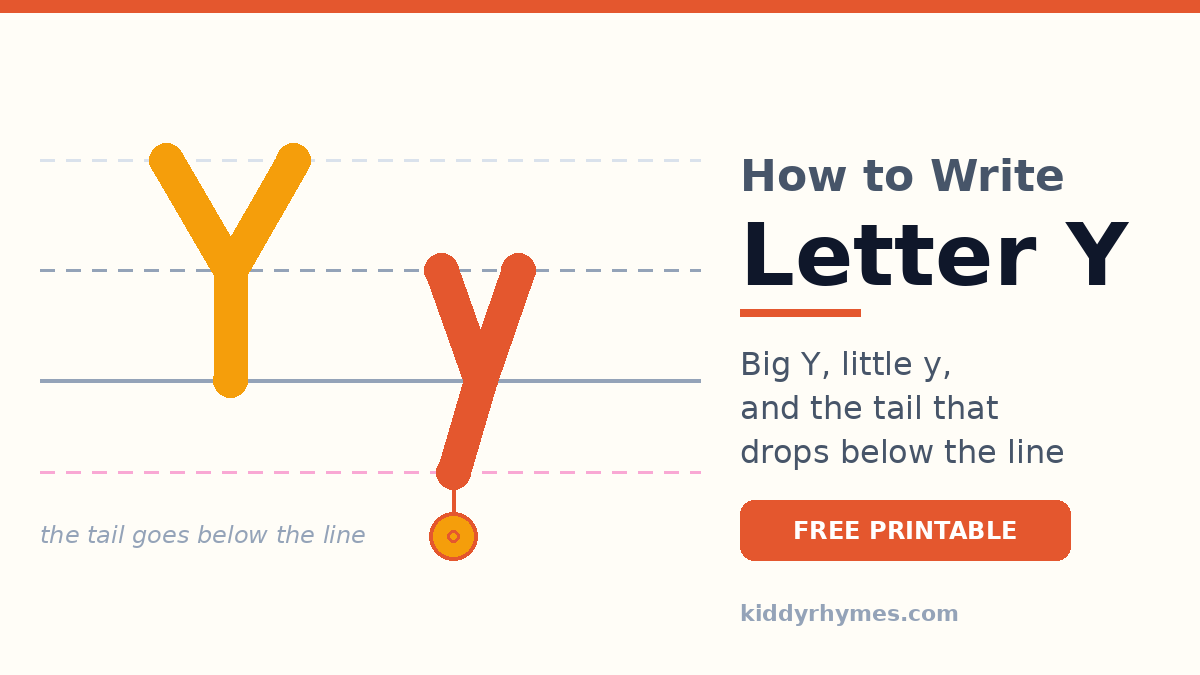
Capital Y takes two strokes — a short slant in from the top left, then a slant in from the top right that carries straight down to the writing line. Lowercase y also takes two strokes, but the second one does not stop at the line. It keeps going below it to make the tail. That tail is the whole letter: a y without it is just a v. Most children can copy Y somewhere between ages 4 and 5, because Y is made entirely of diagonal lines — and diagonals are one of the last pre-writing strokes to arrive.
The Big Y Rhyme
Slide down left, slide down right,
Meet in the middle, nice and tight.
One straight line down to the line —
That’s a big Y, standing fine!
How to Write Uppercase Y — Step by Step
Watch Y being written
Slant down. Slant down. Line down.Stroke 2 starts at the top right, meets stroke 1 in the middle, and carries straight on to the writing line.
Slant down. Slant down… and keep going below the line.Stroke 2 does not stop at the writing line. It carries on down to the pink line to make the tail. Without that tail, it is only a v.
Tap Big Y or little y to switch. Trace along with a finger on the screen, then copy it on paper.
- Slide down from the left. Start at the top line, a little left of centre. Pull a short slanted line down and to the right, stopping halfway down the letter.
- Slide down from the right, then keep going straight. Lift your pencil. Start at the top line on the right. Slant down to the left until you touch the end of the first line — then carry straight on down to the writing line. Do not lift again.
That is the two-stroke “continuous” method you will see on most US classroom posters, including Zaner-Bloser-style manuscript. Some charts split it into three — two slants that meet, then a separate line straight down. Handwriting Without Tears teaches capitals this way, with every capital starting at the top. Both produce the same letter, and neither one is wrong. Pick the version your child’s school uses and stay with it.
How to Write Lowercase y — The Tail Is the Whole Letter
The Little y Rhyme
A little v sits on the line,
But little y won’t stop — oh no!
It drops a string straight down below,
Just like a yo-yo. Now you know!
- Short slant down to the line. Start halfway up (at the middle line), slant down and to the right, and touch the writing line.
- Slant down and keep going. Lift. Start at the middle line on the right. Slant down to the left to meet the bottom of the first stroke — and then do not stop. Carry the same line straight on down below the writing line. That is the yo-yo’s string.
Lowercase y is one of only four letters in English that hang below the line: g, j, p, q, y. Teachers call them descenders. If your child has already met the curly tail on little g, say so out loud — “same family, different tail” — because children learn descenders much faster as a group than one at a time.
The classroom version — what teachers actually say out loud:
Letter Y Handwriting Cues
“Slant down. Slant down. Line down.”
“Slant down. Slant down… and keep going below the line.”
In UK classrooms following Read Write Inc, lowercase y is taught as one unbroken movement using a yak picture — down one horn, back up the other, then on down under the yak’s head, with no pencil lift at all. If your child’s school uses that scheme, follow it: the finished letter is the same, but the hand movement is different, and mixing the two mid-term is what confuses children.
The Mistake Most Children Make: a y That Stops at the Line
Watch for this: your child writes a neat little v, puts the pencil down, and says they wrote y. They are not being careless. On ruled paper every other letter they have learned stops at the writing line, so stopping is the habit. The tail is the only part of the alphabet so far that breaks the rule.
The fix is embarrassingly simple and it works in about a week: draw a second line under the writing line, in a different colour, about a finger’s width down. Tell your child the tail has to go and touch the colour. Children chase a target far better than they follow an instruction. Once the tail reaches reliably, take the colour away.
| What you see | What is going wrong | What to do about it |
|---|---|---|
| y looks like v | Second stroke stopping at the writing line | Coloured target line below the ruling; say “and keep going” as they write |
| The tail curls to the left like a g | Child is recycling the g movement | Write g and y side by side: g’s tail swings round, y’s tail goes straight |
| The two top strokes never meet | Diagonals are still developing | Not a handwriting problem yet — practise big X and V shapes in a tray first |
| Capital Y written where lowercase belongs | Capitals are learned first and feel safer | Normal at 4–5. Point it out, don’t correct it mid-sentence |
| Whole letter floats above the ruling | No sense of the baseline yet | Thicker, darker baseline; one letter per line instead of a row |
Y Songs to Sing While You Trace
Both of these are KiddyRhymes originals, set to tunes that are in the public domain, so you can sing them at home or in a classroom without worrying.
Big Y song — to the tune of Twinkle, Twinkle, Little Star:
Slide down left and slide down right,
Meet them in the middle, tight.
One line down and Y is done,
Big Y standing in the sun.
Y, Y, Y — now you can see,
That is how a big Y came to be.
Little y song — to the tune of London Bridge Is Falling Down:
Little y drops down below,
Down below, down below.
Little y drops down below —
Like a yellow yo-yo!
Fun Ways to Practise Letter Y at Home
Everything here uses what is already in the house. Five focused minutes beats twenty distracted ones.
- The real yo-yo string. Draw a huge lowercase y on paper with the writing line marked. Tape a short piece of wool to the bottom of the letter so it dangles past the line. Your child now has something they can touch that explains what a descender is.
- Yarn letters. Lay short pieces of wool into a big Y and a little y on the floor, then on card with glue. The two cases side by side is the point — children usually see them as two unrelated shapes.
- Y with your whole body. Arms up and out in a V, legs together and straight — that is a capital Y. Then sit on the floor and stretch one leg out below you for the lowercase tail. Big movements first, pencil second.
- Atta or salt tray. Spread flour or rava in a flat tray and draw a dark line across the base with a marker. Your child traces y with a finger and has to carry the tail past the line. Mess that wipes clean, and no pencil grip to worry about.
- The yellow hunt. Find five yellow things in the house, then say the sound together. Y is one of the few letters where the sound and a colour line up perfectly.
Safety first: keep wool and string lengths short — no longer than your child’s forearm — and put them away afterwards. Loose string is not a toy for under-5s to be left alone with.
Words That Start With Y — and Words That End With y
Y is the only letter in the alphabet that needs two word lists, and this is worth five minutes of your time because it explains something your child will meet in every reading book.
Starts with Y (here Y makes its own /y/ sound): yak, yam, yarn, yawn, yellow, yes, yo-yo, yogurt, young, yummy.Ends with y (here Y is doing a vowel's job): baby, happy, sunny, puppy, my, cry, sky, fly.At the end of a longer word, y usually sounds like a long “ee” — baby, happy. At the end of a short word, it usually sounds like a long “i” — my, cry. You do not need to teach the rule to a four-year-old. You just need to not be surprised when they read “happy” and look confused.
Letter Y in Hindi
य
The Hindi letter य (ya) carries the same sound Y makes at the start of English words. Try it with य से योग and य से यमुना — the river your child may already know by name.
Bilingual tracing tip: English y grows downwards, past the writing line. Hindi य finishes upwards — the शिरोरेखा, the straight line across the top, is usually added last. Say that difference out loud while your child writes. Children who are learning both scripts at once need the contrast named, not hidden.
Letter Y Tracing Pack
Big Y and little y on proper four-line ruling with a coloured descender target, arrow-and-number formation cards, a v-or-y sorting page, and a yo-yo colouring sheet.
Letter Y Tracing Pack (A4 PDF)
Printable handwriting practice sheet with strokes & stroke direction guides.
Moral of the Rhyme
Little y teaches something I say to my own class every year: the last bit is the bit that counts. A v and a y are the same letter until that final stroke carries on past the line. Plenty of children stop one step early — at a puzzle, at a drawing, at a tidy-up — because the job looks finished. Y is a nice, small, cheerful reminder to keep going a little longer than feels necessary.
Questions Parents Ask
Letter Y Parent FAQs & Troubleshooting
Why does my child’s y look like a v?
Because they are stopping at the writing line, which is exactly what every other letter has taught them to do. This is a habit, not a mistake. Draw a coloured target line a finger’s width below the ruling and tell them the tail must touch the colour. Say “and keep going” out loud each time. Most children fix this within a week.
How many strokes should letter Y have?
For capital Y, two in the common continuous method — the second slant carries straight down without a lift. Some charts, including Handwriting Without Tears, show three: two slants and a separate line down. Lowercase y is two strokes in US-style print, but Read Write Inc in the UK teaches it as a single unbroken movement. There is no universal correct number. The number your child’s school uses is the correct one for your child.
My three-year-old cannot write Y at all. Should I be worried?
Almost certainly not. Pre-writing strokes arrive in a known order: vertical and horizontal lines around age 3, the cross shape around 4, and diagonal lines around 4 to 4½, with the X shape nearer 5. Y is made entirely of diagonals. A three-year-old who cannot do it is not behind — they are simply not there yet. Practise big V and X shapes in a tray instead and come back to Y in a few months. If you have ongoing concerns about your child’s fine motor skills, your pediatrician or an occupational therapist is the right person to ask.
Is it a problem if the tail curls instead of being straight?
No, as long as it is consistent and it goes below the line. Print styles use a straight tail. Joined and pre-cursive styles, including Read Write Inc, finish with a curve or a flick so the letter can join to the next one. If your child’s school teaches a joined style, leave the curl alone — correcting it will only have to be undone later.
Is Y a vowel or a consonant?
Both, depending on where it sits. At the start of a word it is a consonant making the /y/ sound, as in yes and yellow. At the end of a word or syllable it does a vowel’s job. Literacy specialists point out that Y actually acts as a vowel in far more words than it acts as a consonant — the consonant role is the rarer one, even though it is the one we teach first. For a preschooler, teach the /y/ sound only. The rest comes later.
Should we teach big Y or little y first?
Capitals first is the usual advice, and it is sound: capitals are all the same height, all start at the top, and are much harder to reverse. But do not stay on capital Y for long. In real text, lowercase y appears far more often, and the tail is the part that needs practice. A week on Y, then straight to y.
More letters in the series
- Two tall posts and a little chair for H
- The other letter with a tail below the line
- Fenny the Frog’s two stretched-out arms
- Where the series started, with a mountain and a bridge
- Browse every rhyme activity on the site
If you are wondering why a four-line jingle sticks when a clear instruction does not, it is worth reading what rhyme and rhythm do to a young memory. It is the reason this whole series exists.