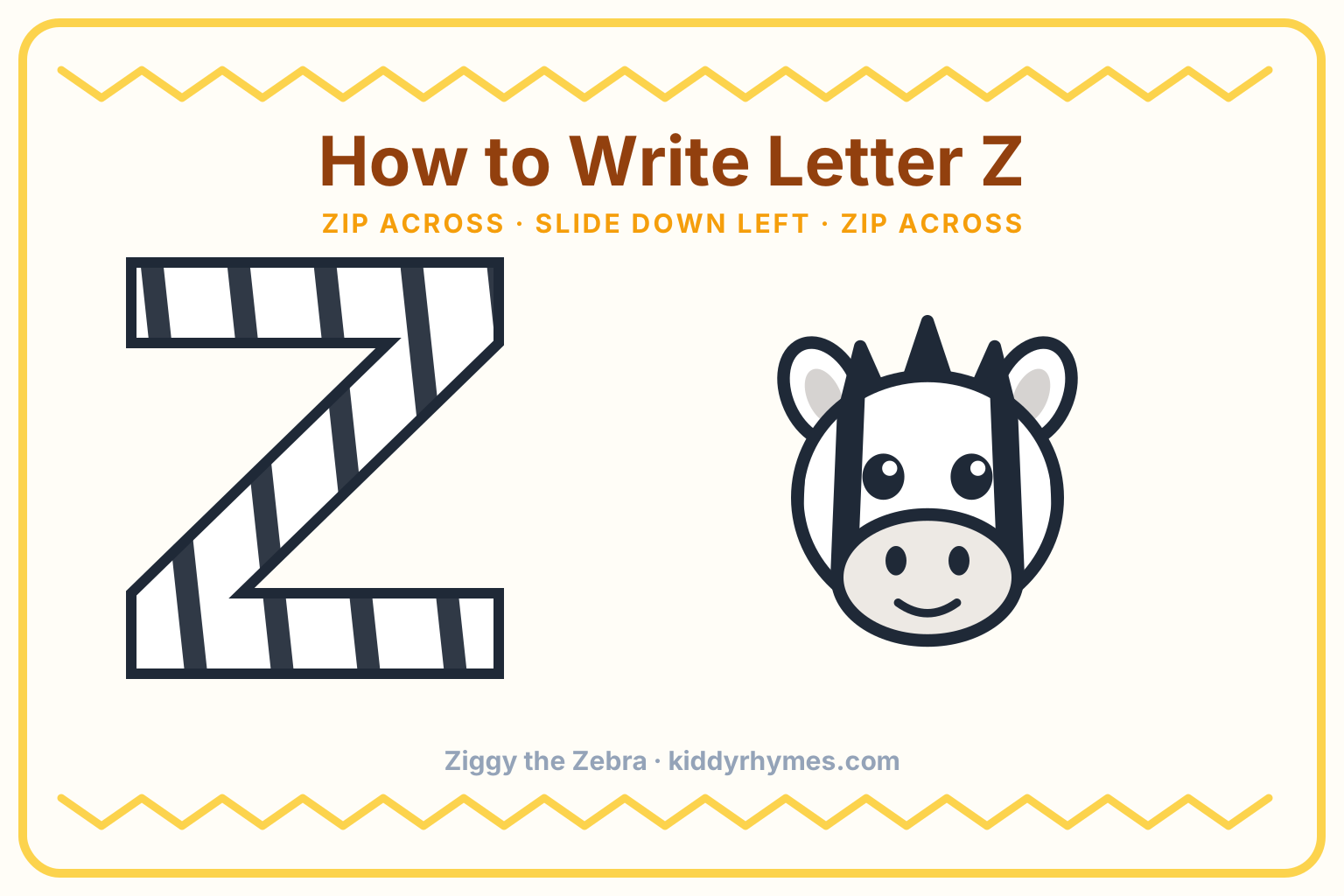
Meet Ziggy the Zebra. Every stripe on Ziggy’s back is a zigzag — and a zigzag is exactly what the letter Z is. Across, slide down, across. That’s the whole letter.
Capital Z = 3 straight lines, drawn without lifting the pencil. Go across the top to the right, slide down and to the left, then go across the bottom to the right. Lowercase z is the same shape, half the size — it sits between the middle line and the floor. Start at the top left every time. Most children manage Z somewhere around ages 4 to 6, and every child moves at their own pace.
Ziggy’s Zigzag Rhyme (original)
Zip across the top line — go!
Slide down left to the floor below.
Zip across the ground again —
Zigzag Z, the last of them!
Say it out loud while your child writes. A rhyme turns a shape into a movement, and movement is what sticks — here’s more on why rhymes stay in a young child’s memory.
How to Write Uppercase Z — Step by Step
⚡ Trace the Zigzag
Tap Watch Ziggy first, then trace from the orange dot.
- Across the top
- Slide down to the left
- Across the floor
🎉 You wrote Z! Ziggy the Zebra is proud of you.
- Across the top. Put your pencil on the top line, at the left. Slide straight across to the right. Stop.
- Slide down to the left. From where you stopped, slide diagonally down to the bottom line — and go left as you come down. This is the stripe on Ziggy’s back.
- Across the floor. Slide straight across to the right again, the same length as the top line.
- Check: two sharp corners, three straight lines, no curves anywhere. That’s Z! 🎉
Don’t lift the pencil. Z is one journey, not three separate lines. The Handwriting Without Tears program files Z with the letters that start in the top-left corner and travel left to right — the same direction we read — because that habit is what stops the letter coming out backwards.
How to Write Lowercase z
Here is the good news, and it is the best news in the whole alphabet: little z is the same shape as big Z. Nothing new to learn. It is simply smaller and it sits lower on the page.
Little z Rhyme (original)
Same three zips, but half the size —
Little z stays low, not high!
- Start on the middle line, not the top line. Slide across to the right.
- Slide down left to the bottom line.
- Slide across the bottom to the right. Done.
In print, lowercase z stays neatly between the middle line and the floor. It has no tail and nothing dips below the line — the looped z with a tail belongs to joined-up writing, which comes years later.
Z belongs to a small family of letters whose two cases look the same: c, o, s, v, w, x and z. Research on how children learn letter names has found that lowercase letters are learned far more easily when they resemble their capital. So teach big Z and little z in the same sitting. With Z you get two letters for the price of one.
The classroom version — say the same short words every single time:
Across. Slide down. Across.For little z, keep the words identical and just add one: “Small across. Small slide down. Small across.”
For UK parents: Read Write Inc. uses a short three-beat phrase for z built around the word zigzag, with a zip as the picture cue. Our script follows the same stroke order and the same three beats, so it sits alongside whatever your child is doing at school rather than competing with it.
The Mistake Most Children Make
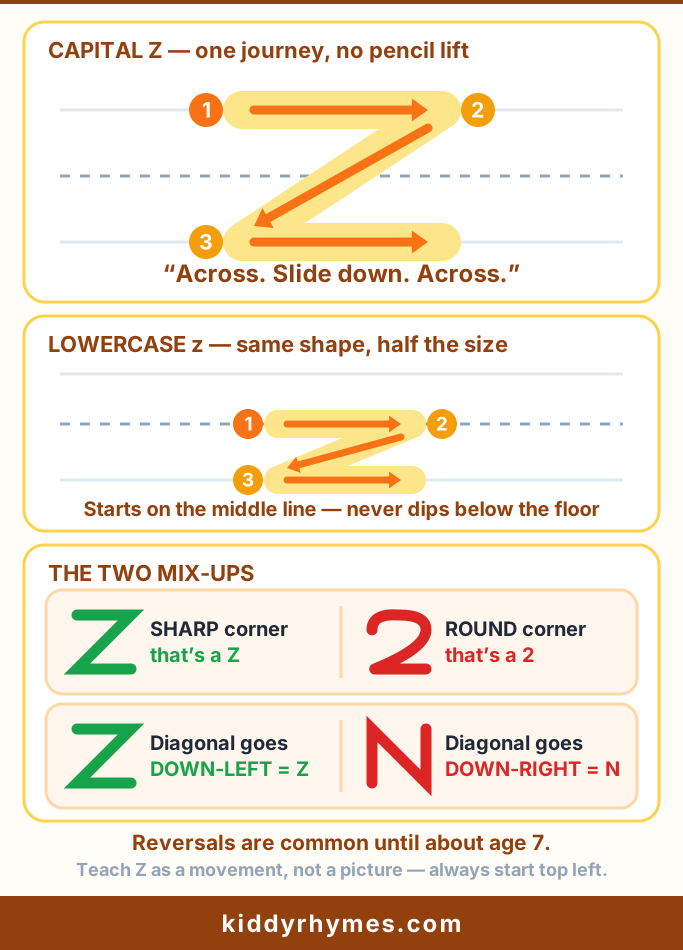
Z turns into a 2. This is the single most common Z problem, and it comes down to one thing: the corner. A 2 curves over at the top. A Z turns a hard, sharp angle. If your child sweeps round instead of stopping, you get a 2 every time.
The fix — stop, turn, go. Teach a tiny pause at each corner. Say “across — stop — slide down.” Pausing is what makes the corner sharp. Draw a 2 and a Z side by side and ask your child to point at the pointy one.
Z turns into an N
If the middle stroke travels down to the right instead of down to the left, you have built a sideways N. Both letters are three straight lines; only the diagonal direction differs. Put a small dot where the diagonal should finish — bottom left — and let your child aim for it.
Z comes out backwards
Very common, and not a warning sign on its own. The NHS children’s therapy guidance notes that letter reversals are typical up to around age seven, and it names z as one of the letters children reverse most often, along with b, d, s and c. Research suggests that at about age five children store a letter’s shape but not reliably its direction. The advice from therapists is consistent: teach the letter as a movement, not a picture. Always begin at the top left, and say the words aloud while the pencil moves.
Should you cross the Z?
You will see adults write Z with a line through it (Ƶ). That is a grown-up habit from writing next to numbers — it separates Z from 2 on a page of maths, and it is common in French, German, Spanish and Italian handwriting. Do not teach it to a preschooler. It adds a fourth stroke to a letter your child is still learning, and it is not how Z appears in any book they will read. Teach the sharp corner instead; the bar can come later, if ever.
Z Songs to Sing While You Trace 🎵
All lyrics below are original. Tunes are traditional and in the public domain.
1. “Zip, Slide, Zip” (tune: Twinkle, Twinkle, Little Star)
Zip across and slide back down,
Zip across along the ground.
Two sharp corners, nice and neat,
Z is standing on its feet!
2. “The Zebra Says Zzz” (tune: The Farmer in the Dell)
The zebra says zzz, zzz,
The zebra says zzz, zzz,
Hi-ho, it starts with Z,
The zebra says zzz, zzz!
Swap in zip, zoo and zero for more verses.
3. “Twins” (tune: Row, Row, Row Your Boat)
Zip, slide, zip again,
Keep it small and low.
Little z and big Z
Are twins, you know!
Looking for more singing? Browse the full rhyme activity library.
Fun Activities to Practice Letter Z
1. Walk the Zigzag. Lay a giant Z on the floor with masking tape. Your child walks the top line, turns sharply, walks the diagonal, turns sharply, walks the bottom. Say the rhyme as they go. The feet learn the corners before the pencil does. Safety: clear the space first and use bare feet or grippy socks on smooth floors.
2. Ziggy’s Stripes. Draw a big outline Z on white paper. Your child fills it with black paper strips or black crayon stripes — a zebra-striped Z. Safety: pre-cut the strips yourself for under-5s; keep scissors adult-held.
3. Z or 2? Sorting Game. Write five Z’s and five 2’s on cards. Your child sorts them into a “pointy” pile and a “curvy” pile. This is the single most useful five minutes you can spend on this letter. Safety: use card large enough not to be a choking risk for younger siblings.
4. Atta Tray Zigzags. Spread a thin layer of flour or atta on a steel tray. Your child draws Z with one finger, then shakes the tray to erase. Free, endlessly repeatable, and no pencil grip required.
5. The Zip Hunt. Find every zip in the house — bags, jackets, pencil cases. Each time, say “zzz — zip!” and trace a Z in the air. This is the cue UK phonics programs use, and it works because the sound and the action arrive together.
Words That Start With Z
Z words are rare, which is exactly why they feel special. Point out zebu — the humped cattle you see all over India. It may be the only Z word your child meets on the road home.
Z in Hindi 🇮🇳
ज़
This is the Hindi letter for the /z/ sound. Look closely: it is ज (ja) with a tiny dot underneath. That dot is called a nukta, and it is the whole difference between ja and za.
ज़ेब्रा — zebra • ज़िप — zip • चिड़ियाघर — zoo
Bilingual tracing tip: Hindi has no original /z/ sound, which is why so many children say “jebra” instead of “zebra.” Hold the buzz before the word: zzz…ebra. Put a finger on your throat — a real z makes it hum. Then write the Z while buzzing. The sound and the stroke land together.
Letter Z Tracing Pack
8 pages: big Z and little z tracing with directional arrows, a Z-or-2 sorting page, a Z-or-N page, zebra stripe colouring, word tracing, a Hindi ज़ page, and a parent script card. A4 and US Letter.
Letter Z Printable Pack (A4 PDF)
Printable handwriting practice sheet with stroke directions & tracing guides.
Moral of the Rhyme 🌱
A zigzag changes direction twice — and still gets all the way across the page. Turning around is not the same as going backwards. Z is also the very last letter, and it waits patiently at the end for twenty-five others to go first. Good things sit at the end of the line too.
Questions Parents Ask
Letter Z Parent FAQs & Troubleshooting
How many strokes is the letter Z?
Three straight segments — but in Handwriting Without Tears and Zaner-Bloser style manuscript they are drawn as one continuous motion without lifting the pencil. Read Write Inc. counts it as three beats. Both are correct; the order is identical either way. If your child’s school teaches a lift, follow the school.
Why does my child’s Z look like a number 2?
Because they are curving the top corner instead of turning it sharply. A 2 is round at the top; a Z is pointy. Teach a tiny pause: “across — stop — slide down.” The pause is what creates the corner. Sorting a pile of Z cards and 2 cards fixes this faster than any worksheet.
Should I teach my child to write Z with a line through it?
No, not at preschool age. The crossed Z is an adult convention for telling Z apart from the numeral 2 on a page of maths, common in several European handwriting traditions. It adds a stroke your child does not need and does not match the Z in their storybooks. Teach the sharp corner instead.
Are capital Z and lowercase z really the same shape?
Yes. Little z is big Z at half the height, sitting between the middle line and the baseline. Z belongs to a small group — c, o, s, v, w, x, z — where both cases match. Research on letter learning shows children pick up lowercase letters most easily when they look like the capital, so teach both in one sitting.
My child writes Z backwards. Is that normal?
Usually yes. NHS children’s therapy guidance describes letter reversals as common up to around age seven and lists z among the letters reversed most often. The recommended approach is to teach letters as movements rather than shapes: always start top left, say the words aloud, and practise in sand, flour or playdough. If writing is still very hard, slow or painful after age seven or eight despite regular practice, speak to your pediatrician or an occupational therapist.
Does it matter if my child starts Z from the bottom?
At three, gently redirect rather than correct: “Ziggy starts up at the top.” Starting at the top left and moving left to right is the same direction we read, and it is the habit that prevents reversals later. It costs nothing to build now and is awkward to undo at seven.
More letters in the series
- A — where the series started, with A
- C — C and its one curved stroke
- F — Fenny the Frog’s three-stroke F
- G — the big curve and the g with a tail
- H — two tall posts and a little chair
We jumped to the end of the alphabet for this one — because finishing feels good. Back to Letter I next.