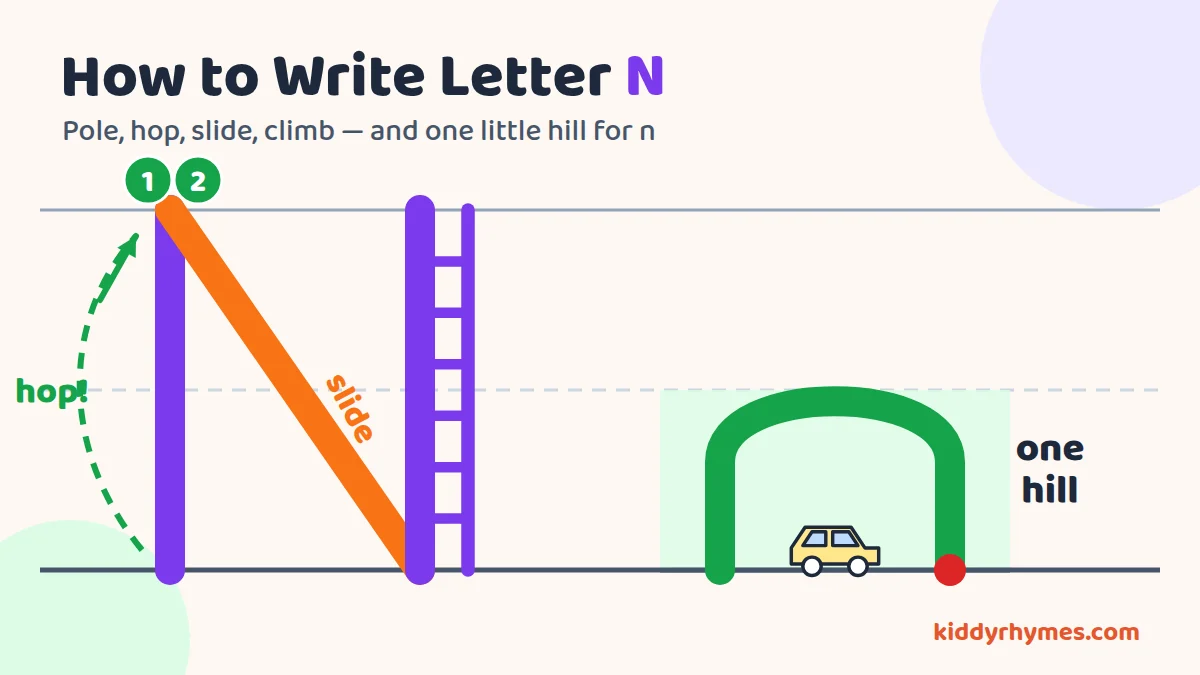
Big N takes two strokes. First, pull a tall line down on the left. Then hop back to the same top corner, slide down to the bottom right, and climb straight up. Little n is one stroke: start on the middle line, go down, come back up the same line, and go over one little hill. One hill is n. Two hills is m. Most children are ready to practice N between ages 3 and 5 — go at your child’s pace.
The Big N Playground Rhyme (original)
Down the pole from top to ground,
Hop back up — don’t turn around!
Slide down to the corner, whee,
Climb the ladder: N, you see!
How to Write Uppercase N — Step by Step
Trace the Letter N ✏️
Loading the tracer… If this message does not change, JavaScript is blocked on this page. The steps below still work on paper.
Big N: Start at the top on the left. Big line down. Frog jump back to the same corner. Slide down to the bottom right. Climb straight up.
Little n: Start on the middle line. Down to the bottom line. Back up the same line. Over one hill and down. Stop.
Think of big N as a playground: a pole, a slide and a ladder. Big N sits between the top line and the bottom line.
- Pole down. Start on the top line, on the left. Pull a straight line down to the bottom line.
- Hop back up. Lift the pencil and go back to the same top corner where you started. Teachers call this a “frog jump”.
- Slide down. Slant all the way down to the bottom line, on the right side.
- Climb the ladder. Without lifting, go straight up to the top line. Stop.
Two things make N look right: the slide starts at the top of the pole, and it goes all the way to the bottom corner. If the slide starts halfway down the pole, the N looks squashed.
Different schools, different last lines. Handwriting Without Tears teaches big N as a “frog jump” capital: big line down, jump back to the start, slide down, then go up. Zaner-Bloser also ends N with a push up. Many worksheets instead draw three separate lines that all start at the top, so the last line goes down. All of these make a correct N. Use the version your child’s school uses, so they only learn one. (Our tracer accepts both.)
How to Write Lowercase n
The Little n Rhyme (original)
Down and up the same line, then —
Over one hill. That’s little n!
Little n lives in the bottom half: between the dashed middle line and the bottom line. It looks like a little tunnel.
- Start on the middle line. Not the top line — starting up high makes an h.
- Line down. Pull straight down to the bottom line.
- Back up the same line. Go up over the line you just made, almost to the middle line.
- Over one hill. Curve over to the right and come straight down to the bottom line. Stop.
Some guides lift the pencil at the bottom and start the hill again from the line. That’s fine too. What matters is that the hill grows out of the first line, not from the air next to it.
The classroom version — the short words to say while the whole class writes:
Letter N Stroke Order & Verbal Cues
- 1 Line down.
- 2 Jump.
- 3 Slide down.
- 4 Line up.
- 1 Line down.
- 2 Back up.
- 3 Over the hill.
In UK schools that use Read Write Inc., children learn n with a picture of a character’s head and his net: down the first line, then over the top. It’s the same two moves in story form, so if your child’s school uses it, the words above won’t clash.
The Mistakes Children Make With N
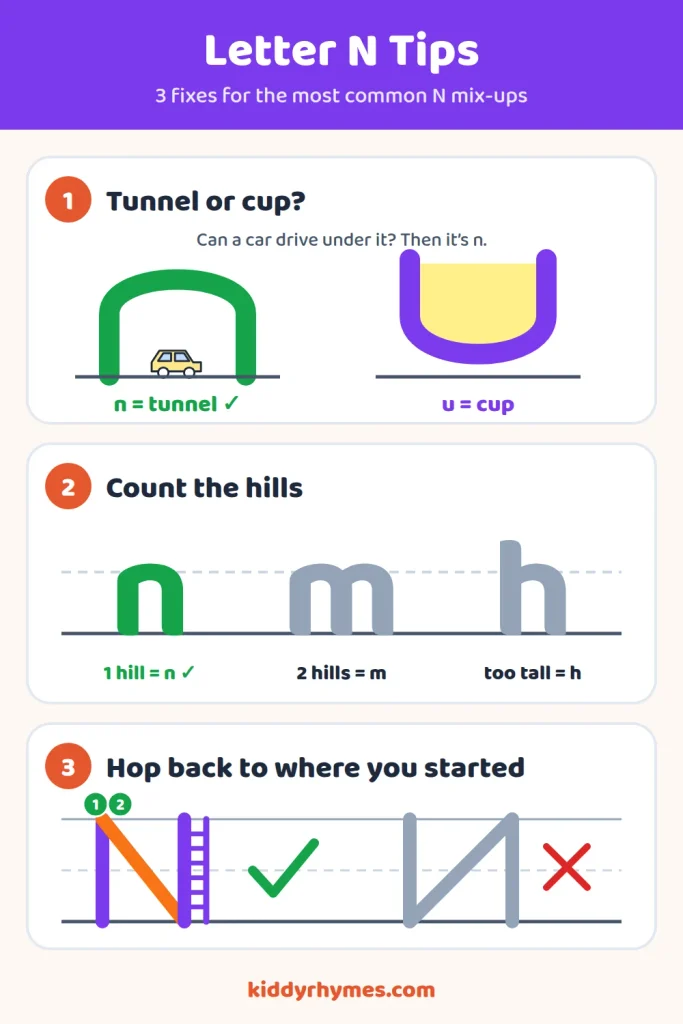
1. Backwards N. The slide goes from the top right down to the bottom left, so the N looks like it is facing the wrong way. N is one of the capitals that young children often write in reverse. The fix is the hop: “Jump back to where you started.” If the slide always begins at the top of the first pole, it can’t go the wrong way.
2. The zigzag from the bottom. Some children start at the bottom left and go up, down, up. The finished shape may look fine, but starting at the bottom makes writing slower later. Keep saying: “Big letters start at the top.”
3. Little n turns into u, h or m. Flip n upside down and you get u. Start it too high and you get h. Add one more hill and you get m.
Letter Formation Quick Fixes & Verbal Cues
| Looks Like | What Happened | Say This (Verbal Cue) |
|---|---|---|
| u | The hill is upside down, like a cup. | “n is a tunnel — cars go under. u is a cup — it holds water.” |
| h | Started on the top line. | “Little n starts on the middle line.” |
| m | Kept going over a second hill. | “One hill, then stop.” |
| Backwards N | The slide started on the right. | “Hop back to where you started.” |
Writing some letters backwards or upside down is a normal part of learning. Most children grow out of it by the end of Grade 2 (Understood.org explains when it’s expected). If it keeps happening after that, or pencil work seems hard in general, talk to the teacher and your pediatrician, who may suggest an occupational therapist.
Nnn — The Nose Sound
N makes a humming sound that comes out of your nose. Try it together: say “nnnn” and then gently pinch your nose. The sound stops! That’s because /n/ is a nasal sound (Reading Universe has a short explainer). Now try “ssss” with your nose pinched — it keeps going.
N and M are both nose sounds, which is why children mix them up. The difference is in the mouth. For M, the lips close. For N, the lips stay a little open and the tip of the tongue presses just behind the top teeth. When you teach the sound, say a short, clean “nnn”, not “nuh” and not the letter name “en”.
N Songs to Sing While You Trace
These are our own words, set to old public-domain tunes. Sing slowly: one line of the song for each stroke.
Big N Song (tune: Frère Jacques / Are You Sleeping?)
Line down, line down,
Hop back up, hop back up,
Slide down to the corner,
Climb up to the top line —
That’s big N! That’s big N!
Little n Song (tune: Mary Had a Little Lamb)
Down and up and over the hill,
over the hill, over the hill,
Down and up and over the hill —
one hill makes an n!
Tunes help children remember the order of the moves, not just the shape. Here’s more on what rhyme and rhythm do for a young brain.
Fun Activities to Practice Letter N
1. Toy-car playground N
Draw a giant N on paper with a marker. Your child drives a toy car down the pole, lifts it back to the top (“hop!”), zooms down the slide and drives up the ladder. Big arm moves first, pencil later.
2. Tunnel or cup?
Write a big n and a big u on two cards. Put a toy car under the n: “It’s a tunnel!” Try the u: the car can’t go under — “It’s a cup!” Mix the cards and let your child say “tunnel” or “cup” for each one. This targets the n/u mix-up directly.
3. Noodle N
Use dry spaghetti or pasta tubes to build big N: one long piece for the pole, one for the slide, one for the ladder. Then bend a piece of cooked noodle into a hill for little n.
4. Pinch-your-nose game
Say a word, then say it again with your nose pinched. If the word sounds funny, it has an N or M sound: “nose”, “nine”, “nap”. Sounds like “sun” only change at the end — can your child hear where?
Safety note: Stay close for the noodle and toy-car activities with children under 3. Dry pasta pieces and small toy parts can be a choking risk. Keep pasta play at the table, and put everything away when you’re done.
Words That Start With N
These all start with a clean /n/ sound and are easy to picture or act out:
- nose — touch it, then pinch it and say “nnn”
- nest — cup your hands like a bird’s nest
- net — pretend to catch a fish
- nine — hold up nine fingers
- nap — rest your head on your hands
- noodles — slurp pretend noodles
- naan — the soft bread many families love
- night — look for the moon, then sing the bedtime star song
Free Printable
Letter N Tracing Pages
Big N with numbered start dots and a slide arrow, a little-n “tunnel” page, a tunnel-or-cup n/u sorting game, N picture words to color, and a Hindi न page. Print it, or slip it into a plastic sleeve for a whiteboard marker.
Moral of the Rhyme
On a real playground, you can’t slide down until you’ve climbed up. Big N is the same: go back to the top, then slide. Some things take a little effort first, and the fun part comes right after.
Questions Parents Ask
LETTER N HANDWRITING & PHONICS FAQ
Does the last line of N go up or down? ▼
My child writes N backwards. Should I worry? ▼
Why does my child write u instead of n? ▼
Should my child lift the pencil before the hill of little n? ▼
Should I teach big N or little n first? ▼
My child says “d” instead of “n”. Is that normal? ▼
More letters in the series
- A, with its two slanted sides
- Big B and its two bellies
- The curl that makes C
- D, another pole-first letter
- E and its three short arms
- F and its frog hop
- G with its little shelf
Written by Tanu Bhardwaj — early-childhood teacher who runs a playschool in Mathura. She writes KiddyRhymes’ letter-writing series in the same simple words she uses with her own classroom of little learners.