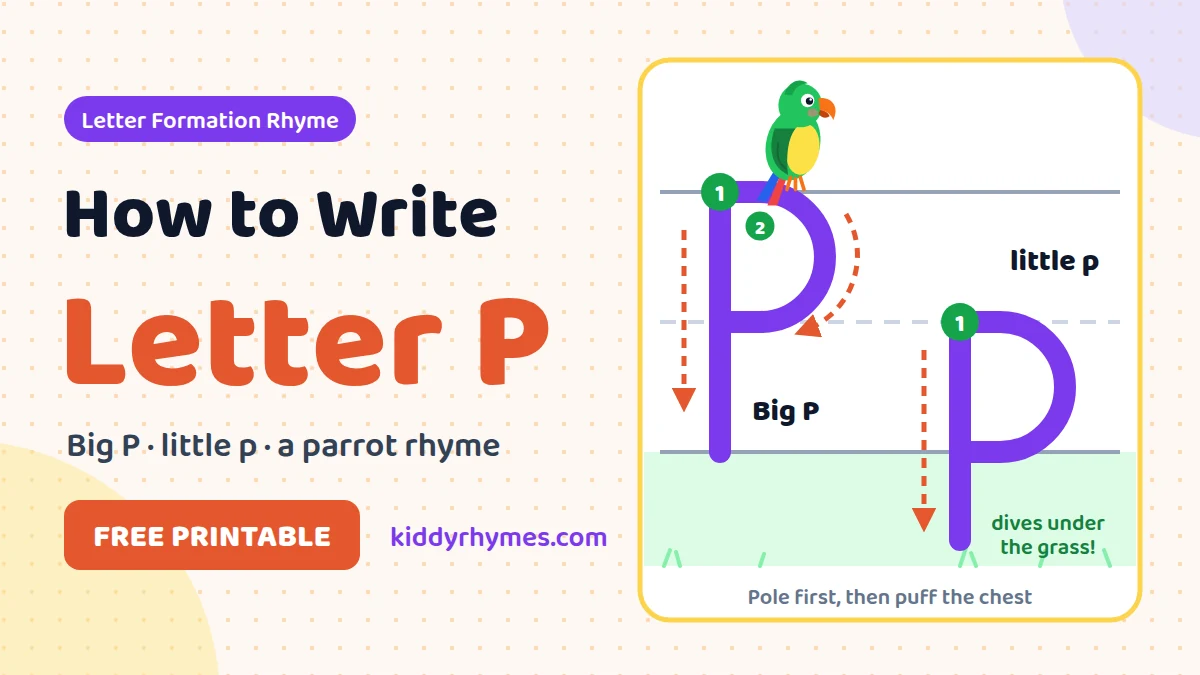
Capital P takes two strokes: a tall line straight down, then hop back to the top and draw a small curve that stops at the middle line. Lowercase p is usually one stroke: start at the middle line, dive down below the bottom line, come back up the same way, and curve round to the right. Most children are ready to practice P between ages 3 and 5, but every child’s pace is different.
Picture a parrot sitting on top of a tall pole, puffing out its round chest to the right. That is the letter P. The pole comes first, the puffy chest comes second, and the chest only covers the top half of the pole. Keep that picture in mind and both big P and little p get much easier.
The Big P Rhyme (original)
Start at the top, the pole goes down,
Jump back up — don’t touch the ground!
Puff out a chest, round and small,
Stop at the middle — P stands tall!
How to Write Uppercase P — Step by Step
Trace the Letter P ✏️
Loading the tracer… If this message does not change, JavaScript is being blocked on this page.
Big P sits between the top line and the bottom line. It belongs to the “line first, then jump back up” family of capitals, which also includes B, D, E, F, M, N and R.
- Start at the top. Put the pencil on the top line.
- Pole goes down. Pull a straight line all the way to the bottom line. Lift the pencil.
- Jump back up. Go back to the top of the pole — the same spot where you started.
- Puff the chest. Curve out to the right and round, like half a circle.
- Stop at the middle. Bring the curve back to touch the pole at the dashed middle line. Not lower!
This is the same hop back to the top your child already knows from Fenny’s hop back to the top in letter F. In the Handwriting Without Tears program, P is taught with this exact order — line down, jump to the top, little curve to the middle.
How to Write Lowercase p
The Little p Rhyme (original)
Start at the middle, dive down deep,
Under the grass where the tree roots sleep,
Swim back up the very same way,
Round to the right — p’s here to stay!
Little p is where most children need help. The top part sits in the small space between the middle line and the bottom line. The pole then goes under the bottom line — the same “under the grass” space your child met in the grass line from little g.
- Start at the middle line. Not at the top line — little p is a short letter on top.
- Dive down deep. Pull a straight line down, past the bottom line, about half as far again.
- Swim back up. Without lifting, go back up the same line to the middle.
- Round to the right. Curve out to the right and down, and close the curve on the bottom line.
Some schools teach little p with a lift — line down, lift, then draw the round part as a second stroke. Both work. Follow the version your child’s school uses, so they only learn it once.
Big P and Little p: Same Shape, Different Floor
Here is something most worksheets never say out loud. P and p are almost the same shape. What changes is where they sit. That is why many children write a tiny capital P sitting on the line when they mean little p.
Big P vs Little p Comparison Guide
| Check | P Big P | p Little p |
|---|---|---|
| Where does it start? | Top line | Middle line |
| Where does the pole end? | On the bottom line | Below the bottom line |
| Where is the round part? | Top half, top line to middle | Between middle line and bottom line |
| Strokes | 2 | Usually 1 (some schools teach 2) |
A quick test: if your child’s little p doesn’t poke below the line, it’s really a small capital. Ask, “Did your pole go under the grass?”
The Teacher’s Version
The classroom version — short words to say out loud while the whole class writes:
Letter P Stroke Order & Verbal Cues
- 1 Line down.
- 2 Hop up.
- 3 Little curve.
- 1 Down under.
- 2 Back up.
- 3 Round.
In UK schools that use Read Write Inc. phonics, children learn little p with a short picture rhyme about a pirate — down the pirate’s long plait, then round his face. It’s the same two moves: down first, round second.
The Mistakes Most Children Make With P
1. The chest is too big. If the curve on big P runs all the way to the bottom line, it turns into D. Say “stop at the middle” every time.
2. The chest is on the wrong side. A little p with its round part on the left is a q. A little p with its round part at the top of a tall pole is a b. These four letters — b, d, p and q — are the same pieces turned different ways.
3. The pole doesn’t go down far enough. This gives you the tiny-capital problem from the table above.
4. The curve is drawn first. Starting with the round part is what makes p flip into q. Pole first, always.
Big P is also just the bat-and-bellies B lesson with only the top belly. If your child can write B, show them: “Take away the bottom belly — now it’s P!”
Why Do p, q, b and d Get Mixed Up?
It isn’t carelessness. Our brains are built to recognize a cup as a cup whichever way the handle points. Letters are one of the few things where the direction changes the meaning, so every child has to learn to notice it. There’s a lovely explanation of this in a TED Ideas essay on mirror letters.
A simple rule for p: p faces forward, the way we read. Its round part points toward the next letter in the word. Q looks back.
Reversals are very common while children learn, and many still flip letters until about age 7 (Understood.org explains when it’s typical). Writing letters backwards on its own does not mean dyslexia. If reversals continue into Grade 2–3, or pencil work is hard in general, talk to the teacher, a pediatrician or an occupational therapist.
P Songs to Sing While You Trace
These are our own short songs, set to old public-domain tunes. Sing one line per stroke.
Big P Song (tune: Pop Goes the Weasel)
Start up high and draw a pole,
Straight down to the bottom,
Jump back up and puff it round —
POP! goes the P!
Little p Song (tune: Frère Jacques / Are You Sleeping)
Middle line, middle line,
Dive down deep, dive down deep,
Up and round the chest, up and round the chest,
That’s little p! That’s little p!
Rhymes help because children remember the order of the moves, not just the shape. Here’s more on why rhyme and rhythm help memory.
Fun Activities to Practice Letter P
1. Parrot on a pole
Stand a straw upright in a lump of playdough. Roll a small playdough ball — the parrot’s chest — and press it onto the top right of the straw. Ask: “Is the chest at the top? Is it on the right?” Then push the straw deeper so half of it is hidden in the playdough “ground”. That’s little p.
2. Popcorn P
Draw a big P on card. Your child glues popcorn or murmura (puffed rice) along the lines — pole first, then the curve. Say the rhyme while gluing.
3. Forward-facing p hunt
Write a row of p and q letters on paper. Your child circles only the ones whose round part “looks forward” to the right. This one game targets the p/q mix-up directly.
4. Dive under the rope
Lay a skipping rope or a line of tape on the floor as the bottom line. Your child walks little p: start above the rope, walk straight across it and a few steps past, walk back, then circle round on the top side.
Safety Note: Popcorn and hard puffed snacks are a choking risk for young children — for under-4s, use cotton balls or torn paper instead, and don’t let the glued pieces go in mouths. Stay close during playdough play with children under 3. Clear the floor before the rope game.Words That Start With P
Letter P Easy Pictures & Actions Guide
| Word | Easy Picture or Action |
|---|---|
| parrot | Flap your arms and say “hello” in a squeaky voice |
| peacock | Spread your fingers wide like a fan of feathers |
| pig | Push up your nose and say “oink” |
| pencil | Hold one up — it looks like P’s pole! |
| pot | Stir an imaginary pot of dal |
| papaya | Cut one open and count the seeds |
| panda | Cover your eyes with circles made of fingers |
| puppy | Pant and wag an imaginary tail |
| pumpkin | Make a big round shape with your arms |
| pop | Clap once, loud — POP! |
Say the words slowly and let your child feel the little puff of air on their hand for the /p/ sound.
Letter P Tracing Pack — Big P & Little p
Numbered stroke guides, a “same shape, different floor” page, a p-or-q sorting sheet, P picture words to color, and a Hindi प tracing page. Print it, or slip it into a plastic sleeve for a whiteboard marker.
Looking for more? Browse more free printable sheets.
Moral of the Rhyme
The parrot stands straight first, and only then puffs out its chest. Letter P teaches the same thing: build a strong, straight start before adding the fancy part. When your child gets the pole right first, everything else has something to lean on — in writing and in life.
Questions Parents Ask
LETTER P HANDWRITING & PHONICS FAQ
Why does my child write q instead of p? ▼
My child’s little p sits on the line. Is that wrong? ▼
How far below the line should the tail of p go? ▼
Is lowercase p one stroke or two? ▼
Why does my child’s capital P look like a D? ▼
Should I teach uppercase or lowercase P first? ▼
More letters in the series