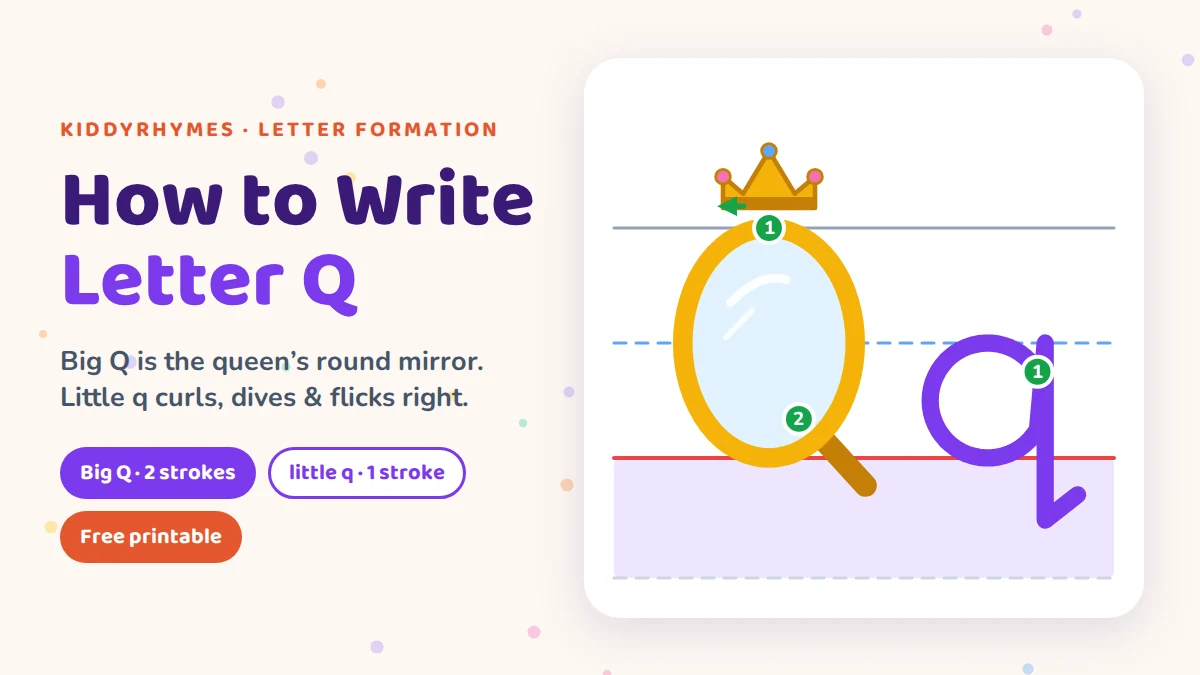
Big Q is a round O plus one short slanted tail at the bottom right — 2 strokes. Little q is 1 stroke: curve round like a c, go up to the middle line, pull a straight line down below the bottom line, and flick the end to the right. Most children are ready to try Q between ages 4 and 6, usually after they can write O and c.
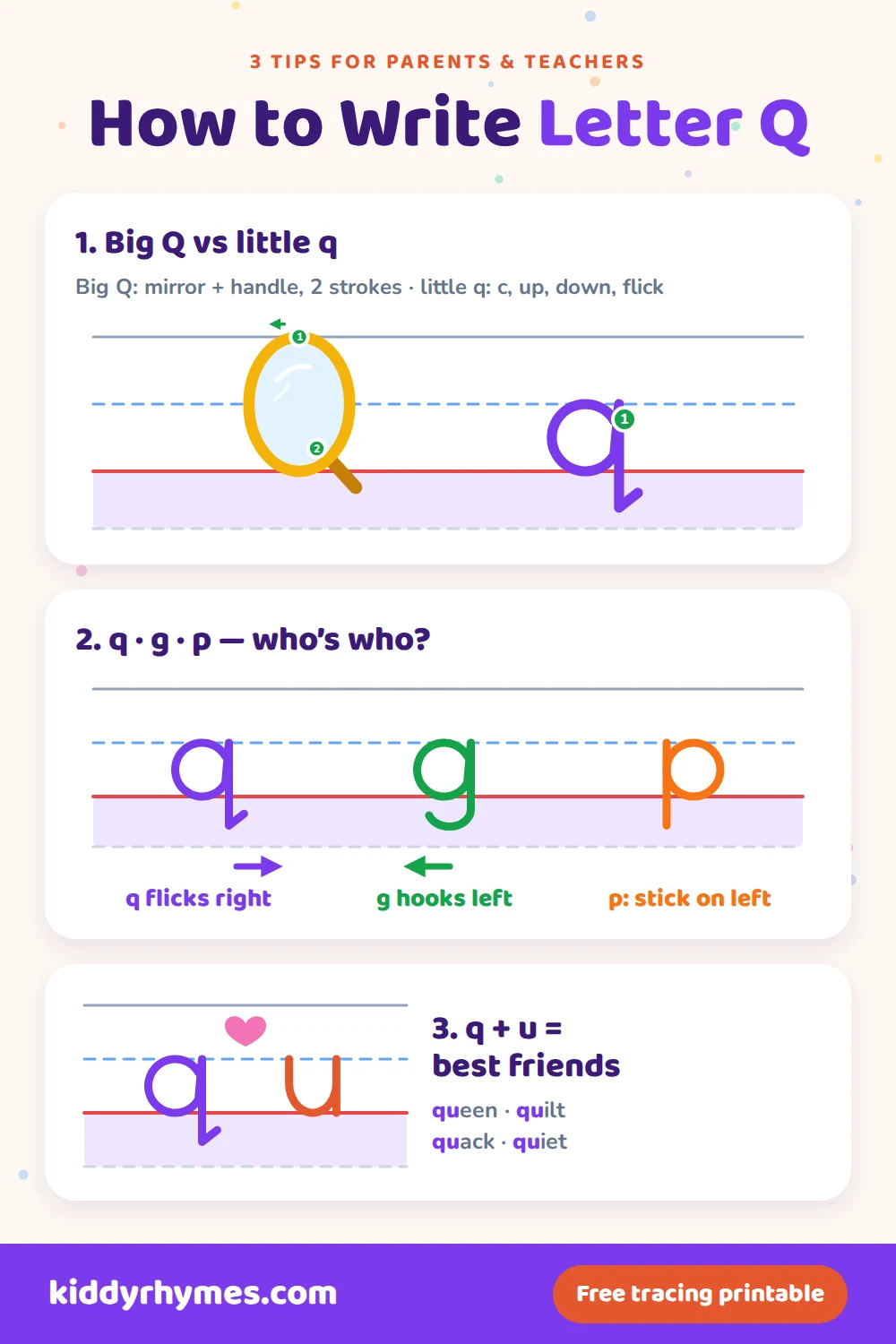
Q is one of the least-used letters in English, so it gets very little practice time. That is exactly why children mix it up. They add the tail in the wrong place, turn little q into a p, or give it a hook like a g. This page fixes all three, with a short rhyme, a tracing game and a free printable.
The Big Q Rhyme (original)
Round and round the queen’s mirror goes,
Start at the top, as everyone knows.
Lift your pencil, a tiny line,
A handle down the side — Q looks fine!
How to Write Uppercase Q — Step by Step
Trace Q with Queen Quinny
Start at the green dot and follow the dotted line.
Tip: trace with one finger first, then try a pencil on paper.
Big Q is an O with a handle, just like a queen’s round hand mirror. If your child can already write O, they are most of the way there. (Round letters start the same way as C’s kitten curl — at the top, moving left.)
- Start at the top. Put the pencil on the top line, in the middle. Not on the side, and never at the bottom.
- Round the mirror. Curve to the left, down to the bottom line, and back up the right side. Stop where you started.
- Lift, then the handle. Lift the pencil. Put it just inside the circle at the bottom right and pull a short slanted line down and out, past the bottom line.
Handwriting Without Tears describes it the same way: a “magic C” that keeps going all the way round, then a jump down for a little line. Some worksheets start the tail outside the circle and cut across it — both are fine. What matters is that the tail sits at the bottom right.
How to Write Lowercase q
Little q is the tricky one. It sits in the middle space like a, c and o, but its stick hangs down below the line, like g and p.
The Little q Rhyme (original)
Curl like a c, then up to the top,
Down past the line — now flick and stop!
- Small c. Start just under the dashed middle line and curve round like a little c, touching the bottom line.
- Up. Without lifting, go up to the dashed middle line on the right side.
- Down, down, down. Pull a straight line all the way down, past the bottom line.
- Flick right. Finish with a tiny turn to the right, like a small u-turn.
This matches Handwriting Without Tears (“magic c, up, bump, slide back down, u-turn”) and most US and UK schemes. Some print styles end q with a plain straight stick and no flick. If your child’s school uses a straight stick, follow the school — but the flick is the easiest way to stop q turning into g, which you’ll see below.
Big Q vs Little q at a Glance
| Feature | Big Q | Little q |
|---|---|---|
| Strokes | 2 (circle, then tail) | 1 (c, up, down, flick) |
| Where it starts | Top line, middle | Just under the dashed middle line |
| Round part | Full size, top line to bottom line | Small, middle line to bottom line |
| Extra part | Short tail at the bottom right | Long stick on the right, below the line |
| Ends with | Tail just past the bottom line | Flick to the right, below the line |
The Teacher’s Version
The classroom version — short words you can say out loud every time, so your child hears the same steps:
Letter Q Formation Prompts
In UK phonics classrooms using Read Write Inc., little q is taught with a picture of a queen — the pencil goes round her face, up and down her long hair, and ends with a flick. Our rhyme uses the queen too, so the picture your child sees at school and at home can be the same one.
The 3 Mistakes Most Children Make With Q
1. Little q turns into p. The round part and the stick swap sides. p has its stick on the left; q has its stick on the right. Fix: “Make the c first. The stick comes after, on the right.” Starting with the c makes a backwards q almost impossible.
2. Little q turns into g. Both have a round part and a stick that hangs down. The only difference is the end: g hooks left, q flicks right. This is why Handwriting Without Tears teaches q later than g — so the two don’t get muddled in the same week.
3. Big Q loses its tail (or grows it in the wrong place). A tail at the top or on the left turns Q into a strange O. Say “handle at the bottom, on the right side — the side you’re going to read next.”
Flipping p and q is very common for children under 7. The brain first learns that a cup is still a cup whichever way it faces, and has to unlearn that for letters. The researcher Stanislas Dehaene explains this in a short essay on why children write letters backwards. If reversals are still frequent after age 7, Understood.org suggests talking to the teacher — reversing letters alone does not mean dyslexia. For writing trouble that goes beyond one letter, ask your pediatrician or an occupational therapist.
Q Is Almost Always Followed by U
In English, q nearly always comes with u: queen, quilt, quack, quiet. Once your child can write q, practice qu together as one little pair. Two good reasons:
- The sound is “kw”, and it only makes sense with the u.
- Little q’s flick to the right leads straight into the u, so the two letters feel joined even in print.
Q Songs to Sing While You Trace
All three are our own words on old public-domain tunes. Sing slowly and trace in the air at the same speed.
1. The Queen’s Mirror (tune: London Bridge)
Round and round the mirror goes,
mirror goes, mirror goes,
Round and round, then add the handle —
Big Q, hello!
2. Little q Dives (tune: Row, Row, Row Your Boat)
Curl, curl, curl a c,
Up and down we go,
Past the line and flick it right,
Little q, you know!
3. The Quiet Duck (tune: Twinkle, Twinkle, Little Star)
Quack, quack, quack, says little duck,
Quiet, quiet, queen says “hush”.
Q and U go hand in hand,
Best of friends in Letter-land.
Singing while writing works because rhythm helps memory — more on how rhymes help a young brain remember.
Fun Activities to Practice Letter Q
- Bangle mirror Q. Place a plastic bangle (choodi) on paper and trace round it with a crayon. Remove the bangle and add the handle. Instant Big Q! Use plastic, not glass, for little hands.
- Cotton-bud dot Q. Dip a cotton bud in paint and dot along a dotted Q on the printable. Keep cotton buds away from ears and mouths, and supervise under-5s.
- Paper quilt. Cut coloured paper into squares (you cut, your child arranges) and glue them into a quilt. Write a big Q in the middle square.
- Quick and quiet game. Call “quick!” and your child writes q in the air fast; call “quiet!” and they write it very slowly, whispering the steps.
- q or p hunt. Write a row of mixed q’s and p’s. Your child circles each q — stick on the right, round part first.
Words That Start With Q
| Word | Picture idea | Hindi |
|---|---|---|
| queen | A queen with a round mirror | रानी |
| quilt | A patchwork blanket | रज़ाई |
| quail | A small brown bird | बटेर |
| quack | A duck saying hello | बत्तख़ की आवाज़ |
| queue | Children standing in a line | कतार |
| quiet | Finger on lips | शांत |
| quick | A rabbit running | तेज़ |
| question | A child with a hand up | सवाल |
Letter Q Tracing Pack (6 pages)
Big Q mirror page, little q page with a shaded below-the-line zone, a q-p-g sorting game, qu word practice, Q picture words and a Hindi क़ page.
Letter Q Tracing Pack
Printable handwriting practice worksheets for kids
Looking for more? Browse our printable rhyme sheets.
Moral of the Rhyme
The queen never walks alone — q almost always holds hands with u. Letters, like friends, work best together. When your child finds a letter hard, write it next to a friend they already know. A little help from a friend makes every hard thing easier.
Questions Parents Ask
Letter Q Handwriting FAQ
Why does my child’s little q look like a g?
Look at the very end of the stick. g hooks back to the left; q flicks to the right. Many children just copy whichever of the two they learnt first. Teach the flick as “q points to its friend u”, since u always comes next.
Why does my child write q backwards, like a p?
They are drawing the stick first, so the round part lands on the wrong side. Always start little q with the c curve. Flipping p and q is very common before age 7 and usually fades with practice.
Where exactly does the tail on capital Q go?
At the bottom right. It can start just inside the circle or cross it — both are correct in different handwriting styles. A tail at the top or on the left is the only real mistake.
Is lowercase q one stroke or two?
Handwriting Without Tears teaches one continuous stroke: c, up, down and a u-turn. Some schools let children lift the pencil after the c. Either is fine — follow your child’s school so home and class match.
Should my child learn q before or after g and p?
After is easier. Handwriting Without Tears places q later than g on purpose, so the two look-alikes aren’t learnt together. If your child is already mixing p and q, pause q for a week and practise only c-first letters (c, a, d, g), then bring q back.
Should I teach uppercase or lowercase Q first?
It depends on the school. Handwriting Without Tears starts with capitals, which are easier to form. Phonics programmes such as Read Write Inc. teach lowercase first, with the sound. Both work — consistency matters more than the order.
More letters in the series
- Start at the top with A’s mountain
- B’s two round bellies
- D, the drum and drumstick
- Elphie’s steps for E
- Fenny the Frog’s F
- little g and its left hook