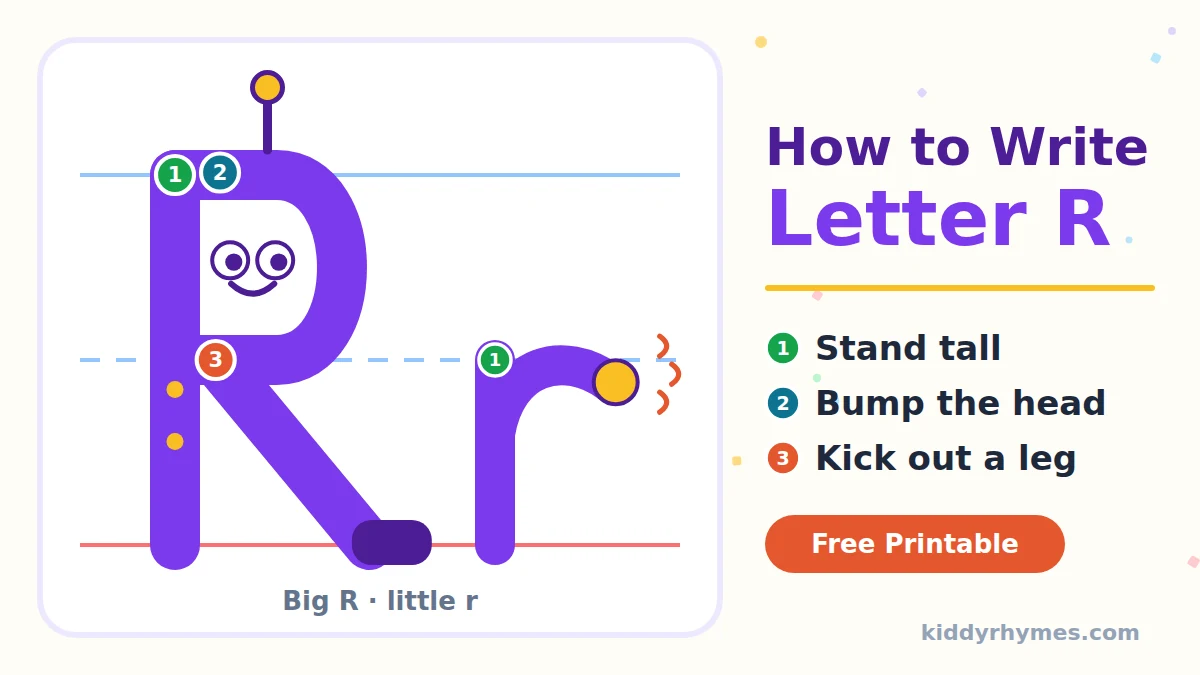
Capital R is a tall line down, then a jump back to the top for a round bump that stops at the middle, then a slanted leg kicked out to the bottom corner. Little r is shorter: start at the middle line, go down, climb back up the same line, and curve over into one small “arm” — then stop. Most children are ready to practice R somewhere between ages 4 and 6, and every child gets there at their own pace.
Meet Robo the Robot. Robo stands up tall, has a round head, and loves to kick out one leg. That is exactly the shape of a capital R. His little brother, little r, waves just one arm. Say the rhyme, trace the letter with your finger, and then pick up a crayon.
Robo’s Letter R Rhyme (original)
Down goes Robo, tall and straight,
Back to the top — don’t make him wait!
Round his head to his tummy line,
Kick out a leg — now R looks fine!
How to Write Uppercase R — Step by Step
Use paper with three lines: a top line, a dotted middle line, and a bottom line. Put a small green dot at the top left so your child knows where to begin.
- Line down. Start on the top line and pull a straight line all the way down to the bottom line. This is Robo standing tall.
- Jump back to the top. Lift the pencil and go back to the very same starting point. Handwriting Without Tears calls this a “frog jump.”
- Make the bump. Curve out to the right and round, like Robo’s head, and come back in to touch the line at the dotted middle. Stop there — not lower.
- Kick out the leg. From the middle, slide a slanted line down and out to the bottom line, a little further right than the bump.
That is two pencil lifts at most. Some schools let the bump and the leg flow as one movement; others lift the pencil in between. Both are fine — what matters is starting at the top and going down.
How to Write Lowercase r
Little r Rhyme (original)
Little r is short and small:
Down, back up, one wave — that’s all!
- Start at the middle line, not the top. Little r is a short letter.
- Line down to the bottom line.
- Climb back up the same line — don’t lift the pencil.
- Curve over to the right, like one little robot arm waving hello. Then stop. If the arm comes back down, it turns into an n.
The Teacher’s Version: Words to Say Out Loud
At home, stories help. In the classroom, short flat words work better because children can say them while they write. Here is the stroke script we use for both letters:
Letter R Formation Prompts
Capital R belongs to one family with B, D, E, F and P — they all start with the same tall line and a jump back to the top. If your child already knows the frog-jump letter F, the first move of R is the same. R is really a P with a leg, and it follows the same bump idea as the bat-and-bellies B and the drum-shaped D.
In many UK schools using Read Write Inc., little r is also taught with a robot picture: children go down the robot’s back and come up to curl out its arm. Our Robo rhyme is our own, but the picture matches — so a child who learns r at school will recognize it here.
| Handwriting method | Capital R | Little r |
|---|---|---|
| Handwriting Without Tears (US) | Big line down, frog jump to the top, little curve to the middle, little line slides to the corner | Starts at the middle; same start as n, but stops after the first curve |
| Zaner-Bloser (US) | “Pull down straight” first, then back to the top for the curve and slant | Pull down straight, push up, curve forward |
| Read Write Inc. (UK) | Focus is on lowercase first, taught together with the sound | Robot picture: down the back, up, curl out one arm |
If your child’s school uses a different method, follow the school’s words. Same letter, different labels.
The Mistakes Most Children Make with R
1. The leg starts in the wrong place. Children often start the leg from the top, or drop it straight down. Then R looks like a P holding a stick. Fix: say “stop at the tummy” at the end of the bump, and only then kick out.
2. The leg goes missing. No leg means P. Fix: count the parts on your fingers — “stand, bump, kick” — three parts, three fingers.
3. The bump faces the wrong way. A backwards R is very common in 3- to 5-year-olds. Fix: the bump always goes the same way as the reading direction — toward the rest of the word.
4. Little r grows into n. The arm keeps going and comes back down. Fix: the rhyme’s last words, “that’s all,” mean lift the pencil.
🎵 R Songs to Sing While You Trace
“Stand Up, Robo” (original words, to the tune of Frère Jacques):
Stand up, Robo, stand up, Robo,
Line goes down, line goes down.
Bump his head around now, bump his head around now,
Kick, kick, R! Kick, kick, R!
“Little r Waves” (original words, to the tune of Mary Had a Little Lamb):
Little r goes down and up,
down and up, down and up,
Little r goes down and up
and waves one robot arm.
Singing while moving is not just fun — rhythm helps children remember a sequence. You can read more about why rhythm helps early learning.
Fun Activities to Practice Letter R
- Rice tray R. Spread a thin layer of rice or suji on a plate. Your child writes R with one finger, shakes the plate, and tries again.
- Rope R on the floor. Make a big R with a rope or dupatta. Your child walks it: straight line, back to the start, around the bump, then out along the leg.
- Robot air-writing. Stand up, stiff arms like a robot, and write a giant R in the air while saying the stroke words in a robot voice.
- Rainbow R. Write one big R on paper. Your child traces over it with three different crayons — the same path, three times.
Safety note: Stay close during the rice tray — toddlers may put grains in their mouth or nose. Keep ropes and dupattas on the floor, never around the neck, and clear the space before any walking game.
Words That Start With R
Rabbit, rain, rainbow, red, ring, river, robot, rocket, rope, rose. Say each word, stretch the “rrr” sound, and let your child draw the easiest one.
R in Hindi
The English R sound matches the Hindi letter र (ra). Easy words: रेल (rel — train), रस्सी (rassi — rope), रंग (rang — color), राजा (raja — king).
Bilingual tip: After your child writes a big R, ask for one Hindi र word. Same sound, two scripts — it helps the sound stick to the shape. Hindi has no “big” and “small” र, which many children find funny once they notice English has two.
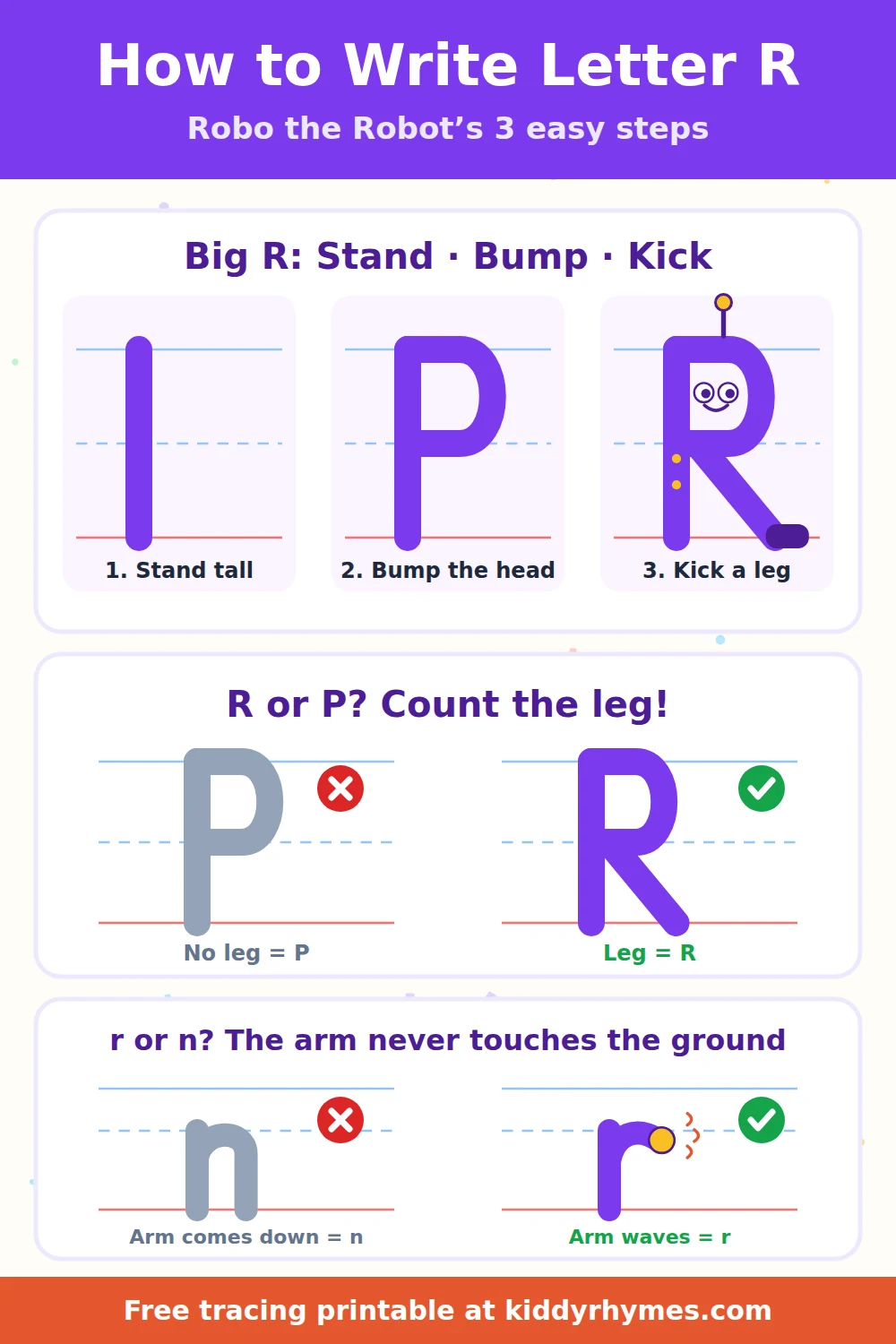
Robo’s Letter R Tracing Pack
Big R and little r with start dots and arrows, a P-or-R sorting page, an r-or-n page, and a Robo coloring sheet. Print, trace, repeat.
Letter R Tracing Pack
Printable handwriting practice worksheets for kids
Moral of the Rhyme
Robo never kicks too early. He finishes his head, stops at his tummy, and only then kicks out his leg. Good writing works the same way: finish one part, pause, then start the next. It is a small lesson in patience — and it works for more than letters.
Questions Parents Ask
Letter R Handwriting FAQ
Why does my child write R backwards?
Because young brains are built to see an object as the same thing whichever way it faces. A chair facing left is still a chair — but a backwards R is not an R. Writing letters backwards is common and normal before about age 7. Keep showing the right start point and the bump direction. Understood.org’s guide to letter reversals explains this well. If reversals are still frequent after age 7, or come with reading trouble, talk to the teacher or your pediatrician.
My child keeps writing P instead of R. What do I do?
This is usually a memory slip, not a skill problem — your child can already make the hard part. Name the three parts every time (“stand, bump, kick”) and let them draw the leg in a different color for a week so it stands out.
Why does my child’s little r look like an n?
The arm is too long and curves back down. Tell them the arm only “waves hello” — it never touches the ground. Practicing r and n side by side helps children feel the difference.
How many strokes is a capital R?
It depends on the method. Many programs teach it as a line down, a lift, and then the bump and leg. Some lift the pencil again before the leg. Two or three strokes are both correct — starting at the top is the part that matters.
Should I teach capital R or little r first?
Many occupational therapists and US programs like Handwriting Without Tears start with capitals, because they all sit between the same two lines and are easier to size. UK phonics programs often teach lowercase first, together with the sound. Pick one and stay consistent; if your child is in school, match the school.
Is it okay if my child starts R from the bottom?
It still looks like an R, but gently guide them to start at the top. Bottom-up habits get harder to change later and make writing slower once children join letters. A green “start” dot at the top fixes this for most children within a few days.
More letters in the series
- The mountain-and-bridge letter A
- the round-and-open letter C
- the elephant rhyme for E
- Big G and little g with a tail