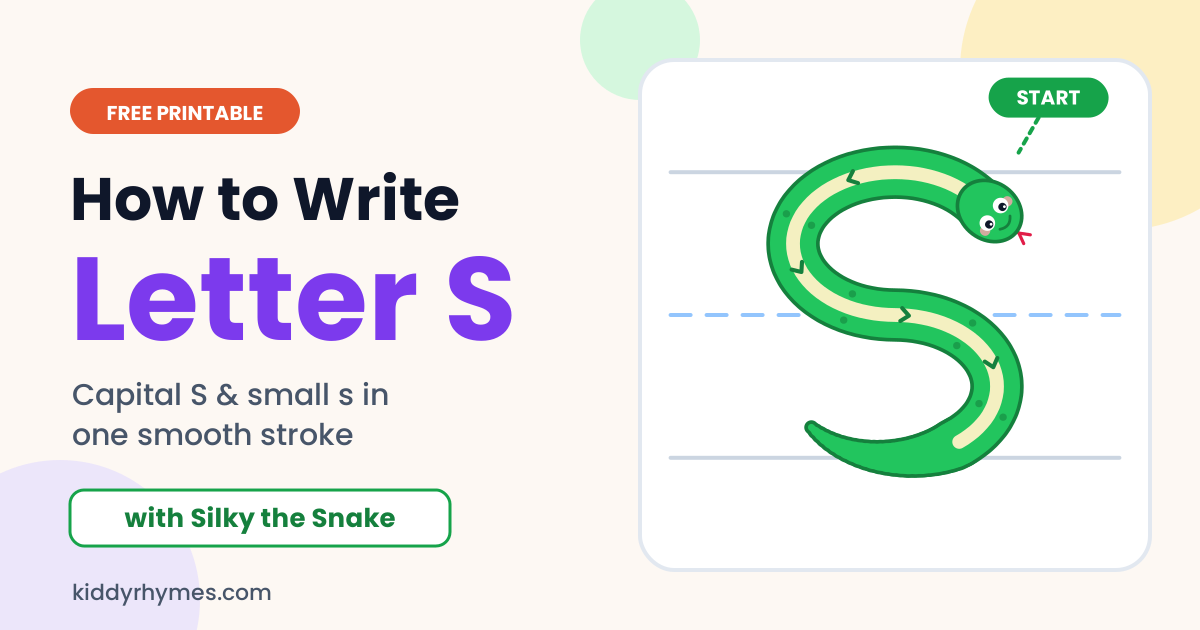
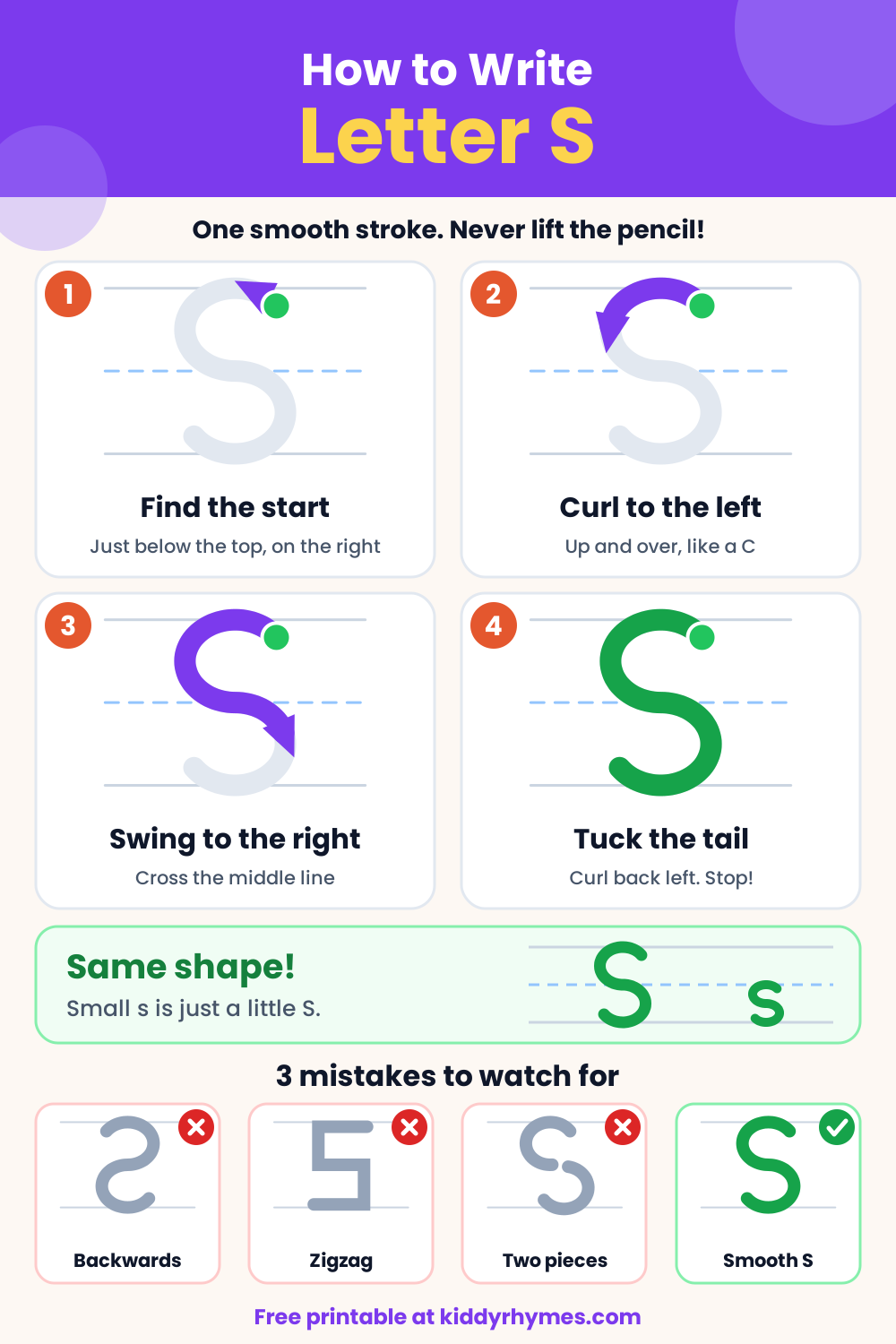
Letter S is written in one smooth stroke, for both capital S and small s. Start just below the top line, a little to the right. Curve back to the left and over the top, slide down and swing to the right through the middle, then curl back to the left along the bottom line. Small s is the exact same shape, only half as tall. It starts just under the dashed middle line. Children usually find S easier once they can already draw a C, because S begins with that same backward curve.
🐍 The Letter S Rhyme (an original KiddyRhymes rhyme)
Silky starts high, just right of the top,
She curls to the left and slides down, don’t stop!
She swings to the right, then curls back below,
Her tail tucks in. That’s S! Hiss-hello!
Why a Snake Helps Children Write S
S is a tricky letter for one simple reason: it changes direction halfway. The pencil curves one way, then has to turn and curve the other way, without stopping. A snake does exactly that when it slithers. So when your child thinks “be the snake,” the hand knows to keep moving and keep wiggling.
The snake is also the picture most classrooms already use for S, so Silky will feel familiar. If your child knows the kitten curl for Letter C, tell them the good news: S starts with that same curl.
How to Write Uppercase S, Step by Step
- Find Silky’s head. Put the pencil just below the top line, a little to the right of the middle.
- Curl to the left. Go up and over the top, then round to the left, just like starting a C.
- Swing to the right. Keep moving down. Cross the middle line and swing out to the right side.
- Tuck the tail. Curve down to the bottom line and back to the left. Stop. The pencil never lifts.
The two bumps should be about the same size. If the top bump is huge and the bottom one is tiny, the S will look like it is falling over. Say “same-size tummies” as your child writes.
How to Write Lowercase s
Here is the best news in the whole alphabet: small s is the same shape as capital S. Nothing new to learn. It just lives in the bottom half of the lines.
Little Silky’s Rhyme
Little Silky starts just under the line,
Left curl, right curl: tiny s, so fine!
- Start just under the dashed middle line, a little to the right.
- Make a small curl to the left, then swing right.
- Curl back left on the bottom line and stop.
The most common lowercase mistake is size. Children often make small s almost as tall as capital S. Keep the top of the s touching the dashed line, not the top line.
The Teacher’s Version
The classroom version — short words you can say out loud while the pencil moves:
Start at the top. Curve back. Swing forward. Curl back. Stop.
Different handwriting programs describe S in different words, but they agree on the important parts: one stroke, start near the top, and the first curve goes to the left.
| Program | How it teaches S |
|---|---|
| Zaner-Bloser / standard manuscript | One continuous stroke, starting near the top line. Small s starts just below the middle line. |
| Handwriting Without Tears | Capital S is a “center starter” letter. Small s is taught with the c-shaped letters, because it begins like c. |
| Read Write Inc. (UK) | Teaches small s early, with a short cue about sliding down a snake. |
| Success for All (UK) | Uses a left-around, right-around cue that runs from the snake’s head to its tail. |
If your child’s school uses one of these programs, use their words at home. Matching the classroom language helps more than any rhyme.
The 3 Mistakes Most Children Make With S
1. The backwards S. The child starts by curving to the right instead of the left. Mirror-writing is common in young children, and reversals are a normal part of learning to write until about age 7. The fix: always put a green “start” dot at the top right, and say “curl to the left first.”
2. The lightning-bolt S. The curves turn into sharp corners, so S starts to look like a Z or a 5. Slow down. Ask your child to draw it “like a snake, not like a zigzag.” Writing S big in the air, with the whole arm, helps the curves come back.
3. The two-piece S. The child draws one curve, lifts the pencil, then adds a second curve. It can look fine, but it builds a slow habit. Practice in a sand or salt tray, where the finger naturally keeps moving.
S and the number 5 are easy to mix up because both have a curve that opens the same way. If your child is also learning numbers, rhymes that teach numbers are a fun way to practice 5 separately, so the two shapes don’t blur together.
🎵 S Songs to Sing While You Trace
Both songs below are original KiddyRhymes songs, written to old public-domain tunes you already know.
Where Is Silky? (tune: Frère Jacques)
Where is Silky? Where is Silky?
Near the top, near the top.
Curl left, then swing right,
Curl left, then swing right.
Hiss and stop! Hiss and stop!
Silky Makes a Wiggly S (tune: Mary Had a Little Lamb)
Silky makes a wiggly S,
Wiggly S, wiggly S.
Silky makes a wiggly S,
Left, then right she goes!
Sing slowly. The song should match the speed of the pencil, not the other way round. Rhymes are not just fun here. They are a memory tool, and there is good reason why rhymes help young brains hold on to steps like these.
Fun Activities to Practice Letter S
- Salt-tray snake: Spread salt or sand on a baking tray. Your child writes S with one finger, then shakes the tray to erase and tries again.
- Playdough Silky: Roll a long playdough snake, then bend it into an S on a printed letter. Rolling also builds hand strength for holding a pencil.
- Rope-snake walk: Lay a skipping rope or dupatta in a big S on the floor. Your child walks along it from head to tail, saying “left curl, right curl.”
- Back writing: Write a slow S on your child’s back with one finger. Can they guess the letter? Then swap places.
Safety note: Stay close during salt and playdough play with children under 5, as small hands go to mouths quickly. Keep floor activities clear of furniture edges.
Words That Start With S
Say each word and stretch the sound: sssss-un.
- sun ☀️
- snake 🐍
- star ⭐
- sock
- spoon
- seal
- swing
- soap
- six
- sandwich
S in Hindi
स — सांप, सूरज
The English S sound matches the Hindi letter स (sa). And here is a lovely coincidence: the Hindi word for snake, सांप (saanp), starts with स too, just like “snake” starts with S. सूरज (sooraj) means sun.
Bilingual tip: Say “S for snake, स से सांप” as your child traces. One snake picture now teaches the sound in both languages.
Letter S Tracing Pack with Silky the Snake
Capital S and small s tracing with start dots and arrows, an S-or-not sorting page, a snake maze, and a bilingual S / स page. Print at home, no sign-up needed.
Letter S Tracing Pack
Printable handwriting practice worksheets for kids
Moral of the Rhyme
Silky never rushes. She curls left, swings right, and keeps going until her tail is tucked in. Writing S is the same: a slow, smooth S is better than a fast, zigzag one. When something feels wiggly and hard, keep moving gently, and don’t give up halfway.
Questions Parents Ask
Letter S Handwriting FAQ
Why does my child write S backwards?
Because S curves to the left first, and young brains haven’t yet stored which way it faces. Backwards letters and numbers are a normal part of learning to write until around age 7, and they are not a sign of dyslexia on their own. Use a start dot at the top right and say “curl left first.” If reversals are still frequent after age 7, talk to your child’s teacher.
Is S one stroke or two?
One. Both capital S and small s are written in a single smooth stroke without lifting the pencil. Drawing it in two pieces may look fine, but it slows writing down later.
Should I teach capital S or small s first?
For S, it hardly matters, because both are the same shape. Many programs teach capitals first since they are easier to see and copy. With S you can show both on the same day and simply say, “Small s is baby Silky.”
My child’s S looks like a lightning bolt or a 5. What do I do?
The curves are turning into corners, usually because the child is going too fast or drawing in small pieces. Practice big S shapes in the air or in a salt tray, then come back to paper. Saying “snake, not zigzag” is a quick reminder.
Is it okay if my child starts S from the bottom?
It’s common, but worth gently correcting. Letters that start from the bottom are slower and harder to join later. Put a green dot where the S begins and celebrate every time they start there.
When should I worry about handwriting?
Every child moves at their own pace, and age ranges are guides, not deadlines. If writing seems painful, your child avoids it completely, or you have other concerns about hand strength or coordination, an occupational therapist or your pediatrician can check what’s going on.
More letters in the series
- Letter A’s mountain-and-bridge rhyme
- The bat with two bellies (B)
- Drum-and-drumstick Letter D
- Elphie the Elephant’s E
- Fenny the Frog’s F lesson