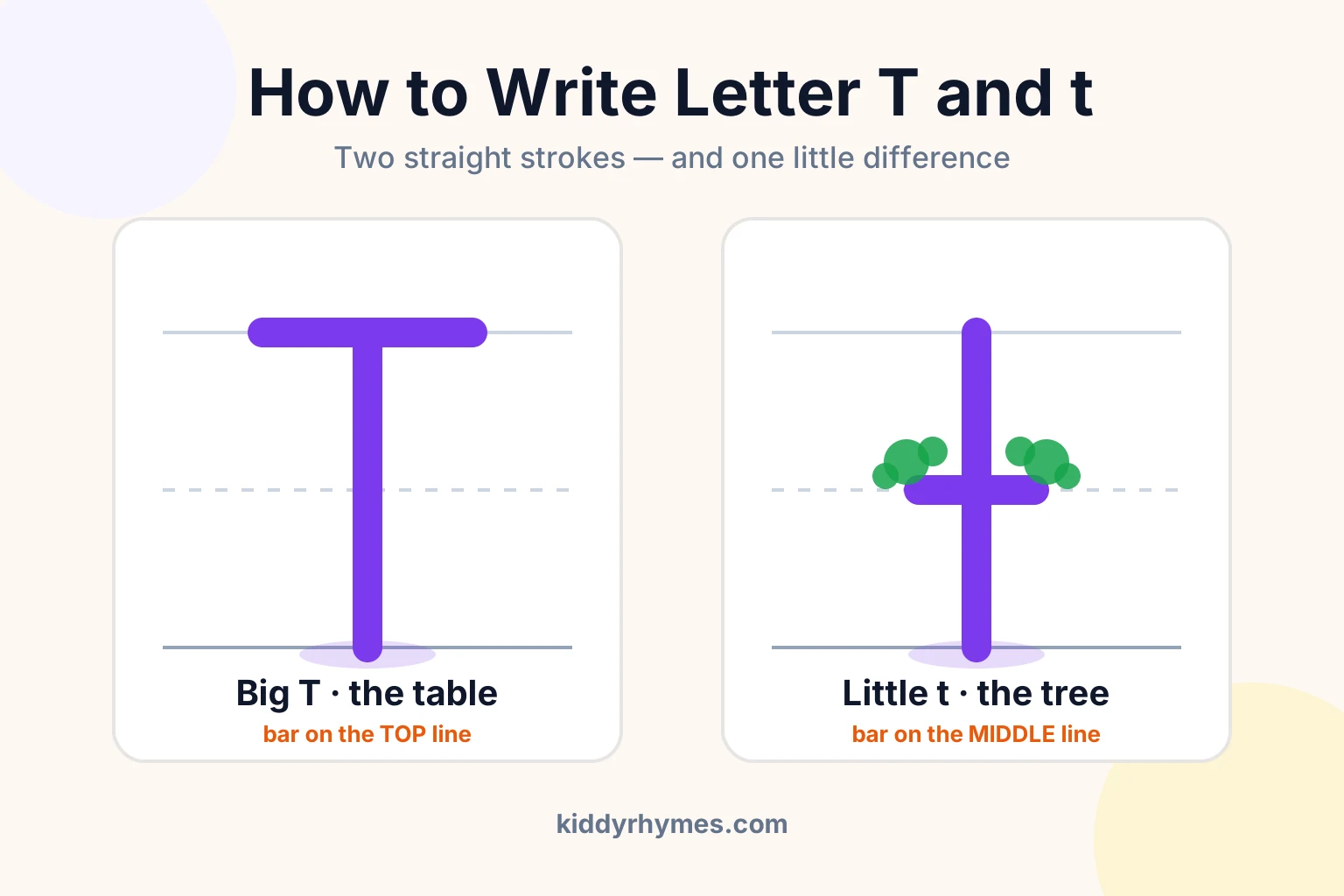
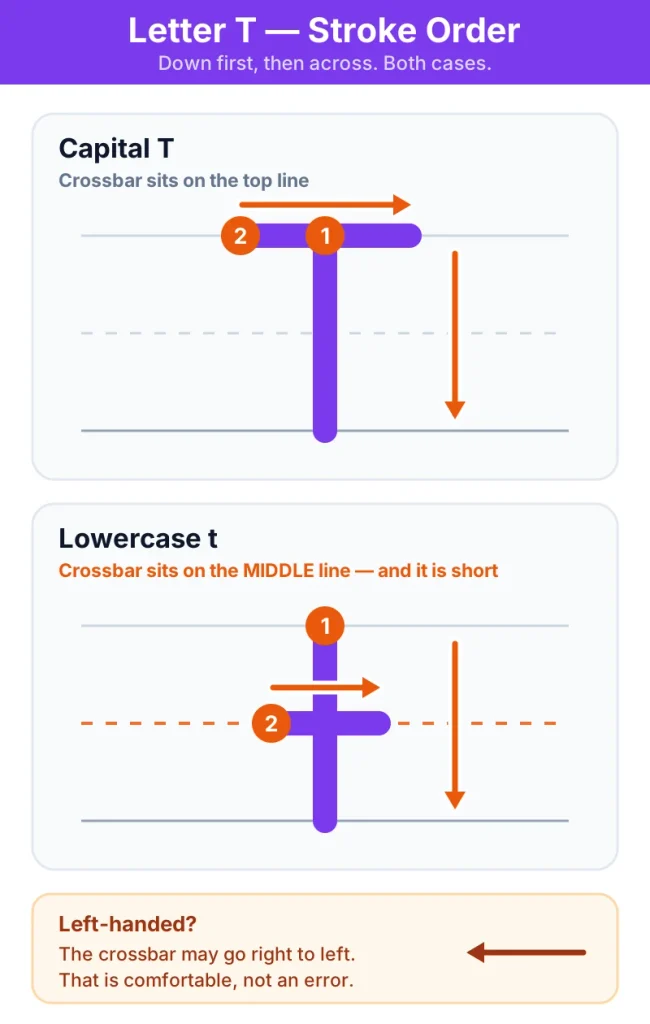
Capital T is two strokes — a straight line down from the top line, then a line across the top. Lowercase t is also two strokes, but the little crossbar sits on the middle line, not on top. Both start at the top. T is one of the first letters many schools teach, because it is made of straight lines only — most children can copy one somewhere around ages 3 to 4, and every child gets there in their own time.
The Big T Rhyme · original
Down the table leg, straight and tall,
Lift your pencil — that is all.
Slide the tabletop across the top,
Big T is standing. Full stop!
Say it slowly while your child writes, one line per stroke. The words become the movement, and the movement becomes the letter — that is the whole trick, and it is also what rhymes do for a young brain.
How to Write Uppercase T — Step by Step
- Start at the top, in the middle. Put the pencil on the top line, about halfway across the space — not in the corner.
- Straight line down. Pull all the way down to the bottom line in one go. This is the table leg.
- Lift the pencil. Take it off the paper and go back up to the top line, a little to the left of the tall line.
- Slide across the top. Draw a straight line left to right along the top line, crossing the very top of the tall line.
- Check it. The top should sit on the leg like a tabletop — about the same amount sticking out on each side.
Starting in the middle of the top line feels odd to grown-ups, but it is deliberate. In the Handwriting Without Tears scheme, T is one of the “center starter” capitals, and it is taught in the very first group of letters — L, F, E, H, T, I — because all of them use only straight lines. You can see the full Handwriting Without Tears teaching order on The OT Toolbox.
How to Write Lowercase t
The Little t Rhyme · original
Down the tree trunk, tall and thin,
Lift your pencil, now begin:
Cross the middle — not the top!
Little t, and there we stop.
- Start high. t is a tall letter. Begin on the top line (some schools make t slightly shorter than l and h — at this age, the top line is fine).
- Straight line down to the bottom line. Lift.
- Go back to the middle line. This is the part children skip.
- Cross it. A short line, left to right, sitting on the middle line. Shorter than the capital’s tabletop.
Why the t in books looks different
Open any storybook and the printed t has a small curve at the foot and a little flag at the top. The t on your child’s worksheet is a plain line with a cross. Children notice this and get stuck on it — All About Learning Press even publishes a whole activity set treating lowercase t as a “tricky letter” for exactly this reason.
Say it out loud and the problem disappears: “Books use the fancy t. We write the simple t.” Show both side by side once, then move on.
Does lowercase t have a curl at the bottom?
It depends entirely on which scheme your child’s school follows, and this is worth checking before you correct anything at home.
| Scheme | Where it’s used | Foot of the t |
|---|---|---|
| Handwriting Without Tears | US, many international schools | Straight — no curl |
| Zaner-Bloser manuscript | US | Straight — no curl |
| Read Write Inc. (RWI) | UK primary schools | Small curl at the foot, then lift and cross |
| Nelson-style “ladder letter” phrasing | UK | A hook at the foot, then lift and cross |
None of these is wrong. The stroke order is identical in all four — down first, cross second — so a child who learns it one way is never starting over. Follow the school, and don’t let a curl become a fight.
The Teacher’s Version
Flat classroom words — say exactly the same thing every single time:
Letter T Formation Prompts
UK parents: Read Write Inc. gives t a tall castle-tower picture — the stem runs down the tower, a small curl at the foot, then the crossbar goes over it. Our script keeps the same two strokes in the same order, so it sits alongside what your child hears at school rather than against it.
The Mistake Most Children Make
The crossbar ends up in the wrong place. This is the single biggest T problem, and it shows up in three shapes.
1. Little t comes out as a tiny capital T
The bar lands on top of the stem instead of across the middle. It is the most common error of all, because the child has just spent a week learning capital T and is copying the picture in their head.
The fix: go back to the tree. A tree’s branch does not sit on top of the trunk — it comes off in the middle. Tap the middle line with your finger before they start and say, “Branch goes here.”
2. t turns into a plus sign
The bar drops too low, or the stem is too short, and the letter becomes +. Worth naming clearly, because children meet + in maths at the same age and the two get tangled.
The fix: the crossbar is above the middle of the stem. The stem starts at the top line, the bar crosses at the middle line, and then the stem keeps going down to the bottom line. Longer below the bar than above it — a plus sign is even all round.
3. t, f and l get mixed up
All three are tall, thin and start with a line down. The differences are small but sayable: f has a hook at the top, t is straight at the top, l has no cross at all. Write all three in a row and let your child circle the one with the cross in the middle.
If Your Child Writes With Their Left Hand
T is one of the very few letters where the usual instruction — “always left to right” — may not be the best advice, and almost nobody tells parents this.
When a left-hander drags a crossbar from left to right, they are pushing the pencil away from the body, and their hand covers the letter they just wrote. Most left-handed children work this out for themselves and cross their t and f from right to left, pulling the pencil towards them instead. Handwriting specialists treat that as a sensible adaptation rather than a mistake — the handwriting researcher Rosemary Sassoon notes in her guidance on letters and joins for left-handers that almost all left-handers cross f and t this way, and recommends letting them.
What to do at home
Down-stroke: top to bottom, same for everyone. Crossbar: whichever way is comfortable.
Two other small things that help more than anything else: tilt the paper so the top-right corner lifts up, and let your child hold the pencil a little further from the tip so they can actually see what they are writing. T, t and f are the only everyday letters where this comes up.
T Songs to Sing While You Trace 🎵
All lyrics below are original. The tunes are traditional and public domain.
1. “Down and Across” (tune: the Twinkle Twinkle tune)
- Straight line down and cross the top,
- Big T standing, now we stop.
- Down the trunk and cross the tree,
- Little t is small, you see.
- T says tuh, like tap and ten —
- Sing it, write it, once again!
2. “Line Goes Down” (tune: Frère Jacques)
- Line goes down, line goes down,
- Cross the top, cross the top,
- T is for the table,
- T is for the tiger,
- Tuh, tuh, tuh! Tuh, tuh, tuh!
3. “Little t” (tune: Row, Row, Row Your Boat)
- Down, down, down the tree,
- Lift and cross the line,
- Middle, middle, middle, middle,
- Little t looks fine!
Fun Activities to Practice Letter T
1. Two sticks, two letters. Give your child one long craft stick or straw and one short one. Lay the short one across the top of the long one — that is big T. Now slide the short stick down to the middle — that is little t. Same two pieces, and the difference becomes something they can feel. Safety: small pieces are a choking risk, so supervise closely with under-3s.
2. Floor tape T. Make a giant T on the floor with masking tape. Your child walks down the long line, stops, lifts an imaginary pencil, then walks the top line left to right. Big movements first, small ones later. Safety: clear the space, and bare feet or grippy socks on smooth floors.
3. The /t/ hunt. Five minutes around the house collecting things that start with the /t/ sound — tap, towel, toothbrush, tomato, tiffin box, TV, tin. Line them up and count them.
4. Atta tray tracing. Spread a thin layer of atta or flour on a steel tray. Trace T with one finger, then shake gently to erase. No pencil grip needed, so it works for the youngest children.
Words That Start With T
Words That Start With Letter T
T in Hindi
ट · त
The English T sound lives in two Hindi letters. ट is the harder one — टमाटर (tamaatar, tomato) and टोपी (topi, cap). त is softer — तितली (titli, butterfly) and तारा (taara, star).
A bilingual tracing tip: in Devanagari, the letter is written first and the शिरोरेखा — the line across the top — is added last. Capital T works exactly the same way: the tall line first, the line across the top last. Point that out once and children carry the habit across both scripts.
Letter T Tracing Pack
8 pages: big T and little t tracing with numbered start dots, a crossbar-height page, a “spot the real t” sorting sheet, a left-handed version with the crossbar arrow reversed, T word tracing, a Hindi ट / त page and a parent script card. A4 and US Letter.
Letter T Tracing Pack
Printable handwriting practice worksheets for kids
Browse more free practice sheets for the rest of the alphabet.
Questions Parents Ask
Letter T Handwriting FAQ
How many strokes is the letter T?
Two, for both cases. Capital T: a line down, then a line across the top. Lowercase t: a line down, then a line across the middle. Schemes word the steps differently, but every mainstream scheme uses the same two strokes in the same order — down first, cross second.
Why does my child’s lowercase t look like a small capital T?
Because the crossbar is landing on top of the stem instead of across the middle of it. It is the most common T error and it usually means the child has just learned capital T and is reaching for that shape. Tap the middle line before they start and use the tree picture: the branch comes off the middle of the trunk, never off the very top.
My child is left-handed. Should they cross the t from right to left?
If that is what feels natural, yes — let them. Left-handers pull the pencil towards themselves going right to left, which is easier than pushing it away and means their hand is not sitting on top of the letter. Handwriting specialists treat this as a normal adaptation for t, f and capital T rather than an error to correct. Keep the down-stroke top-to-bottom, and let the crossbar go whichever way is comfortable.
Why does the t in books look different from the t we write?
Printed typefaces give lowercase t a curved foot and a small flag at the top. Handwriting schemes strip it back to a straight line and a cross, because that is what a small hand can actually make. They are the same letter. Showing both once and naming the difference — “the book t and the writing t” — clears it up faster than ignoring it.
Should lowercase t have a curl at the bottom?
It depends on the scheme. Read Write Inc., used across UK primary schools, adds a small curl at the foot before the pencil lifts. US print schemes such as Handwriting Without Tears and Zaner-Bloser keep the stem straight. Both are correct within their own system — find out what your child’s school uses and match it, rather than correcting something the teacher taught.
Should I teach capital T or lowercase t first?
Capital T is the easier one — two straight lines, both of them long, and no judgement about where the crossbar sits. Many occupational therapists suggest capitals first for that reason. UK phonics programs go the other way and start with lowercase letter sounds. Either path works; the one that matters is the one your child’s school is using, so the two of you are not teaching different things.
Is it okay if my child starts the line at the bottom and goes up?
At three, gently redirect rather than correct: “T starts at the top.” Top-down starts make joining letters much easier later, so it is worth building the habit early without making it a battle. If writing is still painful, very slow or exhausting by around age 7 or 8 despite regular practice, that is the point to talk to your pediatrician or an occupational therapist.
More letters in the series
- the mountain and bridge method for A
- B, built from a bat and two bellies
- the kitten curl that makes a C
- drum and drumstick, for letter D
- Elphie’s three-step staircase for E
- Fenny the Frog, and the F that hops
- big G, little g and that tricky tail