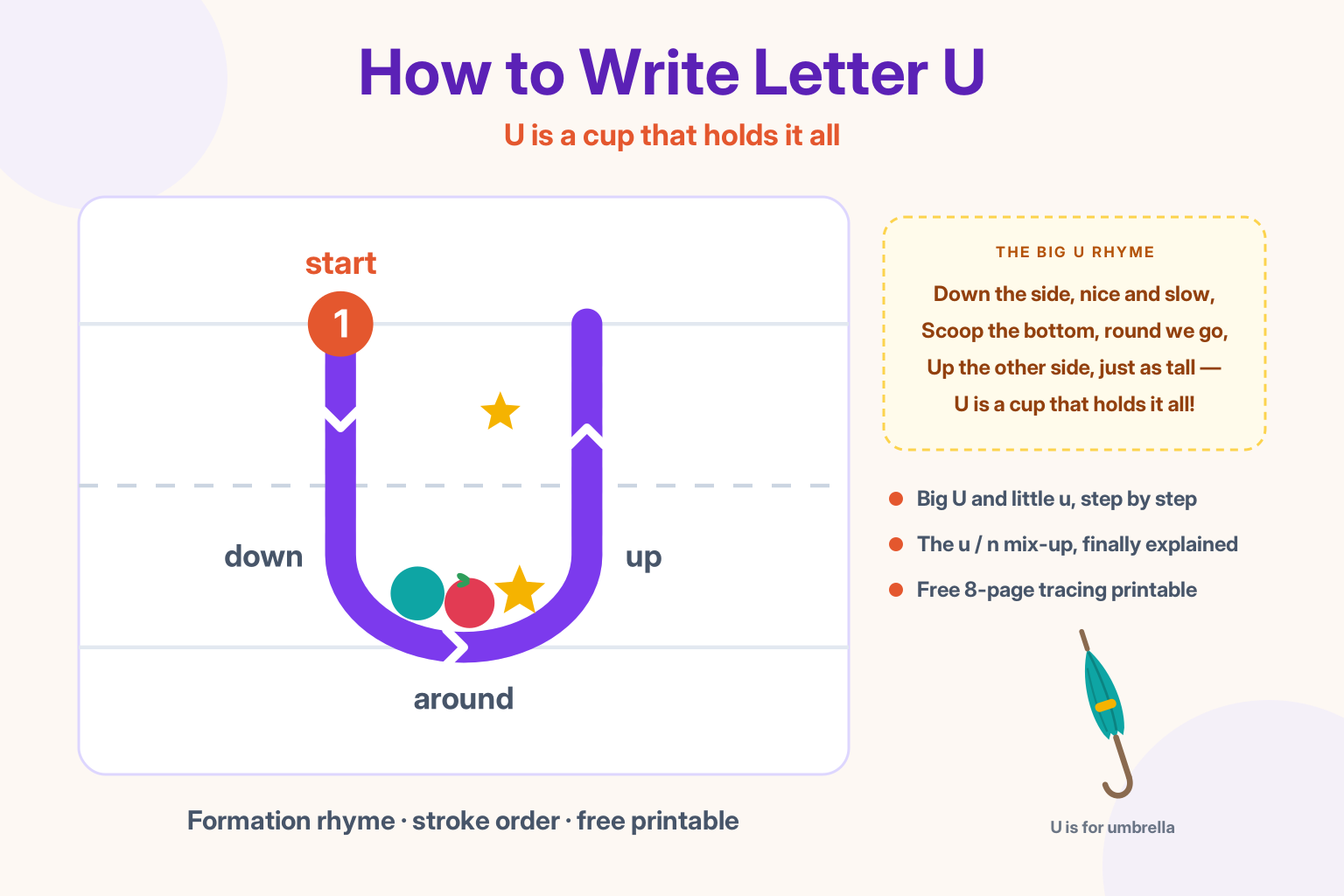
Capital U is one smooth stroke — start at the top, pull straight down, curve around the bottom, and come straight back up to the same height. Lowercase u takes two strokes — down, scoop under, back up to the middle line; then lift and pull one straight line down. Most children begin forming U somewhere around ages 4 to 5, and every child arrives at it in their own time.
The Big U Rhyme · original
Down the side, nice and slow,
Scoop the bottom, round we go,
Up the other side, just as tall —
U is a cup that holds it all!
Say it out loud while your child writes. The words do the remembering so the hand can do the moving — which is why rhyme makes instructions stick far better than “no, the other way.”
How to Write Uppercase U — Step by Step
Watch the Letter U Being Written
One smooth stroke. Start at the orange dot, go down, around the bottom, then back up.
Two strokes. Trace the scoop first, then lift and add the straight line.
- Start at the top, on the left
- Pull straight down
- Scoop around the bottom
- Climb straight back up to the top
- Start on the middle line
- Down, scoop under, back up to the middle
- Lift your pencil
- One straight line down
Big U is one smooth stroke. No lifting.
Little u is two strokes. The second line is the one everyone forgets.
Capital U is one of the kindest capitals to learn. No lifting, no jumping, no crossing. One movement, start to finish.
- Start at the top, on the left. Pencil on the top line, a little left of centre.
- Pull straight down. Keep going until you are almost at the bottom line — but not quite. Leave room to turn.
- Scoop around the bottom. Curve smoothly to the right, touch the bottom line, and keep curving up. Round, like the inside of a cup. Never a sharp point.
- Climb back up to the top. Straight up, all the way to the top line. Both sides must finish at the same height.
- Check it: open at the top, round at the bottom, two sides the same height. That is U.
How many strokes is that? One, in the continuous-stroke print taught in most US classrooms. The Handwriting Without Tears programme describes the same letter as three building pieces — a big line, a big curve and a big line — and places U with the capitals that begin in the top-left "starting corner." Both descriptions produce the same letter. Follow whichever wording your child's school uses.
How to Write Lowercase u
This is the one that goes wrong. Little u has two strokes, and the second one is the stroke children skip.
The Little u Rhyme · original
Down, scoop under, up to the top,
One straight line down — and then we stop.
- Stroke one — down and under. Start on the middle line. Pull straight down, curve under along the bottom line, and come back up to the middle line on the right.
- Lift the pencil. This is a real stop. Say "lift" out loud so it becomes part of the letter.
- Stroke two — one line down. Put the pencil back where stroke one finished, on the middle line, and pull straight down to the bottom line.
- Check it: a round scoop with a straight post on its right shoulder. That post is what makes it a u and not a bowl.
If your child's lowercase u looks empty, the second stroke is missing — not the curve. Practise stroke two on its own: draw the scoop for them, hand over the pencil, and let them add only the straight line. Five of those beats fifty full letters.
The Teacher's Version (Stroke Script)
Classrooms use flat, short words and repeat them identically every single time. No story, no variation. Children need the same sound cue attached to the same movement.
Say this while your child writes:
Letter U Formation Prompts
For UK parents: Read Write Inc. gives u a short spoken cue built around an umbrella — the pencil travels down and under the umbrella, returns to the top, then comes down again. Note that RWI groups u with its "down" letters, not its "curly" ones, and that the stroke goes beneath the umbrella rather than over it. Our script follows the same stroke order, so the two work together rather than against each other.
The Mistake Most Children Make: u Turns Into n
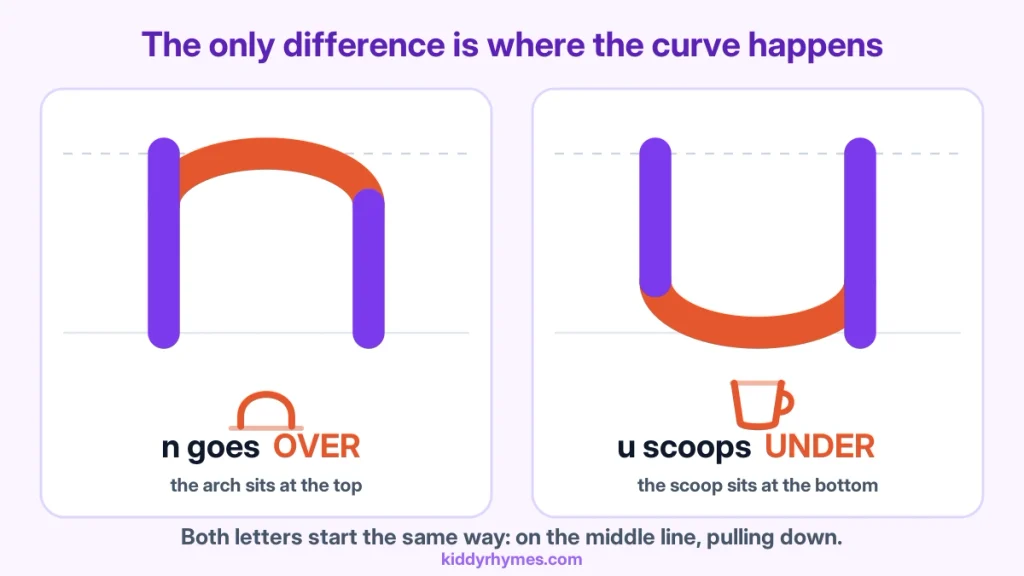
This is the big one. Your child writes n where they meant u — or reads one as the other. It is the same category of mix-up as b and d, and u and n are both on the list of letters researchers have found children struggle most to write legibly in their first three years of school.
It is almost never an eyesight problem. It is a starting-point habit. Both letters begin in the same place: pencil on the middle line, pulling down. The only difference is where the curve happens.
| Letter | Where the curve is | Say this | Picture it as |
|---|---|---|---|
| n | At the top — the pencil arches over | “n goes over” | A bridge you walk over |
| u | At the bottom — the pencil scoops under | “u scoops under” | A cup you pour into |
The fix that works fastest is physical, not written. Put a cushion on the floor. Step over it — "that's n." Crawl under a table — "that's u." Do it three times, then go straight to paper while the body still remembers. Over and under stop being abstract.
And when u looks like v
Different problem, simpler cause: speed. A child racing through the bottom of the letter turns the curve into a corner. Slow the bottom down and nothing else needs fixing. The cue is "u is round at the bottom, v is pointy" — and it helps to say it while running a finger along a real cup and a real funnel.
One planning note for teachers and homeschoolers: do not teach U and V in the same week. Introducing look-alike letters together is a known way to create the very confusion you are trying to avoid. Give them space.
Is "U is for Umbrella" Actually a Good Picture?
Almost every worksheet, flashcard and phonics scheme pairs U with an umbrella. For the sound, it is excellent — "umbrella" opens with a clean short /u/ and children already know the word.
For the shape, be careful. An open umbrella's canopy is an arch, and an arch is the shape of n — the letter children already confuse with u. Show a child an umbrella and say "this is u," and you have handed them a picture of an n.
Read Write Inc. gets this right by sending the pencil under the umbrella, into the space beneath it. That distinction is the whole point, and it is exactly what disappears when a parent simply prints an umbrella card and holds it up.
Our suggestion: keep the umbrella for the sound, and use a cup for the shape. A cup is round at the bottom, open at the top, and it holds things — it teaches the stroke and fixes both the n mix-up and the v mix-up in one image. Use a real cup from your kitchen. Pour a little water in and say the rhyme.
The Two Sounds of U
U is a shape-shifter, and this trips children up more than the handwriting does. It makes two common sounds:
| Sound | Say it like | Words | Teach it |
|---|---|---|---|
| Short u | “uh” | up, us, under, umbrella, umpire, uncle | First. It is the u inside cup, bus, sun and mud — the words they will sound out earliest. |
| Long u | “yoo” | unicorn, uniform, ukulele, unicycle | Later, once short u is solid. Introduce it as “u’s other voice.” |
Start with short u and stay there for a while. Bringing in "unicorn" on day one because it is the most exciting U word is understandable — and it slows the reading down.
U Songs to Sing While You Trace
All lyrics below are original. The tunes are traditional and in the public domain.
1. "Down and Around" (tune: Row, Row, Row Your Boat)
Down, and round we go,
Up to where we start,
Big U is a great big cup,
Hold it in your heart!
2. "Uh, Uh, Umbrella" (tune: The Farmer in the Dell)
Uh, uh, umbrella,
Uh, uh, up and under,
Hi-ho, it starts with U,
Uh, uh, umbrella!
Swap in uncle, umpire and unhappy for more verses.
3. "Little u Needs Two" (tune: Twinkle, Twinkle, Little Star)
Scoop it under, up you climb,
Lift your pencil, take your time,
Now one line, straight and true,
That is how we make a u.
Fun Activities to Practice Letter U
1. The pouring cup — Put a plastic cup on a tray. Let your child pour a little water in and out while you say the Big U Rhyme. Then trace a U on the wet tray with one finger. The word "holds" becomes something they have felt.
2. Over or under? — The n/u game from above. Step over a cushion, crawl under a table, call out which letter each one is. Finish on paper straight away.
3. Rice-tray scoop — Spread rice or flour thinly on a baking tray. Draw U with one finger, shake to erase, repeat. The resistance of the grains gives the hand feedback that paper cannot.
4. Bendy U — Bend a pipe cleaner or a paper straw into a U. Ask, "Is the bottom round or pointy?" Then bend a second one into a V and compare. Safety: supervise closely — pipe cleaners have wire ends and small pieces are a choking risk for children under three.
5. Two-stroke relay — You draw the scoop, your child adds the straight line. Then swap. Ten rounds takes two minutes and drills the stroke everyone forgets.
Words That Start With U
Letter U Sound Examples
U rarely starts a word compared with the other vowels, so it is worth hunting for it in the middle too: cup, bus, sun, mud, jump, duck. That is where your child will actually meet it first.
U in Hindi
उ — ऊ
उ से उल्लू (ullu — owl) · ऊ से ऊन (oon — wool)
A lovely coincidence to use: Hindi has a short उ and a long ऊ, exactly the way English U has a short "uh" and a long "yoo." Say them as a pair — उ / ऊ, uh / yoo — and a bilingual child gets both systems from one idea.
Bilingual tracing tip: English letters sit on the bottom line. Devanagari letters hang from the top line (the शिरोरेखा). When your child switches between the two scripts, name the line first: "this one sits, this one hangs." It removes a surprising amount of confusion about where to start.
Letter U Practice Pack
8 pages: capital U and lowercase u tracing, a stroke-two-only page, a u-or-n sorting sheet, a u-or-v sheet, short and long U word tracing, a Hindi उ/ऊ page, and a parent script card. A4 and US Letter.
Letter U Tracing Pack
Printable handwriting practice worksheets for kids
Moral of the Rhyme
U is a cup. It is open at the top, and it holds whatever you put inside it. Children are the same — open, and holding on to far more than we realise. What we say while they write is part of what they keep.
Questions Parents Ask
Letter U Handwriting FAQ
How many strokes is the letter U?
Capital U is one continuous stroke in the print taught in most US classrooms: down, around, up. Handwriting Without Tears describes the same letter as three pieces — a big line, a big curve, a big line — but the hand makes one movement. Lowercase u is two strokes in every print scheme: the scoop, then a separate straight line down.
Why does my child write n instead of u?
Because both letters start in the same place and travel the same way — down from the middle line. The only difference is where the curve happens: n arches over at the top, u scoops under at the bottom. It is a starting-point habit, not an eyesight problem. Say “n goes over, u scoops under,” and practise it physically first — step over a cushion, crawl under a table. Flipping letters is common until around age seven and usually settles with practice.
My child’s lowercase u has no second line. What do I do?
Practise the second stroke on its own. You draw the scoop, hand over the pencil, and let your child add only the straight line down from the middle line to the bottom line. Say “lift” out loud between the two strokes so the pause becomes part of the letter rather than an interruption to it. A few of these beat a page of whole letters.
Her u looks like a v — is something wrong?
Usually it is speed, not shape. Rushing through the bottom of the letter turns a curve into a corner. Slow that part down and say “round at the bottom” as she gets there. It also helps not to teach U and V in the same week — introducing look-alike letters together tends to create the confusion rather than prevent it.
Should I teach the “uh” sound or the “yoo” sound first?
Short u (“uh,” as in up and umbrella) first. It is the sound inside cup, bus, sun and mud — the simple words your child will sound out earliest. Introduce the long “yoo” of unicorn and uniform later, as “u’s other voice,” once the short sound is automatic.
Is it okay if my child starts the u from the bottom?
At three, it is fine — redirect gently with “we start at the top.” Top-down starts build a habit that pays off later when writing gets faster and letters start joining. If handwriting is still very slow, effortful or painful after ages seven to eight despite regular practice, that is worth raising with your pediatrician or an occupational therapist.
Should I teach capital U or lowercase u first?
Many occupational therapists start with capitals because straight lines and single strokes are easier for young hands, and capital U is one of the friendliest. UK phonics programmes such as Read Write Inc. begin with lowercase letter sounds instead. Both routes work — the useful thing is to match whichever one your child’s school uses, so home and classroom say the same words.
More letters in the series
- The mountain-and-bridge trick for A
- A bat with two bellies makes B
- The kitten curl that becomes C
- Drum and drumstick for letter D
- Elphie's three-step staircase
- Why F only has two arms
- The curve and shelf that make G